
Souter Lighthouse
Souter Lighthouse: The World’s First Electric Beacon on the Tyne Coast
In 1871, something happened at a lighthouse on the cliffs between the Tyne and the Wear that changed the science of maritime navigation forever. On 11 January 1871, Souter Lighthouse was switched on — and it was powered not by oil or gas but by alternating electric current, making it the first lighthouse in the world to be designed and built specifically to use electricity. The beam that swept out over the North Sea that January night was described at the time as “one of the most powerful lights in the world,” and the technology it pioneered would eventually spread to lighthouses across the globe.
Souter stands on Lizard Point near South Shields, unmistakeable in its bold red and white hooped exterior, overlooking Marsden Bay and the treacherous reefs of Whitburn Steel — a stretch of coastline that had earned the grim reputation of being the most dangerous in Britain, with an average of 44 shipwrecks per mile. Today the lighthouse is managed by the National Trust, decommissioned in 1988 but preserved with its original Victorian equipment intact, its tower open to visitors and two former keepers’ cottages available as holiday accommodation. This guide covers everything you need to know about visiting and staying at Souter.
Where Is Souter Lighthouse?
Souter Lighthouse stands on the clifftops at Marsden, South Shields, in Tyne and Wear, on the North East coastline midway between the mouths of the River Tyne (to the north) and the River Wear (to the south). It is approximately three miles south of the River Tyne and is reached via the A183 Coast Road.
The surrounding landscape is dramatic and varied: The Leas to the north — 2.5 miles of magnesian limestone cliffs, beaches and wildflower-rich grassland — and Whitburn Coastal Park and Nature Reserve to the south, a former colliery site now rich with wildlife. Marsden Bay is immediately below, with Marsden Rock — a spectacular 139-foot sea stack — as its centrepiece.
A Brief History of Souter Lighthouse
The wreck of Whitburn Steel was not a single disaster but a relentless pattern. In 1860 alone, twenty ships were lost on the reefs off this stretch of the North East coast. Trinity House determined to act, and the result was Souter — but not an ordinary lighthouse. James Douglass, Trinity House’s Chief Engineer (the same engineer who would later build Anvil Point Lighthouse in Dorset), was commissioned to design a beacon for Whitburn Steel, and he embraced an entirely new technology: the alternating electric current generator, powered by a coal-fired steam engine in the engine room.
The lighthouse was named after Souter Point, a mile to the south, which had been the originally planned site, but was built on Lizard Point to better serve the dangerous reefs. It was first lit on 11 January 1871, its massive carbon arc lamp floating on 1.5 tonnes of mercury — a counterintuitive solution that allowed a lamp of that weight to rotate smoothly and almost without friction. It guided shipping through these waters for 117 years, until automation and advances in navigational technology made it redundant and it was decommissioned in 1988.
The mercury beneath the lamp is the engineering detail that makes you stop. The carbon arc lamp produced by Souter weighed so much that rotating it by conventional mechanical means would have required enormous effort and caused constant wear. The solution was to float the entire rotating assembly on a bath of liquid mercury, which bears the weight and allows the heavy optic to turn with the lightest of touches. The same principle — first proven in practice at Souter — was subsequently used in major lighthouses around the world.
Architecture & The Light
Souter is a Victorian lighthouse tower of around 28 metres (92 feet), immediately recognisable by its bold red and white hooped exterior — a colour scheme chosen to make it stand out clearly against both the cliffs and the sky as a daymark for ships at sea. The Fresnel lens, still on display inside, was part of the lighthouse’s original equipment.
The engine room — once the beating heart of the station, generating the electricity to power both the light and the foghorn — has been carefully preserved by the National Trust with its original Victorian machinery intact, including the alternating current generators that made Souter a landmark in engineering history. The foghorn house, which powered a signal for ships in poor visibility, is also preserved on site. The lighthouse is decommissioned and no longer an active navigational aid, but every significant element of its Victorian working life has been maintained.
Visiting the Lighthouse
Souter is managed by the National Trust and is open to visitors from roughly February to November each year; it closes in winter. An admission fee applies for non-National Trust members; NT members visit free.
The highlight for most visitors is climbing the tower. The steep spiral staircase leads to the lantern room, where the massive Victorian lamp — still floating on its bath of mercury — can be seen close up, and the views extend along the North East coastline. Note that the climb includes a near-ladder section near the top and requires a reasonable level of fitness and confidence with heights; it is not suitable for those with mobility difficulties.
The reconstructed Victorian Keeper’s Cottage and engine room are open with hands-on exhibits telling the story of lighthouse life and the engineering breakthrough of 1871. The Foghorn Field is a play area for children. The Lighthouse Café serves light meals and local specialities including singing hinnies, a traditional North East griddle scone. Coastal walks along The Leas and to Whitburn Coastal Park extend the visit considerably.
As opening hours and admission fees vary by season, check the National Trust website for current information before visiting.
Check Tickets & Tour Times for Souter Lighthouse →
Staying at the Lighthouse
Two former lighthouse keepers’ cottages — Lighthouse Keeper’s Cottage 1 and Lighthouse Keeper’s Cottage 2 — are available as National Trust holiday accommodation, set within the lighthouse grounds on the clifftops above Marsden Bay. Both cottages have been carefully updated to provide comfortable self-catering living while retaining their Victorian lighthouse character, and both enjoy the sea views that made the keeper’s post both striking and demanding.
|
Cottage |
Sleeps |
Features |
|
Lighthouse Keeper’s Cottage 1 |
4 |
Double and twin rooms, sea views, garden, fully equipped kitchen; dogs welcome by arrangement |
|
Lighthouse Keeper’s Cottage 2 |
4 |
Double and twin rooms, sea views, garden, fully equipped kitchen; dogs welcome by arrangement |
A cot is available on request for families with young children. Dogs are welcome by arrangement. As National Trust holiday properties, these cottages book up well ahead, particularly in summer and school holiday periods.
Find Lighthouse & Coastal Stays Near South Shields →
The Best Time to Visit
Spring (March to May) sees Souter reopen after its winter closure, with the seabird colonies returning to Marsden Rock and The Leas wildflowers beginning their season. Summer (June to August) is the warmest and most popular time, with the best wildlife-watching in Marsden Bay, clear views along the coast and the full range of National Trust events; the cottages and the tower are at their busiest.
Autumn (September to November) brings quieter trails, excellent coastal light and the spectacle of migrating birds along the clifftops. Winter sees the lighthouse close, though the exterior and the surrounding coastal paths remain accessible.
For the calmest visit, weekday mornings in spring or autumn are ideal. This is an exposed North East coastline and the North Sea weather changes fast, so check the forecast and dress for wind.
How to Get There
By car. Follow the A183 Coast Road from South Shields or Sunderland to the lighthouse, where pay-and-display parking is available (free for National Trust members).
By public transport. The Tyne and Wear Metro runs to South Shields, East Boldon and Seaburn stations. Stagecoach bus services connect to the lighthouse: the E1 stops at the lighthouse drive, and the E2 is around a ten-minute walk away. The Shields Ferry crosses the River Tyne from Newcastle to South Shields twice hourly, from where bus connections are available.
By bike. National Cycle Network Route 1 connects Seaburn and South Shields, passing near the lighthouse.
On foot. The coastal path along The Leas connects the lighthouse to South Shields and is one of the finest short coastal walks in the North East.
Compare Transfers & Local Transport in Tyne and Wear →
Wildlife & The Coast
Marsden Bay and the cliffs around Souter are exceptional for wildlife. Marsden Rock — the dramatic 139-foot sea stack visible from the clifftops — hosts one of the most accessible seabird colonies on the North East coast, with kittiwakes, cormorants and other species nesting on the rock face through the spring and summer season. Dolphins and other marine mammals pass offshore, and the wildflower-rich grassland of The Leas supports butterflies and a range of coastal plant life including several nationally scarce species.
Whitburn Coastal Park and Nature Reserve to the south, a reclaimed colliery site, provides excellent wildlife-watching in a landscape of surprising richness.
A pair of binoculars for wildlife watching is particularly rewarding at Marsden Rock, where you can watch the seabird colony at close quarters from the clifftop path.
Nearby Attractions
Souter sits in the heart of the North East coast, between the Tyne and the Wear, with some excellent sites nearby.
|
Attraction |
Why Visit |
Distance |
|
Marsden Rock |
139-foot sea stack with nesting seabird colony — one of the North East’s iconic sights |
Adjacent |
|
The Leas |
2.5 miles of magnesian limestone cliffs, beaches and wildflower grassland |
On-site |
|
Arbeia Roman Fort, South Shields |
A significant Roman fort marking the eastern end of Hadrian’s Wall supply route |
~3 miles |
|
South Shields beaches |
Sandhaven and Seaburn — popular North East beaches |
~3 miles |
|
Victoria Tunnel, Newcastle |
Preserved 19th-century wagonway tunnel under the city — fascinating underground tour |
~12 miles |
A natural day out: tour Souter Lighthouse in the morning, walk The Leas to Marsden Bay for the seabird colony, then visit Arbeia Roman Fort in South Shields for the afternoon.
Browse Tyne & Wear Coast Tours →
Safety & Accessibility
Safety. Stay on the marked coastal paths — the magnesian limestone cliffs of The Leas can be unstable. Marsden Bay and Whitburn Steel have tidal considerations for beach walking; check conditions. North Sea weather on this exposed coast changes fast.
Accessibility. The car park, café and grounds are level and accessible. The tower involves a steep spiral staircase and a near-ladder section near the top — not suitable for those with mobility difficulties or fear of heights. Accessible toilets, including a Changing Places facility, are on site. Dogs are welcome in the grounds and on the coastal paths.
Families. Souter is excellent for families, with the Foghorn Field play area, hands-on exhibits in the keeper’s cottage and engine room, and the Marsden Rock seabird colony a short walk away. The tower climb may not suit very young children.
Practical Tips
- Check the National Trust website for current opening dates, times and admission prices before visiting — Souter closes in winter.
- National Trust members enter free and can use the car park without charge.
- Wear waterproof walking boots — The Leas coastal path and the clifftops are uneven and often wet.
- Pack a waterproof walking jacket; the North Sea coast here is fully exposed and the weather changes quickly.
- Bring binoculars for Marsden Rock’s seabird colony — the clifftop view of the nesting birds is outstanding.
- Overseas visitor? The UK uses Type G plugs, so a UK travel adapter is essential for charging your devices.
- The Lighthouse Café’s singing hinnies — a traditional North East griddle scone — are well worth trying.
- Try the tower climb early in the day before groups arrive.
Conclusion
Souter Lighthouse is a place where Victorian engineering ambition and the relentless danger of the North Sea coast came together to create something new in the history of navigation. The world’s first electrically powered lighthouse still stands above Whitburn Steel in its unmistakeable red and white hoops, its mercury-floated lamp still on display in the lantern room, its engine room still humming with the preserved machinery of 1871. To stay in a keeper’s cottage here, with Marsden Rock and the North Sea as the view, is to occupy one of the North East coast’s most distinctive and historically significant corners.
Frequently Asked Questions
What is the history of Souter Lighthouse?
Built in 1871 by Trinity House engineer James Douglass, Souter was the world’s first lighthouse designed and built to use electricity — specifically alternating current — and was described as having “one of the most powerful lights in the world” at the time. It guided ships away from the treacherous Whitburn Steel reefs until its decommissioning in 1988.
Where is Souter Lighthouse located?
On the clifftops at Marsden, South Shields, Tyne and Wear, midway between the mouths of the River Tyne and River Wear, overlooking Marsden Bay.
Can I visit Souter Lighthouse?
Yes — the lighthouse is managed by the National Trust and is open to visitors from roughly February to November each year. An admission fee applies for non-members.
What are the opening hours of Souter Lighthouse?
Typically open February to November; closed in winter. Check the National Trust website for current opening times.
How much does it cost to visit Souter Lighthouse?
An admission fee applies for non-National Trust members; NT members visit free. Check the National Trust website for current pricing.
Can I climb to the top of Souter Lighthouse?
Yes — the steep spiral staircase leads to the lantern room with panoramic coastal views. Note that the climb includes a near-ladder section and requires physical fitness and confidence with heights.
Can I stay overnight at Souter Lighthouse?
Yes. Two former keepers’ cottages (each sleeping up to 4 guests) are available as National Trust holiday accommodation. Booking in advance is recommended.
Is Souter Lighthouse suitable for families?
Yes — the Foghorn Field, hands-on exhibits and the nearby Marsden Rock seabird colony make it excellent for families. The tower climb may not suit very young children.
What wildlife can I see near Souter Lighthouse?
Nesting seabirds (kittiwakes, cormorants and more) on Marsden Rock, dolphins offshore, and the wildflower-rich grassland of The Leas, especially in spring and summer. Bring binoculars.
What makes Souter Lighthouse unique?
Its status as the world’s first electrically powered lighthouse (1871), its preserved Victorian engineering including the mercury-floated lamp, and its bold red and white hooped exterior make it one of the most distinctive and historically significant lighthouses in the UK.
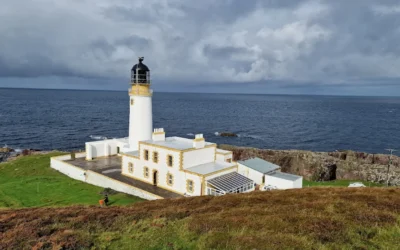
Rua Reidh Lighthouse
Rua Reidh Lighthouse: Wild Wester Ross Beacon Above Loch Ewe's WWII Convoys Three miles beyond the last village on a private track across the moorland of Wester Ross, where the headland of Rubha Rèidh — the Gaelic for flat headland — reaches out into the Minch, a...
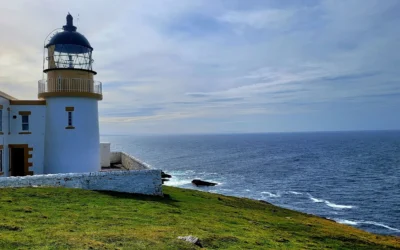
Stoer Lighthouse
Stoer Lighthouse: On Scotland's NC500, Two Miles From the Old Man of Stoer Two miles north of Stoer Lighthouse, the cliff edge drops away and the Old Man of Stoer rises from the sea — a 62-metre sandstone stack, sheer on all sides, standing apart from the headland as...
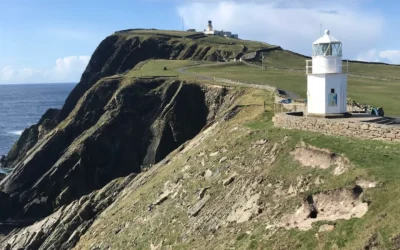
Sumburgh Head Lighthouse
Sumburgh Head Lighthouse: Robert Stevenson's 1821 Beacon on Shetland's Puffin Cliffs At the southernmost tip of Mainland Shetland, where the North Sea and the Atlantic meet in the turbulent tidal race known as the Sumburgh Roost, Robert Stevenson — the founder of the...
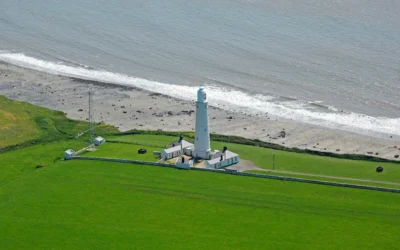
Nash Point Lighthouse
Nash Point Lighthouse: The Last Light in Wales to See Its Keeper Go In 1998, the keeper at Nash Point Lighthouse on the Glamorgan Heritage Coast turned off the oil lamps for the last time, handed the keys to Trinity House and walked away, making Nash Point the last...
Noss Head Lighthouse
Noss Head Lighthouse: A North Coast 500 Gem With a World-First Lantern On the Noss Head peninsula three miles north-east of Wick, a lighthouse stands above Sinclairs Bay that is less famous than it deserves to be. When Alan Stevenson designed the lantern room here in...