
Stoer Lighthouse
Stoer Lighthouse: On Scotland’s NC500, Two Miles From the Old Man of Stoer
Two miles north of Stoer Lighthouse, the cliff edge drops away and the Old Man of Stoer rises from the sea — a 62-metre sandstone stack, sheer on all sides, standing apart from the headland as if it decided one day to stop being a cliff and become something else entirely. It is one of the most dramatic sea stacks in Scotland, and the walk from the lighthouse to the viewpoint above it is one of the finest two-mile stretches on the entire North Coast 500.
The lighthouse itself, built by Thomas and David Stevenson in 1870 and standing on the high cliffs of Stoer Head, looks out across the Minch towards the Isle of Lewis. Its white tower is trimmed with ochre — a distinctive detail — and at 14 metres it is modest in height, but the cliffs on which it stands give it a focal height of 59 metres above the sea, making the beam visible for 24 nautical miles in any weather.
Two former keepers’ flats in the lighthouse buildings are available as self-catering holiday accommodation, making Stoer a natural base for exploring this remote and spectacular corner of Sutherland. This guide covers everything you need to know about visiting and staying at Stoer Lighthouse.
Where Is Stoer Lighthouse?
Stoer Lighthouse is located on Stoer Head in the Assynt region of Sutherland, approximately 12 miles north of Lochinver. From Lochinver, take the B869 towards Unapool; after around 7 miles, turn onto the signposted single-track road towards Stoer. The lighthouse is a further 5 kilometres along this track — allow around 30 minutes from Lochinver. The nearest houses are half a mile away at Raffin; shops and services are in Lochinver or Drumbeg.
There is no public transport; a car is essential. The B869 and the final track are narrow — drive carefully and use the passing places.
A Brief History of Stoer Lighthouse
Stoer Lighthouse was constructed in 1870 by Thomas and David Stevenson — the same engineering partnership that built Cantick Head in Orkney (1858) and Corran on Loch Linnhe (1860) — as part of a programme to light the most dangerous stretches of the Minch. The Minch, the strait between mainland Scotland and the Outer Hebrides, is exposed, tidal and treacherous in poor visibility, and Stoer Head was one of 45 sites the Stevensons identified as critical for maritime safety along Scotland’s coast.
The lighthouse was manned by a Principal Lightkeeper and an Assistant, along with their families, until automation in 1978. The keepers lived in genuine self-sufficiency on this remote headland — the site still retains the remnants of a byre, stable, cow shed and pig house from the era when the lighthouse community grew its own food and kept its own animals. Keepers’ children attended the local primary school but had to board elsewhere for secondary education, so complete was the isolation of Stoer Head.
The bothy built during construction carries an extraordinary survival. Tucked within the lighthouse complex, this small building contains a mural of the lighthouse’s eastern elevation, almost certainly painted during the construction period of the 1870s. It is an intimate and accidental piece of history — a builder’s record of what they were making, preserved in the building that housed them while they made it.
Architecture & The Light
Stoer Lighthouse is a compact cylindrical stone tower, 14 metres (46 feet) tall, painted white with a black lantern and ochre trim. The tower’s modest height is entirely compensated by the elevation of the headland cliffs, which give the light a focal height of 59 metres (194 feet) above the sea — a beam visible for 24 nautical miles across the Minch and out towards the Outer Hebrides. The light flashes white every 15 seconds.
The lighthouse was automated in 1978, when the original oil lamps were replaced by sealed beam electric lamps. The tower is maintained by the Northern Lighthouse Board and remains an active navigational aid.
Visiting the Lighthouse
The lighthouse tower is not open to the public. The grounds are freely accessible at all times, with no admission fee, and the setting is superb — the white tower and ochre trim against the Minch, the Old Man of Stoer visible as a distant stack along the clifftop, and the ancient mountains of Assynt rising behind.
The two-mile coastal walk to the Old Man of Stoer is the outstanding visitor experience at this lighthouse. The path follows the clifftops north from the lighthouse to the viewing point above the stack. The Old Man is 62 metres of Torridonian sandstone — a column that was once connected to the headland and is now entirely surrounded by the sea. It is popular with rock climbers and is one of the most photographed sea stacks in Scotland.
The construction bothy with its historic mural of the lighthouse is worth seeking out when exploring the grounds.
Staying at the Lighthouse
Two refurbished self-catering flats in the former keeper’s buildings are available as holiday accommodation. The flats can be rented separately or together for larger groups:
|
Accommodation |
Sleeps |
Features |
|
First Floor Flat |
4 |
2 twin bedrooms, kitchen, bathroom, lounge with fireplace, TV, Wi-Fi |
|
Ground Floor Flat |
4 |
2 twin bedrooms, kitchen, bathroom, lounge with fireplace, TV, Wi-Fi; dog-friendly |
|
Both Flats Combined |
8 |
Full lighthouse complex; ideal for larger groups or families |
The ground floor flat is dog-friendly. Both flats are thoughtfully equipped, with an eco-friendly approach (low-energy bulbs, fair-trade products). The lighthouse setting, the views and the proximity to the Old Man of Stoer make this an excellent base for several days of Sutherland exploration.
Find Lighthouse & Highland Stays Near Lochinver →
The Best Time to Visit
Summer (May to August) offers the longest days — in June the light barely dims in Sutherland — the best conditions for the coastal walk to the Old Man and the mildest weather for exploring Assynt. Midges are a significant consideration in summer (particularly June to August); bring insect repellent and be prepared, especially for still, warm evenings. Spring (April to May) is excellent — quieter, with the seabirds returning to the cliffs and the highland wildflowers beginning.
Autumn (September to October) is when Sutherland is at its most dramatic — the bracken turning gold on the hillsides, fewer midges, and the autumn Atlantic light extraordinary on the sea stacks and the Assynt mountains. Winter (November to March) is genuinely remote and elemental, but the lighthouse complex is bookable year-round and the experience of a Highland winter here is unforgettable for those who come prepared.
How to Get There
By car. From Lochinver, take the B869 towards Unapool for approximately 7 miles, then turn onto the signposted single-track road to Stoer. Follow it for 5 kilometres to the lighthouse car park, just below the site. Allow 30 minutes from Lochinver.
From Inverness, allow approximately 2 hours; from Glasgow, Edinburgh or Aberdeen, allow around 4 hours.
There is no public transport to Stoer Head. A car is essential.
Compare Transfers & Local Transport in Sutherland →
Wildlife & The Coast
The cliffs of Stoer Head and the waters of the Minch below are rich in wildlife. Grey seals are regularly visible on the rocks, and the sea around the Old Man of Stoer is home to common dolphins and harbour porpoises. Minke whales pass through the Minch in summer, particularly between June and September. Basking sharks are also seen in warm months.
Above the moorland, golden eagles are regular over the Assynt hills, and the cliffs support razorbills, guillemots, fulmars and kittiwakes through the breeding season. The short-eared owl hunts the moorland at dusk.
A pair of binoculars for wildlife watching is essential — from the lighthouse grounds and the Old Man of Stoer clifftop path, the wildlife-watching is outstanding.
Nearby Attractions
Stoer Lighthouse is in the heart of Assynt, one of the most spectacular landscapes in the British Isles.
|
Attraction |
Why Visit |
Distance |
|
Old Man of Stoer |
Scotland’s most dramatic sea stack — a 62m column of Torridonian sandstone |
2 miles (walk) |
|
Lochinver |
Charming fishing town with fresh seafood, harbour and views of Suilven |
~12 miles |
|
Suilven |
One of Scotland’s most iconic mountains — an extraordinary inselberg rising from the Assynt moorland |
~15 miles |
|
Knockan Crag |
A geological landmark that changed how we understand the age of rocks — outstanding visitor centre |
~25 miles |
|
Sandwood Bay |
One of Scotland’s finest and most remote beaches — a full day’s walk away |
~35 miles |
A natural day out: walk to the Old Man of Stoer in the morning, drive to Lochinver for the afternoon, then back to the lighthouse for the sunset over the Minch.
Browse Assynt & Sutherland Coast Tours →
Safety & Accessibility
Safety. The clifftop path to the Old Man of Stoer and the surrounding cliff edges require extreme care — stay well back from the edges, which can be unstable. The coastal paths involve uneven terrain; sturdy footwear is essential. The B869 and the approach track are narrow and require careful, unhurried driving.
Midges. Highland midges are serious in summer. Bring repellent and plan outdoor activities for windier conditions. The midge season runs roughly May to September, peaking June to August.
Accessibility. The site is not wheelchair accessible due to the uneven terrain. The ground floor flat has level access.
Families. Both flats together sleep 8 — an excellent option for a multi-family group. The coastal walk to the Old Man of Stoer is suitable for older children (with care near the cliffs). The ground floor flat is dog-friendly.
Practical Tips
- The walk to the Old Man of Stoer is unmissable — 2 miles each way on cliff paths. Allow 2–3 hours and go on a clear day for the finest views.
- Bring insect repellent for summer visits — midges are relentless in still, warm conditions.
- Wear waterproof walking boots for the Old Man walk and any cliff path exploration — the terrain is wet and uneven.
- Pack a waterproof walking jacket; Sutherland weather changes fast and the headland is exposed.
- Bring binoculars for the wildlife — seals, dolphins and eagles are regularly seen.
- Overseas visitor? The UK uses Type G plugs, so a UK travel adapter is essential.
- Stock up in Lochinver before the final approach — there are no shops within 12 miles of the lighthouse.
- Visit Knockan Crag if you have a geological interest — it is where scientists discovered that ancient rocks can be thrust over younger ones, rewriting geological theory.
Conclusion
Stoer Lighthouse stands above one of the finest coastal landscapes in the British Isles, with the Old Man of Stoer rising from the sea two miles along the cliff, the ancient mountains of Assynt behind, and the Minch stretching west towards the Outer Hebrides. Thomas and David Stevenson built it in 1870 to warn ships away from these cliffs; the keepers who lived here raised families in genuine isolation, keeping their own animals and growing their own food. To stay in their flats now, with the lighthouse beside you and the Old Man at the end of the path, is to inhabit a remote and extraordinary piece of Scotland’s coast.
Frequently Asked Questions
What is the history of Stoer Lighthouse?
Built in 1870 by Thomas and David Stevenson to guide ships through the treacherous Minch, Stoer was manned until 1978 when it was automated. The keepers and their families lived in self-sufficient conditions on the remote headland.
Where is Stoer Lighthouse located?
On Stoer Head in the Assynt region of Sutherland, approximately 12 miles north of Lochinver. Reached via the B869 and a 5-kilometre single-track road.
Can I visit Stoer Lighthouse?
The grounds are freely accessible at all times. The tower is not open to the public. The best way to experience the lighthouse is to stay overnight.
Can I stay overnight at Stoer Lighthouse?
Yes. Two self-catering flats (each sleeping 4) are available. The ground floor flat is dog-friendly; both flats can be rented together for 8 guests.
What is the Old Man of Stoer?
A 62-metre free-standing sea stack of Torridonian sandstone, a 2-mile walk along the clifftops from the lighthouse. One of Scotland’s most dramatic natural landmarks and popular with rock climbers.
Is Stoer Lighthouse on the North Coast 500?
Yes — the lighthouse is on the NC500, Scotland’s celebrated 500-mile coastal road trip. The Stoer Peninsula is one of the most dramatic sections of the entire route.
What wildlife can I see near Stoer Lighthouse?
Grey seals, common dolphins, harbour porpoises and minke whales in the Minch; golden eagles over the Assynt moorland; guillemots, razorbills, fulmars and kittiwakes on the cliffs.
What are the midges like at Stoer Lighthouse?
Highland midges can be intense in summer (June–August), particularly in still, warm conditions. Bring insect repellent and plan outdoor activities for windier times of day.
What makes Stoer Lighthouse unique?
Its dramatic clifftop position above the Minch, the two-mile walk to the iconic Old Man of Stoer sea stack, its Stevenson heritage and its position on the North Coast 500 all set it apart.
Are there shops near Stoer Lighthouse?
The nearest shops are in Lochinver (12 miles) or Drumbeg. Stock up before the final approach to the lighthouse.
St John’s Point Lighthouse
St John's Point Lighthouse: The Yellow-Banded Giant of County Down In Van Morrison's song "Coney Island," the lighthouse at St John's Point is mentioned in a list of the things that make the Irish coast of County Down feel like home — somewhere between the Mourne...
Blackhead Lighthouse
Blackhead Lighthouse: The Titanic Passed Here, and You Can Stay the Night In April 1912, RMS Titanic — built at Harland and Wolff's yards on Queen's Island in Belfast, launched in 1911 and fitted out over the following months — left Belfast Lough for the last time on...
St Ann’s Head Lighthouse
St Ann's Head Lighthouse: The Last Shore-Based Light in Pembrokeshire, on the Tudor Coast In August 1485, a small fleet carrying Henry Tudor — exiled pretender to the English throne — rounded this headland and landed at Mill Bay, a sheltered cove just to the north of...
Point Lynas Lighthouse
Point Lynas Lighthouse: A Castle on the Cliffs of North Wales, Guiding Liverpool's Ships Since 1766 Most lighthouses are towers. Point Lynas is not. The lighthouse that stands on the rocky headland at the north-east corner of Anglesey is a low, castellated structure...
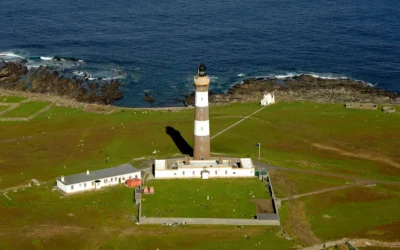
North Ronaldsay Lighthouse
North Ronaldsay Lighthouse: The UK's Tallest, Above the Island of the Seaweed Sheep Around the shoreline of North Ronaldsay — the northernmost and most isolated of the Orkney Islands — runs a drystone wall several miles long called the Sheep Dyke. Its purpose is...