
Sumburgh Head Lighthouse
Sumburgh Head Lighthouse: Robert Stevenson’s 1821 Beacon on Shetland’s Puffin Cliffs
At the southernmost tip of Mainland Shetland, where the North Sea and the Atlantic meet in the turbulent tidal race known as the Sumburgh Roost, Robert Stevenson — the founder of the great lighthouse dynasty, grandfather of Robert Louis Stevenson, and builder of the Bell Rock Lighthouse — first lit this tower on 1 February 1821. It is the oldest lighthouse in Shetland. The cliffs below it are 91 metres high.
In spring and summer, puffins nest in burrows along the clifftop within a few metres of where visitors stand. Shetland is the most remote inhabited archipelago in the United Kingdom — closer to Bergen in Norway than to Edinburgh — and Sumburgh Head is its most southerly point, a Category A listed lighthouse complex managed by the Shetland Amenity Trust following a restoration in 2014.
Two former keepers’ cottages are available as holiday accommodation; the tower is open for guided climbs; the RSPB maintains a nature reserve around the cliffs; and on the same headland, five minutes’ walk away, lies Jarlshof — one of the most extraordinary archaeological sites in Europe, with evidence of continuous settlement from 2500 BC to the 17th century. This guide covers everything you need to know about visiting and staying at Sumburgh Head.
Where Is Sumburgh Head Lighthouse?
Sumburgh Head Lighthouse is on the southernmost point of Mainland Shetland, approximately 25 miles (40 km) south of Lerwick. It is reached by car via the A970 road south from Lerwick to Sumburgh; the lighthouse is signposted just south of Sumburgh Airport.
Shetland is reached by ferry from Aberdeen (overnight sailing with NorthLink Ferries) or by Loganair flights from Edinburgh, Aberdeen and several other UK airports to Sumburgh Airport — which is itself just a short drive from the lighthouse. This is one of the most accessible of all Shetland’s sites, lying close to the main airport.
A Brief History of Sumburgh Head Lighthouse
Robert Stevenson built Sumburgh Head Lighthouse in 1821, making it the oldest lighthouse in Shetland. He had already completed his masterpiece — the Bell Rock Lighthouse, built on a submerged rock in the North Sea (1811), one of the greatest engineering feats of the 19th century — and Sumburgh Head was one of a long series of Scottish lighthouses that cemented the Stevenson name in maritime history.
The lighthouse was built in response to the violence of the Sumburgh Roost — the powerful tidal race that forms around Sumburgh Head as the tidal waters of the North Sea and the Atlantic clash around the peninsula. The Roost is one of the most treacherous stretches of water around the British Isles, and the records of shipwrecks in this area are sobering: the Royal Victoria was wrecked here in 1864, one of many vessels lost to the Roost over the centuries.
A foghorn was installed in 1906 to warn ships in poor visibility, and operated until 1987; the original fog bell, replaced by the foghorn, now hangs in Dunrossness parish church. The foghorn has since been restored and sounds on special occasions. The lighthouse was automated in 1991.
Jarlshof, five minutes’ walk from the lighthouse, places the site in a perspective that few other lighthouses can claim. Robert Stevenson built his lighthouse in 1821 on a headland that had been continuously occupied by human beings for 4,500 years. The Bronze Age settlers came here around 2500 BC. The Iron Age followed; the Picts; the Norse, who farmed here for centuries; and finally the medieval and early modern periods. All of it is visible, excavated and interpretable, within walking distance of the lighthouse. Sumburgh Head is not just a lighthouse. It is one of the longest-inhabited points in the British Isles.
Architecture & The Light
Sumburgh Head is a 17-metre (56-foot) cylindrical masonry tower, painted white with a black lantern and ochre trim, standing on cliffs 91 metres (299 feet) above sea level. The focal height — 91 metres — gives the light a range of 23 nautical miles and means that, despite the modest tower height, the beam reaches well beyond the dangerous Roost to guide ships approaching from the south. The light shows three flashes every 30 seconds, using Stevenson’s equiangular refractor.
The site is a Category A listed building — Historic Scotland’s highest level of protection, equivalent to Grade I in England — recognising it as one of the finest examples of early 19th-century lighthouse architecture in Scotland. The 2014 restoration, costing £5.4 million, brought the visitor centre, the keepers’ cottages and the foghorn house back to a high standard while preserving their historical character.
Visiting the Lighthouse
The lighthouse is managed by the Shetland Amenity Trust and is open to visitors from Thursday to Monday, April to September. The visitor centre features interactive exhibits on the lighthouse’s maritime history, Shetland’s geology and the wildlife of the reserve, alongside a Marine Life Centre focused on the seabirds and marine mammals of these waters.
The tower climb — 106 steps to the top — is available subject to physical ability and availability. The view from the top extends across the Sumburgh Roost, the southern Shetland cliffs and, on clear days, far out to sea. The observatory and gift shop are free to enter; a charge applies for other buildings. Check the official Sumburgh Head website for current pricing and times.
Check Tickets & Tour Times for Sumburgh Head Lighthouse →
Staying at the Lighthouse
Two restored former keepers’ cottages — the Keeper’s Cottage and the Occasional Keeper’s Cottage — are available as self-catering holiday accommodation, each sleeping up to six guests. The cottages were refurbished as part of the 2014 restoration and offer a blend of historical character and modern comfort, with views of the lighthouse and the cliffs.
|
Accommodation |
Sleeps |
Features |
|
Keeper’s Cottage |
Up to 6 |
Restored keeper’s property, lighthouse views, sea views, self-catering |
|
Occasional Keeper’s Cottage |
Up to 6 |
Restored keeper’s property, lighthouse views, sea views, self-catering |
Both properties are part of the restored lighthouse complex. Book through the Shetland Lighthouse accommodation website; check current availability and rates at the time of booking.
Find Lighthouse & Island Stays in Shetland →
The Best Time to Visit
Spring and early summer (April to August) is the exceptional time at Sumburgh Head — the puffin colony returns in April, and the cliffside burrows are accessible (stay on the designated paths during the ground-nesting season, April to mid-August). This is when the lighthouse is at its most alive with wildlife and the visitor centre is fully open. Late summer (August to September) is excellent too, with the full facilities still running and the Shetland landscape at its greenest.
Autumn (September to October) brings the seabird migration and dramatic skies. Winter (November to March) in Shetland is genuinely remote and elemental — the Northern Lights are sometimes visible on clear nights, the Sumburgh Roost is at its most violent, and the cliffs are magnificent in storm conditions. The lighthouse and cottages can be visited year-round.
How to Get There
By air. Loganair operates flights from Edinburgh, Aberdeen, Inverness and other UK airports to Sumburgh Airport, which is within a short drive of the lighthouse. This is by far the quickest option.
By ferry. NorthLink Ferries operates an overnight sailing from Aberdeen to Lerwick, Shetland’s capital. From Lerwick, the lighthouse is 25 miles south via the A970 — around 35 minutes by car.
From Lerwick. Bus services connect Lerwick to Sumburgh Airport; from the airport the lighthouse is a short walk or taxi ride.
Compare Transfers & Travel to Shetland →
Wildlife & The Coast
Sumburgh Head is one of the finest wildlife-watching sites in the British Isles. The puffin colony is the headline attraction — from April to August, Atlantic puffins nest in burrows along the clifftop, and at Sumburgh Head they do so within metres of the viewing areas, making this one of the most accessible puffin-watching experiences in the UK. Guillemots, razorbills, kittiwakes and fulmars also nest on the cliffs.
In the water below, grey seals haul out on the rocks, common and white-beaked dolphins are regularly seen, and orcas (killer whales) visit Shetland waters — the same pods that range south to Orkney and the Caithness coast. Minke whales pass through in summer.
The Fair Isle ferry leaves from Grutness, just one mile north of the lighthouse. Fair Isle — the most isolated inhabited island in Britain — is one of the world’s great birdwatching destinations, renowned for the extraordinary rarities that turn up during migration. Even a day trip is a wildlife experience unlike almost any other in the British Isles.
A pair of binoculars for wildlife watching is essential at Sumburgh Head — for the puffins, the seabirds, the seals and the marine mammals.
Nearby Attractions
Sumburgh Head is surrounded by some of the most remarkable sites in the British Isles.
|
Attraction |
Why Visit |
Distance |
|
Jarlshof |
4,500 years of settlement history on one headland — Bronze Age to 17th century |
~5-min walk |
|
Mousa Broch |
Britain’s finest Iron Age broch tower on the island of Mousa — summer boat trips from Sandwick |
~15 miles |
|
Fair Isle Ferry |
Day trips to Britain’s most isolated island — world-famous for birdwatching |
~1 mile (Grutness) |
|
Lerwick |
Shetland’s capital — museum, Up Helly Aa connections, Norse heritage |
~25 miles |
|
Scalloway Castle |
Historic castle with Norse and Jacobite connections |
~20 miles |
A natural day out: the lighthouse tower in the morning, Jarlshof in the afternoon, the cliffside puffin walk at dusk.
Browse Shetland Island Tours & Experiences →
Safety & Accessibility
Safety. The cliffs at Sumburgh Head are 91 metres high — stay on marked paths and well back from the edges. During the ground-nesting bird season (mid-April to mid-August), dogs must be kept on a short lead. Check tidal and weather conditions before any coastal walk.
Accessibility. The car park has Blue Badge spaces near the lighthouse and near the lookout platform. Toilets are available on site from April to September. The tower climb (106 steps) is not suitable for all visitors; the grounds and visitor centre are more accessible.
Families. The puffin colony, the visitor centre and Jarlshof are all excellent for families. The tower climb has physical requirements; the cliff edges require supervision.
Practical Tips
- Visit for the puffins — April to August is the prime window. Arrive in the early morning or late evening for the quietest conditions.
- Combine with Jarlshof — five minutes’ walk, and one of the most significant archaeological sites in the British Isles.
- Wear waterproof walking boots for the cliff paths.
- Pack a waterproof walking jacket; Shetland weather is notoriously unpredictable.
- Bring binoculars — the puffin colony, the seals and the marine mammals reward close observation.
- Overseas visitor? The UK uses Type G plugs, so a UK travel adapter is essential.
- If visiting in winter, check the Northern Lights forecast — Shetland, with its minimal light pollution, is one of the finest aurora-watching locations in the British Isles.
Conclusion
Sumburgh Head Lighthouse was built by the founder of Scotland’s greatest lighthouse dynasty in 1821, on a headland inhabited continuously for 4,500 years, at the most exposed point of Britain’s most remote inhabited archipelago. Puffins nest within arm’s reach of the clifftop paths. Jarlshof lies five minutes’ walk away. The Sumburgh Roost churns below the cliffs. And the cottages where the keepers once lived are warm and comfortable and available for the night. Of all the lighthouses in this guide, Sumburgh Head reaches furthest — in geography, in time and in the wildness of its setting.
Frequently Asked Questions
What is the history of Sumburgh Head Lighthouse?
Built by Robert Stevenson in 1821 — the same engineer who built the Bell Rock Lighthouse — Sumburgh Head was first lit on 1 February 1821. It is the oldest lighthouse in Shetland and a Category A listed building. Automated in 1991.
Where is Sumburgh Head Lighthouse located?
At the southern tip of Mainland Shetland, approximately 25 miles (40 km) south of Lerwick, near Sumburgh Airport.
Can I climb Sumburgh Head Lighthouse?
Yes — the tower can be climbed (106 steps) subject to availability and physical ability during the visitor season (Thursday to Monday, April to September).
Can I stay overnight at Sumburgh Head Lighthouse?
Yes. Two restored keepers’ cottages — the Keeper’s Cottage and the Occasional Keeper’s Cottage — each sleep up to six guests.
What is the Sumburgh Roost?
The violent tidal race that forms around Sumburgh Head as North Sea and Atlantic tidal waters collide. It has been responsible for many shipwrecks over the centuries, and was the primary reason the lighthouse was built.
When can I see the puffins at Sumburgh Head?
The Atlantic puffin colony is present from April to August. Puffins nest in cliff-edge burrows accessible from the designated viewing paths. This is one of the most accessible puffin-watching experiences in the UK.
What is Jarlshof?
One of the most remarkable archaeological sites in the British Isles, five minutes’ walk from the lighthouse. Evidence of continuous occupation from 2500 BC includes Bronze Age, Iron Age, Pictish, Norse and medieval remains, all on the same headland as the lighthouse.
Is Sumburgh Head Lighthouse suitable for families?
Yes — the puffin colony, visitor centre, Jarlshof and the wildlife reserve are all excellent for families. The tower climb has physical requirements, and cliff edges require supervision.
How do I get to Shetland?
By Loganair flight from Edinburgh, Aberdeen and other UK airports to Sumburgh Airport (the nearest airport to the lighthouse), or by NorthLink Ferries overnight sailing from Aberdeen to Lerwick.
What is the Robert Stevenson connection?
Robert Stevenson (1772–1850) was the founder of the famous Stevenson lighthouse-engineering dynasty and the grandfather of novelist Robert Louis Stevenson. He built Sumburgh Head in 1821 and the Bell Rock Lighthouse — one of the greatest engineering achievements of the 19th century — in 1811.
St John’s Point Lighthouse
St John's Point Lighthouse: The Yellow-Banded Giant of County Down In Van Morrison's song "Coney Island," the lighthouse at St John's Point is mentioned in a list of the things that make the Irish coast of County Down feel like home — somewhere between the Mourne...
Blackhead Lighthouse
Blackhead Lighthouse: The Titanic Passed Here, and You Can Stay the Night In April 1912, RMS Titanic — built at Harland and Wolff's yards on Queen's Island in Belfast, launched in 1911 and fitted out over the following months — left Belfast Lough for the last time on...
St Ann’s Head Lighthouse
St Ann's Head Lighthouse: The Last Shore-Based Light in Pembrokeshire, on the Tudor Coast In August 1485, a small fleet carrying Henry Tudor — exiled pretender to the English throne — rounded this headland and landed at Mill Bay, a sheltered cove just to the north of...
Point Lynas Lighthouse
Point Lynas Lighthouse: A Castle on the Cliffs of North Wales, Guiding Liverpool's Ships Since 1766 Most lighthouses are towers. Point Lynas is not. The lighthouse that stands on the rocky headland at the north-east corner of Anglesey is a low, castellated structure...
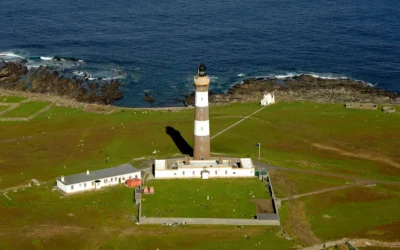
North Ronaldsay Lighthouse
North Ronaldsay Lighthouse: The UK's Tallest, Above the Island of the Seaweed Sheep Around the shoreline of North Ronaldsay — the northernmost and most isolated of the Orkney Islands — runs a drystone wall several miles long called the Sheep Dyke. Its purpose is...