
Rua Reidh Lighthouse
Rua Reidh Lighthouse: Wild Wester Ross Beacon Above Loch Ewe’s WWII Convoys
Three miles beyond the last village on a private track across the moorland of Wester Ross, where the headland of Rubha Rèidh — the Gaelic for flat headland — reaches out into the Minch, a white lighthouse tower with a red lantern room has been guiding ships since 1912.
On a clear day from the headland, the mountains of Skye rise above the water to the south, the Shiant Isles sit in the middle of the Minch, and the long blue outline of the Outer Hebrides stretches away to the west. After dark, the skies above Rua Reidh are among the darkest in mainland Scotland.
The lighthouse has a wartime chapter that is less widely known than it deserves to be. During the Second World War, Loch Ewe — the deep natural harbour just to the south of the lighthouse — became one of the principal mustering points for the Arctic convoys, the extraordinary and hazardous supply lines that carried war materials to the Soviet Union through the North Atlantic and the Arctic Ocean.
The lighthouse guided those convoys through the Minch to Loch Ewe. The ships that assembled there sailed to Murmansk and Arkhangelsk; many did not return. Rua Reidh saw them come and go. This guide covers everything you need to know about visiting and staying at Rua Reidh.
Where Is Rua Reidh Lighthouse?
Rua Reidh Lighthouse is located in Wester Ross on Scotland’s west coast, near the village of Melvaig, approximately 13 miles from the town of Gairloch. Access beyond Melvaig is via a three-mile private track across a private estate — suitable for cars but requiring careful, considerate driving, particularly in wet conditions. Park sensibly and respect the estate land.
Driving times to the lighthouse: around 30 minutes from Gairloch; around 2 hours from Ullapool, the Skye Bridge or Inverness; around 4 hours from Glasgow, Edinburgh or Aberdeen. There is no public transport to the site; a car is essential.
A Brief History of Rua Reidh Lighthouse
The lighthouse was proposed as early as 1853 to guide shipping along the treacherous waters of the Minch — the strait between the Scottish mainland and the Outer Hebrides — and to serve vessels entering and leaving Loch Ewe. It was not until 1912 that the lighthouse was actually constructed and first lit, on 15 January 1912. The engineer was David A. Stevenson, the fourth generation of the Stevenson lighthouse dynasty to build lighthouses on the Scottish coast.
The Stevensons had been lighting Scotland’s coasts for nearly a century by the time David A. designed Rua Reidh. His great-grandfather Robert built the Mull of Galloway (1830); his grandfather Alan designed Ardnamurchan and North Ronaldsay (1849–1854); his father David, with his uncle Thomas, built Cantick Head and Corran (1858–1860). By 1912, when David A. lit Rua Reidh, the family had designed the majority of Scotland’s lighthouses. It is one of the most remarkable engineering legacies in the history of these islands.
The wartime chapter came in the 1940s. Loch Ewe, immediately south of the lighthouse’s headland, was chosen as a convoy assembly point for the Arctic convoys — supply lines sailing to the Soviet Union across the most dangerous ocean route of the war, through waters patrolled by German U-boats and aircraft, in conditions of extreme cold and darkness. The lighthouse guided the convoys through the Minch and into Loch Ewe. The original Fresnel lens that made this possible is now preserved at the Gairloch Heritage Museum.
The scale of what Loch Ewe witnessed is staggering. Over 1,400 merchant vessels made the Arctic convoy run from Britain to Murmansk and Arkhangelsk. Loch Ewe was one of the two main mustering points (the other was Loch Long). Convoys gathered in the enclosed waters just a few miles from Rua Reidh Lighthouse, assembled under naval escort, and then sailed north into the Arctic. Of all the lighthouses in this guide, Rua Reidh has perhaps the most significant wartime role.
Architecture & The Light
Rua Reidh is a 25-metre (82-foot) white stone tower topped with a distinctive red lantern room, designed in the functional, aesthetically restrained manner characteristic of early 20th-century Northern Lighthouse Board construction. The surrounding keeper’s cottages and outbuildings are part of a Grade B listed complex, recognised for their architectural and historical merit.
The lighthouse remains fully operational — automated and maintained by the Northern Lighthouse Board — and the current electric light continues to serve as a navigational aid for shipping in the Minch.
Visiting the Lighthouse
The lighthouse tower is not open to the public, as it remains an active navigational aid. The grounds are freely accessible, and the headland provides one of the finest views in Wester Ross: the Minch below, Skye to the south, the Shiant Isles in the middle of the channel, and the Outer Hebrides on the western horizon.
The Gairloch Heritage Museum, 13 miles away in the town of Gairloch, houses the lighthouse’s original Fresnel lens and other historical artefacts from the lighthouse’s working life — an excellent companion visit for those wanting to understand the engineering behind the light.
There is no admission fee for the grounds.
Staying at the Lighthouse
Rua Reidh Lighthouse offers some of the most distinctive accommodation options in the Scottish lighthouse series — a range of rooms and self-catering spaces in the former keeper’s buildings, each named for local wildlife, each with its own character.
|
Accommodation |
Type |
Features |
|
Principal Keeper’s House — Gannet & Orca |
Rooms (B&B style) |
Named after local wildlife, en-suite or private bathrooms, traditional style; 2-night minimum |
|
The Hide |
Room (courtyard) |
2-metre panorama window for wildlife watching — extraordinary views; 3-night minimum |
|
First Officer’s Quarters |
Self-catering |
Sleeps up to 4; closest accommodation to the lighthouse tower; weekly bookings with Saturday changeover |
The Hide is worth special mention. A wildlife-watching room with a two-metre panorama window in the courtyard, it is purpose-built for the extraordinary wildlife of this coast — designed to let guests sit inside in comfort while scanning the headland and the Minch for otters, eagles, whales and dolphins. It is the most unusual piece of lighthouse accommodation in this guide.
As pricing and minimum stay requirements vary by accommodation type and season, check the official Rua Reidh Lighthouse website for current rates and availability.
Find Lighthouse & Highland Stays Near Gairloch →
The Best Time to Visit
Summer (May to August) offers the longest days — Wester Ross in midsummer barely gets dark, and the combination of long light and clear air makes the views to Skye and the Outer Hebrides exceptional. This is also the best season for whale and basking shark sightings in the Minch. Spring (April to May) brings the seabirds back to the cliffs and wildflowers to the coastal heathland, and is quieter than the peak summer season.
Autumn (September to October) is outstanding for wildlife, with sea mammals active and the autumn light spectacular on the Wester Ross mountains. Winter (November to March) is elemental — the darkest skies, the stormiest seas, the most complete solitude — for those well prepared and seeking real remoteness.
The minimal light pollution at Rua Reidh makes it an exceptional location for stargazing in autumn and winter, when clear nights reveal the Milky Way and, on occasion, the aurora borealis.
How to Get There
By car. Drive via the A832 to Gairloch, then north through Poolewe and on to Melvaig. Beyond Melvaig, follow the three-mile private track to the lighthouse — drive slowly and carefully. Allow around 30 minutes from Gairloch. There is no public transport to the site; a car is essential.
From Inverness, Ullapool or the Skye Bridge, allow around two hours. From Glasgow, Edinburgh or Aberdeen, allow around four hours.
Compare Transfers & Local Transport in Wester Ross →
Wildlife & The Coast
Rua Reidh is on one of the finest wildlife-watching coasts in mainland Scotland. The Minch waters below the headland are part of the range of several species of whale — minke whales are regularly seen from June to September, and fin whales and humpback whales occasionally pass through. Basking sharks — the world’s second-largest fish — fin through the Minch in summer. Common and bottlenose dolphins and harbour porpoises are regular.
On the shore, otters are seen with some regularity along the rocky coastline around the lighthouse. Grey seals haul out on the rocks. Above, golden eagles and white-tailed eagles patrol the moorland, and the full range of Wester Ross seabirds nests on the cliffs.
The virtually complete absence of light pollution at Rua Reidh — no towns, no roads, no ambient glow — also makes it one of the best places in mainland Scotland for night-sky watching. On clear nights, the Milky Way is visible with the naked eye; in autumn and winter, auroras occasionally light the northern horizon.
A pair of binoculars for wildlife watching is essential — but The Hide’s panorama window is the most luxurious way to watch wildlife from any lighthouse in this guide.
Nearby Attractions
Wester Ross is one of the great landscapes of the Scottish Highlands.
|
Attraction |
Why Visit |
Distance |
|
Camus Mor Beach |
A beautiful, remote sandy beach reached on foot from the lighthouse |
Short coastal walk |
|
Gairloch Heritage Museum |
Houses the original Rua Reidh Fresnel lens — fascinating maritime collection |
~13 miles |
|
Inverewe Garden (National Trust for Scotland) |
A remarkable garden of exotic and subtropical plants, thriving in the Gulf Stream |
~6 miles |
|
Torridon |
Dramatic ancient Torridonian sandstone mountains — one of Scotland’s finest landscapes |
~30 miles |
|
Shieldaig and Loch Torridon |
A beautiful sea loch village surrounded by National Trust for Scotland land |
~30 miles |
A natural day out: the lighthouse headland and its sea views in the morning, Inverewe Garden in the afternoon, then back to Rua Reidh for the Minch at dusk.
Browse Wester Ross & North West Highlands Tours →
Safety & Accessibility
Safety. The three-mile private track requires careful driving — it is narrow and uneven in places, and wet weather makes it more challenging. The headland cliffs require caution. Weather in Wester Ross can change very rapidly; always check the forecast and carry appropriate clothing.
Accessibility. The site is not wheelchair accessible due to the remote terrain. The three-mile private track is suitable for standard cars but not for large vehicles.
Remoteness. Rua Reidh is genuinely remote — the nearest services are in Gairloch, 13 miles away. Bring provisions, check your fuel and plan your stay accordingly.
Practical Tips
- Plan your journey carefully — the three-mile private track should be driven slowly, particularly in wet conditions. Leave plenty of time.
- The Minch whale and dolphin season is June to September — if wildlife watching is a priority, plan your visit accordingly.
- Wear waterproof walking boots for the coastal walks to Camus Mor and the cliffside paths.
- Pack a waterproof walking jacket; Wester Ross weather is notoriously changeable and the headland is fully exposed to Atlantic weather.
- Bring binoculars — otters, eagles, seals, whales and dolphins are all regularly seen.
- Overseas visitor? The UK uses Type G plugs, so a UK travel adapter is essential.
- Bring provisions — there are no shops at or near the lighthouse. Shop in Gairloch before the final approach.
- On clear autumn or winter nights, step outside and look north for the aurora — this is one of the finest spots on the mainland for aurora watching.
Conclusion
Rua Reidh Lighthouse stands at the edge of the wild Wester Ross coast, looking west to Skye and the Outer Hebrides and south to the waters of Loch Ewe where the Arctic convoys once gathered. Built by the fourth generation of the Stevenson dynasty in 1912, it has guided the Minch for over a century. To stay at The Hide with a two-metre window on the sea, or in the First Officer’s Quarters with the tower a few steps from the door, is to be as completely inside the landscape of the Scottish west coast as any lighthouse in this guide can place you. The darkness is real. The wildlife is real. The history is real. Rua Reidh is one of the finest coastal retreats in Scotland.
Frequently Asked Questions
What is the history of Rua Reidh Lighthouse?
Designed by David A. Stevenson (fourth generation of the famous Stevenson lighthouse dynasty) and first lit on 15 January 1912, Rua Reidh was built to guide ships along the Minch and into Loch Ewe. During the Second World War, it guided the Arctic convoys — the supply lines to the Soviet Union — through the Minch to their Loch Ewe assembly point.
Where is Rua Reidh Lighthouse located?
Near Melvaig in Wester Ross, on Scotland’s west coast, approximately 13 miles from Gairloch. Access is via a three-mile private track beyond Melvaig.
Can I visit Rua Reidh Lighthouse?
The tower is not open to the public. The grounds are freely accessible. The best way to experience the lighthouse is to stay overnight.
Can I stay overnight at Rua Reidh Lighthouse?
Yes. Options include rooms in the Principal Keeper’s House (Gannet and Orca), The Hide (with its panorama wildlife-watching window) and the First Officer’s Quarters (self-catering, sleeps 4).
What is The Hide at Rua Reidh Lighthouse?
A distinctive accommodation option with a two-metre panorama window in the courtyard, designed for watching the extraordinary wildlife of the Wester Ross coast — otters, eagles, whales and dolphins — in comfort from inside.
What was the WWII role of Rua Reidh Lighthouse?
Loch Ewe, immediately south of the lighthouse, was one of the primary mustering points for the Arctic convoys — the supply lines to the Soviet Union that sailed through the Arctic Ocean under constant threat. The lighthouse guided those convoys through the Minch to Loch Ewe.
What wildlife can I see at Rua Reidh Lighthouse?
Otters along the shore, golden and white-tailed eagles above, grey seals, common dolphins, harbour porpoises, minke whales and basking sharks in the Minch. The night skies are among the darkest in mainland Scotland.
How do I get to Rua Reidh Lighthouse?
By car via the A832 to Gairloch, then north through Poolewe to Melvaig, then a three-mile private track to the lighthouse. There is no public transport.
Is Rua Reidh Lighthouse suitable for families?
Yes, with planning for the remote location and limited local amenities. The wildlife, the headland walks and the extraordinary views are wonderful for families.
What is the Stevenson connection at Rua Reidh Lighthouse?
Rua Reidh was designed by David A. Stevenson, the fourth generation of the famous Stevenson family of lighthouse engineers. The family’s lighthouses in this guide span four generations: Robert (Mull of Galloway, 1830) → Alan (Ardnamurchan, North Ronaldsay, 1849–54) → Thomas and David (Cantick Head, Corran, 1858–60) → David A. (Rua Reidh, 1912).
St John’s Point Lighthouse
St John's Point Lighthouse: The Yellow-Banded Giant of County Down In Van Morrison's song "Coney Island," the lighthouse at St John's Point is mentioned in a list of the things that make the Irish coast of County Down feel like home — somewhere between the Mourne...
Blackhead Lighthouse
Blackhead Lighthouse: The Titanic Passed Here, and You Can Stay the Night In April 1912, RMS Titanic — built at Harland and Wolff's yards on Queen's Island in Belfast, launched in 1911 and fitted out over the following months — left Belfast Lough for the last time on...
St Ann’s Head Lighthouse
St Ann's Head Lighthouse: The Last Shore-Based Light in Pembrokeshire, on the Tudor Coast In August 1485, a small fleet carrying Henry Tudor — exiled pretender to the English throne — rounded this headland and landed at Mill Bay, a sheltered cove just to the north of...
Point Lynas Lighthouse
Point Lynas Lighthouse: A Castle on the Cliffs of North Wales, Guiding Liverpool's Ships Since 1766 Most lighthouses are towers. Point Lynas is not. The lighthouse that stands on the rocky headland at the north-east corner of Anglesey is a low, castellated structure...
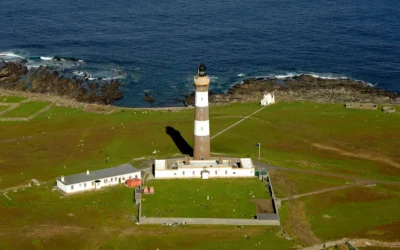
North Ronaldsay Lighthouse
North Ronaldsay Lighthouse: The UK's Tallest, Above the Island of the Seaweed Sheep Around the shoreline of North Ronaldsay — the northernmost and most isolated of the Orkney Islands — runs a drystone wall several miles long called the Sheep Dyke. Its purpose is...