
Cromer Lighthouse
Cromer Lighthouse: Standing 84 Metres Above the North Sea on the Cromer Ridge
There is something quietly astonishing about the numbers at Cromer Lighthouse. The tower itself stands 18 metres tall — modest by lighthouse standards. Yet the light it projects sits 84 metres above sea level, nearly five times the height of the tower. The difference is the Cromer Ridge: a long, narrow spine of high ground above the North Sea coast of Norfolk, and the cliff on which the lighthouse stands is one of the most dramatic points on the entire East Anglian shoreline. From the lighthouse grounds, the North Sea stretches away to the horizon and the Norfolk coastline curves away in both directions, a view quite disproportionate to the tower’s modest height.
Cromer Lighthouse was first lit in 1833 — a replacement for an earlier tower lost to the erosion of the cliff it had stood on — and it remains an active navigational aid today, its light flashing white every five seconds and visible for 21 nautical miles. Two former keepers’ cottages within the grounds, Valonia and The Link, are available as self-catering holiday accommodation, offering the chance to stay on this exceptional clifftop within easy reach of one of England’s finest seaside towns. This guide covers everything you need to know about visiting and staying at Cromer Lighthouse.
Where Is Cromer Lighthouse?
Cromer Lighthouse stands on the clifftop at Foulness Point, east of Cromer town centre in Norfolk, postcode NR27 0JH. It is around one mile from the town centre — a pleasant ten-minute walk along the coastal path from Cromer. The lighthouse is also accessible by car, with parking on site.
Cromer itself is around 28 miles north of Norwich, reached by the A140 and A149, or by train to Cromer station. The surrounding landscape is part of the Norfolk Coast Area of Outstanding Natural Beauty, with the dramatic cliffs of the Cromer Ridge, sandy beaches and the wide North Sea.
A Brief History of Cromer Lighthouse
The story of lighting this stretch of the Norfolk coast begins in 1669, when Sir John Clayton established a lighthouse at Foulness Point — though it was often unlit, undone by the high cost of maintaining a light on this remote and exposed position. A new lighthouse was built in 1719, fuelled by a coal fire. The significant technological step came in 1792, when the lighthouse was upgraded with oil-fired Argand lamps and parabolic reflectors — the same innovation that the Old Lighthouse at Hunstanton on the other side of Norfolk had pioneered in 1776, and now spreading along this coast to mark one of the most dangerous stretches of the North Sea.
Cliff erosion — the persistent enemy of this Norfolk coastline — eventually claimed the original Foulness lighthouse, and the current tower was built in 1833 half a mile further inland to keep it safe from the same fate. The lighthouse was converted to gas in 1905, partially electrified in 1935, fully electrified in 1958 and automated in 1990, when the last keepers departed and the cottages began their new life as holiday accommodation.
The remarkable thing about Cromer’s position is what the cliff means for the light. At 18 metres tall, the tower is not imposing — but the Cromer Ridge lifts it to 84 metres above sea level, giving its beam a range of 21 nautical miles across the North Sea. The cliff does the work that a much taller tower would otherwise have to do. It is a reminder that where a lighthouse stands matters as much as how tall it is — and the Cromer Ridge, rising sharply from the coast, is one of the finest positions on the English east coast.
Architecture & The Light
Cromer Lighthouse is an octagonal masonry tower, painted white, standing 18 metres (59 feet) tall and set on the Cromer Ridge 84 metres (276 feet) above sea level. The octagonal form — a rarer design than the more common round tower — echoes the design of St Catherine’s Lighthouse on the Isle of Wight and gives Cromer a distinctive, slightly Gothic elegance against the cliff and sky. The circular lantern room at the top holds the optic.
Originally equipped with a third-order catadioptric drum lens, the lighthouse’s light has been upgraded over its working life and now uses LED technology following a recent modernisation. The light flashes white every five seconds with an intensity of 294,000 candela, visible for 21 nautical miles across the North Sea. The lighthouse remains an active navigational aid, monitored remotely from Trinity House’s Operations Control Centre in Harwich.
Visiting the Lighthouse
The lighthouse tower is not open to the public. However, the grounds around the lighthouse are freely accessible at all hours of the day, with no admission fee, and the clifftop views of the North Sea and the Norfolk coast are reward enough for the short walk from Cromer.
The surrounding area offers the Cromer Lighthouse Circular Walk, a well-signed coastal path incorporating sections of the Paston Way, which takes walkers along the clifftops with fine views of the lighthouse and the sea. The Norfolk Coast Path also passes through the area, connecting Cromer to the broader coastal walking network.
For those interested in the wider history of this coastline, the Henry Blogg Lifeboat Museum in Cromer celebrates the life of Henry Blogg, the most decorated lifeboatman in RNLI history, who served on the Cromer lifeboat from 1894 to 1947 and is buried in Cromer.
Staying at the Lighthouse
Two former lighthouse keepers’ cottages within the grounds offer self-catering holiday accommodation, managed by Rural Retreats. Both sit on the dramatic clifftop east of Cromer with the lighthouse as their neighbour and the North Sea as their view — a genuinely special setting for a Norfolk coast holiday.
|
Cottage |
Sleeps |
Features |
|
Valonia |
5 |
3 bedrooms (king, twin, single), sitting room, dining room, walled garden with sea views, Wi-Fi; up to 2 dogs welcome |
|
The Link |
2 |
1 double bedroom, shower room, kitchen; shared outdoor spaces with sea views; ideal for couples |
Both cottages are fully equipped for self-catering, with modern kitchen appliances and Wi-Fi. A travel cot and highchair are available on request for Valonia. Note that there is no electric car charging and guests should bring their own barbecue equipment if needed. The sandy beach is around 500 metres away, reached by steep steps.
As these cottages are popular and sit in a particularly sought-after location, reserving early is strongly recommended for summer and school holiday periods.
Find Lighthouse & Coastal Stays Near Cromer →
The Best Time to Visit
Spring (April to June) is a wonderful time on the North Norfolk Coast — the clifftop wildflowers are at their finest, the seabirds are nesting, and Cromer’s famous crab season is fully underway. Summer (June to August) brings the warmest weather, long days and the full bustle of Cromer’s seaside season — busy and energetic, with the pier, the beach and the town all at their most animated.
Autumn (September to October) is perhaps the finest season for clifftop walking on this coast — the light is extraordinary, the trails are quieter and the North Sea has a particular drama in the autumn wind. Winter (November to March) is quiet on this coastline, with a raw North Sea beauty, though some seasonal facilities may be reduced.
Sunrises at Cromer Lighthouse, facing east over the North Sea, are spectacular. Sunsets behind the lighthouse, lighting the western sky above the rolling Norfolk countryside, are equally memorable.
How to Get There
By foot. From Cromer town centre, a ten-minute walk along the coastal path leads to the lighthouse — one of the most enjoyable approaches to any lighthouse in Norfolk.
By car. Follow local roads from Cromer town centre east towards Foulness Point. Parking is available on site.
By train. Cromer has its own railway station, reachable from Norwich (around an hour). From the station it is a pleasant walk of around fifteen minutes to the lighthouse along the coastal path.
Compare Transfers & Local Transport in Norfolk →
Wildlife & The Coast
The cliffs and sea around Cromer are rich in wildlife. Seabirds pass along the clifftops through the spring and summer migration, and the North Sea below is home to seals — often visible from the clifftop — as well as dolphins and porpoises on calmer days. The Norfolk Coast Area of Outstanding Natural Beauty stretches in both directions from the lighthouse, offering walking through some of the finest coastal landscape in East Anglia.
A pair of binoculars for wildlife watching is well worth bringing for the seabirds along the cliffs and for scanning the North Sea for seals and dolphins from the lighthouse clifftop.
The broader North Norfolk coast — within easy reach of Cromer — is one of the finest birdwatching landscapes in England, with the RSPB reserves at Titchwell Marsh and Cley Marshes both within around thirty minutes.
Nearby Attractions
Cromer is a wonderfully complete seaside town, and the North Norfolk Coast around it is full of excellent attractions.
|
Attraction |
Why Visit |
Distance |
|
Cromer Pier |
The working Victorian pier with theatre and café — try the Cromer crab |
~1 mile |
|
Henry Blogg Lifeboat Museum |
The story of Britain’s most decorated lifeboatman |
~1 mile |
|
Cromer Museum |
Maritime and local heritage of the Norfolk coast |
~1 mile |
|
Sheringham & Poppy Line |
The North Norfolk Railway’s heritage steam line |
~15-min drive |
|
Happisburgh Lighthouse |
The only independently operated lighthouse in the UK — climbable red-and-white tower |
~20-min drive |
A natural day out: the coastal walk from the lighthouse to Cromer town, a Cromer crab sandwich on the pier, then the Poppy Line at Sheringham for the afternoon.
Browse North Norfolk Coast Tours & Experiences →
Safety & Accessibility
Safety. The Cromer Ridge cliffs are steep and the edges require care — stay on the marked paths and keep away from the cliff edge, particularly in wet conditions when the path can be slippery. The coastal path may require moderate fitness in places.
Accessibility. The lighthouse grounds are generally accessible by foot from the car park. The cottages have steps and uneven surfaces in places. The lighthouse tower is not open to visitors. Visitors with specific access needs should check with the booking agent before reserving.
Families. The cottages are family-friendly, and the coastal path and beach are excellent for children. Valonia Cottage has a travel cot and highchair available, and dogs are welcome. The steep steps to the beach (500 metres from the cottages) should be noted for families with young children or pushchairs.
Practical Tips
- Book your cottage early — these clifftop cottages, particularly Valonia for families, fill quickly in the summer season.
- The crab sandwiches at Cromer Pier and the town’s seafood outlets are outstanding — Cromer crab is famous throughout England and this is the place to eat it.
- Wear waterproof walking boots for the coastal path — the Cromer Ridge cliffs can be slippery in wet conditions.
- Pack a waterproof walking jacket; the North Sea coast is exposed and the weather here changes quickly.
- Bring binoculars for the seabirds, seals and, on a clear day, the extraordinary coastal views from the clifftop.
- Overseas visitor? The UK uses Type G plugs, so a UK travel adapter is essential for charging your devices.
- For sunrise, the lighthouse faces east over the North Sea — the early light here is exceptional.
- Consider a day trip to Happisburgh Lighthouse, around twenty minutes along the coast — the only independently operated lighthouse in the UK and one of the few still open for climbing.
Conclusion
Cromer Lighthouse is a quiet achiever — a tower of modest height on a cliff of extraordinary altitude, whose 84-metre position above the North Sea makes it one of the most effective lights on the East Anglian coast. From its clifftop, the North Sea stretches to the horizon and the Norfolk coast curves away in both directions, a view that repays every visit. Whether you come for the walk, the crab, the cottage stay or simply to stand above the North Sea and watch the light begin its nightly vigil, Cromer offers one of the most complete lighthouse experiences on the Norfolk coast.
Frequently Asked Questions
What is the history of Cromer Lighthouse?
A lighthouse at Foulness Point was first established in 1669. The current octagonal tower was built in 1833 to replace an earlier structure lost to cliff erosion, and has guided ships along the Norfolk coast ever since. The lighthouse was automated in 1990.
Where is Cromer Lighthouse located?
On the clifftop at Foulness Point, east of Cromer in Norfolk, postcode NR27 0JH — about one mile from Cromer town centre.
Can I visit Cromer Lighthouse?
The lighthouse grounds are freely accessible at all hours with no admission fee. The tower itself is not open to the public.
Can I climb to the top of Cromer Lighthouse?
No — the tower is not open for public climbing. The nearby Happisburgh Lighthouse (around 20 minutes’ drive) is climbable if you are looking for a tower-climb experience on the North Norfolk Coast.
Can I stay overnight at Cromer Lighthouse?
Yes. Two former keepers’ cottages — Valonia (sleeps 5) and The Link (sleeps 2) — are available as self-catering holiday accommodation. Book well ahead for summer.
Why is Cromer Lighthouse 84 metres above sea level when the tower is only 18 metres tall?
Because the lighthouse stands on the Cromer Ridge — a significant clifftop position above the North Sea that lifts even a modest tower to an exceptional height above sea level, giving its beam a range of 21 nautical miles.
What makes Cromer Lighthouse unique?
Its position on the Cromer Ridge, giving an 84-metre elevation to an 18-metre tower, its historic connection to the early use of parabolic reflectors on this coast, and its location above one of England’s finest seaside towns.
What wildlife can I see near Cromer Lighthouse?
Seabirds along the cliffs, seals on the North Sea rocks, and dolphins offshore on calm days. The North Norfolk Coast is one of England’s finest birdwatching areas, with RSPB Titchwell and Cley Marshes within easy reach.
Are pets allowed at Cromer Lighthouse?
Up to two well-behaved dogs are welcome in Valonia Cottage with a small additional charge. Check current pet policy for The Link.
What is the best time to visit Cromer Lighthouse?
Spring for wildflowers and the start of crab season; summer for the full seaside experience; autumn for dramatic light and quieter paths; the lighthouse grounds are accessible year-round.
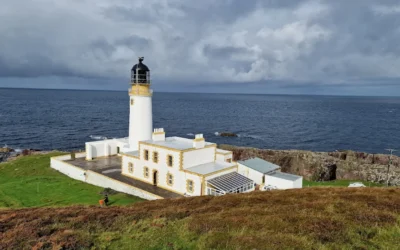
Rua Reidh Lighthouse
Rua Reidh Lighthouse: Wild Wester Ross Beacon Above Loch Ewe's WWII Convoys Three miles beyond the last village on a private track across the moorland of Wester Ross, where the headland of Rubha Rèidh — the Gaelic for flat headland — reaches out into the Minch, a...
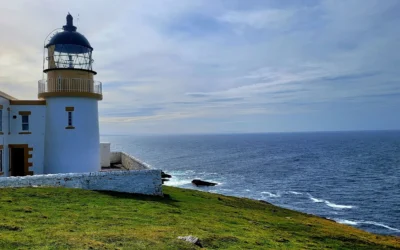
Stoer Lighthouse
Stoer Lighthouse: On Scotland's NC500, Two Miles From the Old Man of Stoer Two miles north of Stoer Lighthouse, the cliff edge drops away and the Old Man of Stoer rises from the sea — a 62-metre sandstone stack, sheer on all sides, standing apart from the headland as...
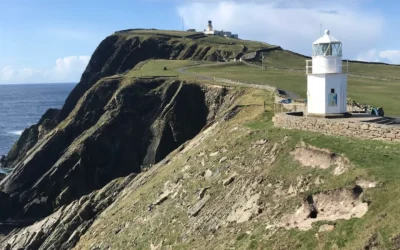
Sumburgh Head Lighthouse
Sumburgh Head Lighthouse: Robert Stevenson's 1821 Beacon on Shetland's Puffin Cliffs At the southernmost tip of Mainland Shetland, where the North Sea and the Atlantic meet in the turbulent tidal race known as the Sumburgh Roost, Robert Stevenson — the founder of the...
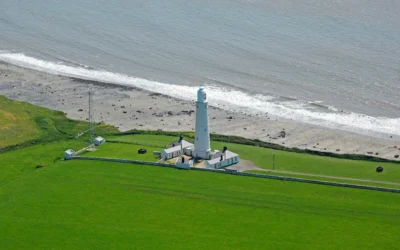
Nash Point Lighthouse
Nash Point Lighthouse: The Last Light in Wales to See Its Keeper Go In 1998, the keeper at Nash Point Lighthouse on the Glamorgan Heritage Coast turned off the oil lamps for the last time, handed the keys to Trinity House and walked away, making Nash Point the last...
Noss Head Lighthouse
Noss Head Lighthouse: A North Coast 500 Gem With a World-First Lantern On the Noss Head peninsula three miles north-east of Wick, a lighthouse stands above Sinclairs Bay that is less famous than it deserves to be. When Alan Stevenson designed the lantern room here in...