
St Ann’s Head Lighthouse
St Ann’s Head Lighthouse: The Last Shore-Based Light in Pembrokeshire, on the Tudor Coast
In August 1485, a small fleet carrying Henry Tudor — exiled pretender to the English throne — rounded this headland and landed at Mill Bay, a sheltered cove just to the north of what is now St Ann’s Head. Henry marched from here through Wales, gathered an army, won the Battle of Bosworth Field and became Henry VII, founding the Tudor dynasty. The chapel at St Ann’s Head, whose coal brazier may have served as the first navigational light on this headland, is said to have been built to commemorate his landing. Whether or not that is true, this is a coast with a claim on English and Welsh history that very few lighthouse headlands can match.
The lighthouse that stands at St Ann’s Head today — an octagonal white tower with a flashing red and white light guiding ships into Milford Haven — is the last remaining shore-based lighthouse in Pembrokeshire. The old high lighthouse nearby, first built in 1713 and repurposed during the Second World War as a military observation post, has been converted into luxury holiday accommodation with a swimming pool, sauna and jacuzzi. The Pembrokeshire Coast National Park stretches away in both directions, with Skomer Island and its extraordinary seabird colonies just offshore. This guide covers everything you need to know about visiting and staying at St Ann’s Head.
Where Is St Ann’s Head Lighthouse?
St Ann’s Head Lighthouse is situated on the Dale Peninsula in Pembrokeshire, West Wales, approximately 2 miles south of Dale village and around 10 miles from Haverfordwest. It is reached by car via the B4327 road south from Dale to the headland, or on foot along the Pembrokeshire Coastal Path from Dale. The surrounding area is part of the Pembrokeshire Coast National Park.
A Brief History of St Ann’s Head Lighthouse
A coal brazier atop St Ann’s Chapel, which stood on this headland from medieval times, may have served as a navigational light for Milford Haven for centuries. The first formal lighthouse was constructed in 1714, on a headland that had guided mariners into one of Britain’s finest natural harbours since at least the Tudor period. The current operational lighthouse — St Ann’s Low Light — was completed in 1844 under the supervision of John Knott of Trinity House, to guide ships through the treacherous channels of the Milford Haven waterway past hazards including Crow’s Rock.
The old high lighthouse at St Ann’s Head, first built in 1713, has a wartime chapter: during the Second World War it was requisitioned as a military observation post, scanning the approaches to Milford Haven. It subsequently served as a coastguard station before being converted to the holiday accommodation it is today. The operational lighthouse was automated in 1998 and remains managed by Trinity House.
Milford Haven is the reason this lighthouse has always mattered. The natural harbour it guards is one of the deepest in Britain — deep enough that it has become one of Europe’s busiest ports by tonnage, handling enormous LNG tankers and crude oil carriers that require precise and reliable navigation of the channels around St Ann’s Head. The lighthouse does not guard a romantic stretch of empty coast. It guards one of the busiest commercial waterways in Wales.
Architecture & The Light
The operational lighthouse tower is a 13-metre (43-foot) octagonal white structure with a lantern room and balcony, equipped with a first-order catadioptric lens producing a white and red occulting light every five seconds, visible for up to 18 nautical miles. The red sector covers the hazardous Crow’s Rock and warns ships of the danger on that side of the channel; the white light marks the safe channel into Milford Haven.
The lighthouse complex also includes the old high lighthouse and the associated keepers’ buildings. The lighthouse remains an active navigational aid, automated and monitored remotely by Trinity House.
Visiting the Lighthouse
The operational lighthouse tower is not open to the public. The surrounding coastal paths are freely accessible and the headland is within the Pembrokeshire Coast National Park. The Pembrokeshire Coastal Path provides outstanding walking in both directions from the headland, with the sheltered bay of Dale to the north and the dramatic clifftops of the Dale Peninsula to the south.
Wildlife-watching from the headland is excellent: choughs, ravens and peregrine falcons patrol the clifftops, and the waters of Milford Haven below regularly host bottlenose dolphins and grey seals.
There is no admission fee for the grounds.
Staying at the Lighthouse
The old high lighthouse at St Ann’s Head — first built in 1713, repurposed as a wartime observation post and later rebuilt in the 1950s to replace the original keepers’ dwellings — has been converted into a luxury holiday let that is among the most well-appointed lighthouse accommodation in Wales. This is not a self-catering cottage; it is a fully equipped retreat with amenities rarely found at a lighthouse.
|
Accommodation |
Features |
|
St Ann’s Head Old High Lighthouse |
Swimming pool, sauna, jacuzzi, spacious living areas, wheelchair-accessible, stunning coastal views; groups and families welcome |
The property is wheelchair accessible — confirm specific details when booking. It is ideal for larger groups and family gatherings seeking a luxury coastal retreat with genuine historical character.
As pricing varies by season and booking platform, check current rates at the time of booking.
Find Lighthouse & Coastal Stays Near Pembrokeshire →
The Best Time to Visit
Spring (April to June) is exceptional in Pembrokeshire — the coastal wildflowers are extraordinary, the puffins are arriving on Skomer, and the sea is at its clearest for dolphin watching. St Ann’s Head is said to be one of the sunniest spots in Wales, and spring sunshine on this coast is memorable. Summer (July to August) brings the warmest weather, the longest days and the peak of the Skomer seabird season — but also the most visitors to the National Park.
Autumn (September to October) is a favourite time for those who know the Pembrokeshire coast — quieter, with dramatic Atlantic skies and the Manx shearwaters still present on Skomer until late September. Winter (November to March) is stormy and atmospheric, with the swimming pool and sauna particularly appealing after a clifftop walk.
How to Get There
By car. Drive the B4327 south from Dale, following signs to St Ann’s Head. From Haverfordwest allow around 25 minutes.
On foot. The Pembrokeshire Coastal Path connects St Ann’s Head to Dale to the north and continues south along the Dale Peninsula.
By public transport. Services connect Haverfordwest with Dale; from Dale the lighthouse is a 2-mile walk along the coastal path.
Compare Transfers & Local Transport in Pembrokeshire →
Wildlife & The Coast
The waters and cliffs of St Ann’s Head are exceptional for wildlife. Bottlenose dolphins — some of the most regularly sighted in Wales — are seen in the Haven year-round. Grey seals haul out on the rocks below, and porpoises are seen on calmer days. The clifftops support choughs, ravens and peregrine falcons.
But the most extraordinary wildlife is offshore. Skomer Island, a short boat trip from Martins Haven north of the headland, hosts one of the world’s most accessible puffin colonies and the world’s largest breeding population of Manx shearwaters — over 300,000 pairs returning to burrow on the island each spring and summer. Skokholm Island has its own lighthouse and its own seabird colony. A visit to Skomer is one of the great wildlife experiences in Wales.
A pair of binoculars for wildlife watching is well worth bringing for the dolphins, seals, choughs and the offshore seabird colonies.
Nearby Attractions
St Ann’s Head sits in one of the finest stretches of coastline in Wales, within the Pembrokeshire Coast National Park.
|
Attraction |
Why Visit |
Distance |
|
Skomer Island |
World-class puffin colony + world’s largest Manx shearwater population — one of Europe’s finest wildlife islands |
~7 miles (ferry from Martins Haven) |
|
Dale Village |
A charming, sheltered harbour village — sailing, kayaking, beach |
~2 miles |
|
Pembrokeshire Coastal Path |
186 miles of some of the finest coastal walking in Britain — the headland is a highlight |
On-site |
|
Milford Haven |
One of Britain’s deepest natural harbours — maritime museum, working port |
~10 miles |
|
Pembroke Castle |
The birthplace of Henry VII, the Tudor who landed near this very headland |
~15 miles |
A natural day out: walk the Pembrokeshire Coastal Path from St Ann’s Head to Cobbler’s Hole in the morning, take the afternoon ferry from Martins Haven to Skomer for the puffins, then back to the luxury of the old lighthouse.
Browse Pembrokeshire Coast & Wildlife Tours →
Safety & Accessibility
Safety. The cliffs of St Ann’s Head are dramatic and the edges can be unstable — stay on the marked Pembrokeshire Coastal Path and well back from the clifftops. This is an exposed headland; check the weather forecast and dress for wind.
Accessibility. The old high lighthouse holiday accommodation is wheelchair accessible — confirm specific requirements when booking. The operational lighthouse and tower are not open to visitors. The coastal paths vary in difficulty.
Families. St Ann’s Head is an excellent family destination. The luxury accommodation, the coastal wildlife, the nearby beaches at Dale and the day trips to Skomer are all outstanding for families.
Practical Tips
- Book Skomer Island ferry tickets early — the island has limited visitor numbers each day, and summer sailings from Martins Haven fill up weeks in advance.
- Wear waterproof walking boots for the Pembrokeshire Coastal Path, which can be muddy and steep.
- Pack a waterproof walking jacket; the headland is exposed to the Atlantic and the weather changes quickly.
- Bring binoculars — the dolphins, choughs, peregrine falcons and offshore seabirds reward close observation.
- Overseas visitor? The UK uses Type G plugs, so a UK travel adapter is essential for charging your devices.
- Visit Pembroke Castle — the birthplace of Henry VII, who landed just around this headland in 1485 — for the full Tudor connection.
Conclusion
St Ann’s Head Lighthouse guards the entrance to one of Britain’s busiest and deepest natural harbours, on a headland where Henry Tudor stepped ashore in 1485 to begin his march to the English throne. The old high lighthouse — wartime observation post, coastguard station, and now luxury holiday retreat with pool and sauna — is the finest accommodation in the Welsh lighthouse series. The Pembrokeshire coast stretches away in both directions, the dolphins move through the Haven below, and Skomer Island and its 300,000 Manx shearwaters wait offshore. St Ann’s Head is the quieter end of Welsh lighthouse history, and one of the finest places to spend a few days on the Pembrokeshire coast.
Frequently Asked Questions
What is the history of St Ann’s Head Lighthouse?
A medieval chapel on this headland may have served as an early light. The first formal lighthouse was built in 1714. The current operational lighthouse, St Ann’s Low Light, was completed in 1844. The old high lighthouse (1713) served as a WWII military observation post before conversion to holiday accommodation.
Where is St Ann’s Head Lighthouse located?
On the Dale Peninsula, Pembrokeshire, West Wales, approximately 2 miles south of Dale and 10 miles from Haverfordwest.
Can I visit St Ann’s Head Lighthouse?
The operational lighthouse tower is not open to the public. The surrounding coastal paths and grounds are freely accessible as part of the Pembrokeshire Coast National Park. The old high lighthouse is available as holiday accommodation.
Can I stay overnight at St Ann’s Head Lighthouse?
Yes. The old high lighthouse has been converted into luxury holiday accommodation with a swimming pool, sauna and jacuzzi. It is wheelchair accessible and ideal for groups.
What is the Henry Tudor connection?
In August 1485, Henry Tudor — later Henry VII, founder of the Tudor dynasty — landed at Mill Bay, just north of St Ann’s Head, with a small army from France. He marched through Wales, won the Battle of Bosworth Field and became King of England. The chapel at the headland is traditionally associated with his landing.
What makes St Ann’s Head Lighthouse unique?
It is the last remaining shore-based lighthouse in Pembrokeshire, in the Pembrokeshire Coast National Park, on a headland with Tudor royal connections, with luxury accommodation in the old lighthouse and one of Europe’s finest wildlife islands (Skomer) just offshore.
What wildlife can I see near St Ann’s Head Lighthouse?
Bottlenose dolphins in Milford Haven, grey seals on the rocks, choughs and peregrine falcons on the clifftops, and the extraordinary puffin and Manx shearwater colonies on Skomer Island offshore.
How do I get to Skomer Island?
By ferry from Martins Haven, north of St Ann’s Head. Skomer has limited visitor numbers; book ferry tickets well in advance for summer sailings.
Is St Ann’s Head Lighthouse suitable for families?
Yes — the luxury accommodation, coastal wildlife, nearby beaches at Dale and day trips to Skomer are all excellent for families.
Is Pembrokeshire known for good weather?
St Ann’s Head is one of the sunniest spots in Wales, with relatively low rainfall. Summer offers the best conditions, but the Pembrokeshire coast is beautiful in any season.
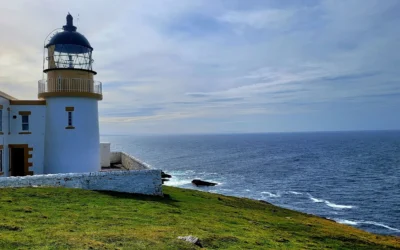
Stoer Lighthouse
Stoer Lighthouse: On Scotland's NC500, Two Miles From the Old Man of Stoer Two miles north of Stoer Lighthouse, the cliff edge drops away and the Old Man of Stoer rises from the sea — a 62-metre sandstone stack, sheer on all sides, standing apart from the headland as...
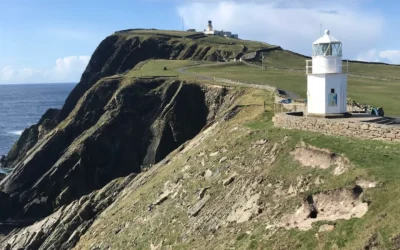
Sumburgh Head Lighthouse
Sumburgh Head Lighthouse: Robert Stevenson's 1821 Beacon on Shetland's Puffin Cliffs At the southernmost tip of Mainland Shetland, where the North Sea and the Atlantic meet in the turbulent tidal race known as the Sumburgh Roost, Robert Stevenson — the founder of the...
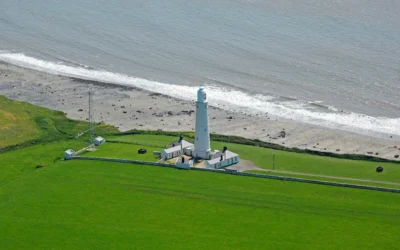
Nash Point Lighthouse
Nash Point Lighthouse: The Last Light in Wales to See Its Keeper Go In 1998, the keeper at Nash Point Lighthouse on the Glamorgan Heritage Coast turned off the oil lamps for the last time, handed the keys to Trinity House and walked away, making Nash Point the last...
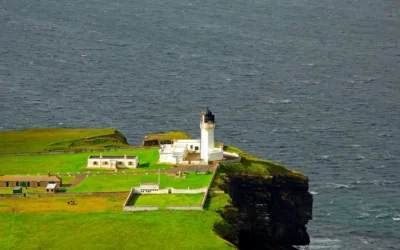
Noss Head Lighthouse
Noss Head Lighthouse: A North Coast 500 Gem With a World-First Lantern On the Noss Head peninsula three miles north-east of Wick, a lighthouse stands above Sinclairs Bay that is less famous than it deserves to be. When Alan Stevenson designed the lantern room here in...
Mull of Galloway Lighthouse
Mull of Galloway Lighthouse: Scotland's Southernmost Beacon, With Four Countries in View At the very tip of the Rhinns of Galloway — the long, narrow peninsula that stretches south from Stranraer like a finger pointing towards Ireland — Scotland ends at a set of sheer...