
Henrhyd Falls
Henrhyd Falls: South Wales' Tallest Waterfall — and the Batcave
The path descends steeply from the car park through sessile oak and ash woodland, and the sound of the water grows before the falls are visible. Then the gorge opens, and Henrhyd Falls drops the full ninety feet of the Nant Llech in a single unbroken curtain of white water into the dark, moss-wrapped gorge below. It is the tallest waterfall in South Wales, and arguably the most dramatic.
What makes Henrhyd different from most UK waterfalls is the geology: the hard sandstone lip known as the Farewell Rock — named by coal miners who found little to mine beneath it — overhangs the gorge just enough to allow visitors to walk behind the cascade. Standing in the alcove behind ninety feet of falling water, the Brecon Beacons pressing in on all sides, is one of the more extraordinary experiences in Welsh outdoors. It was precisely this quality that brought Christopher Nolan's film crew here in 2012, when Henrhyd Falls served as the entrance to the Batcave in The Dark Knight Rises.
Here is everything you need to plan a visit.
About Henrhyd Falls
Henrhyd Falls (Welsh: Sgwd Henrhyd) plunges 90 feet (27 metres) in a single drop where the Nant Llech — a small river in Powys — meets the Henrhyd geological fault and pours over the hard sandstone edge into the Graig Llech Gorge. It is the tallest waterfall in South Wales and the highest in the Bannau Brycheiniog (Brecon Beacons) National Park. The falls sit on the National Trust's Bannau Brycheiniog estate and are free to visit.
The Farewell Rock that forms the lip of the fall is part of the South Wales Coal Measures. The name comes from the mining history of the surrounding valleys: when coal miners digging downwards reached this hard sandstone layer, they knew to say farewell, as little coal lay below. The overhang it creates gives Henrhyd its signature quality — the walkway behind the curtain of water.
In the mid-1800s, the area was surveyed by geologist William Logan, who was mapping the South Wales coalfields. He discovered two fossilised trees at the base of the falls — among the earliest known tree fossils — and donated them to Swansea Museum, where they can still be seen today. The falls have been retreating slowly up the valley since the last Ice Age, eroding the softer rock behind the hard sandstone lip; in that time, the gorge has moved around 165 feet (50 metres) upstream.
The surrounding Graig Llech Woods are a Site of Special Scientific Interest (SSSI), rich in mosses, ferns and ancient woodland flora sustained by the gorge's permanently damp microclimate. The National Trust manages both the woods and the falls.
Getting there
By car, Henrhyd Falls is reached via the National Trust car park at Dol Henrhyd, Coelbren (SA10 9PH). From Swansea, around 30 minutes away, take the A465 to Glynneath and then the A4221 towards Coelbren, following the brown National Trust tourist signs. From Cardiff, the A470 north and then the A465 brings you to the same approach. The final stretch is on narrow country lanes — drive cautiously and allow extra time in peak season, when campervans and summer traffic can cause delays.
By public transport, Neath has a mainline railway station with connections from Cardiff, Swansea and further afield. From Neath, the X8 Cymru Clipper bus runs to Coelbren; from the village it is a one-mile walk along Dol Henrhyd Road to the National Trust car park. Check the current bus timetable before travelling, as services are infrequent.
If you are coming from further afield and prefer not to drive the narrow lanes, a local transfer is available from Neath or Swansea.
Compare Transfers & Local Transport in South Wales →
Where does the name come from?
Sgwd is the Welsh word for a waterfall or cascade — the same word found in the names of many Brecon Beacons waterfalls, including Sgwd yr Eira and Sgwd Clun-Gwyn. Henrhyd translates as "old ford": hen means old, and rhyd means ford — a river crossing. The name almost certainly refers to an ancient crossing point on the Nant Llech upstream, a reminder that people have been moving through this valley for a very long time.
The walk and the trails
From the National Trust car park, the main path to the falls (around 1.5 km / 1 mile return, 20–30 minutes) passes through two wooden gates, descends steeply through oak and ash woodland and reaches a junction at the bottom. Turning left, a wooden footbridge built in 1985 by international volunteers crosses the Nant Llech. Steep wooden steps — added in 2001 after a landslide destroyed the original path — lead up the other side, and a footpath continues roughly 300 metres to the falls.
A sign marks the official viewpoint. Beyond it, a narrow path continues under the overhanging cliff and into the alcove behind the falls — this section is at visitors' own risk, as there is a possibility of falling rocks. The rock is permanently wet and slippery; take real care, particularly in wet conditions, and be aware that you will get wet from the spray.
The longer Nant Llech Valley walk (around 3.6 miles / 5.8 km return, 1.5–2 hours, moderate) continues past the junction at the bottom of the main path, following the Nant Llech upstream through the gorge woodland. The valley is quieter than the falls, with smaller cascades along the way and the ruins of the disused Melin Llech watermill partway through. The path can be slippery and is less well-maintained than the main falls path — good boots are essential.
Parking
The National Trust car park at Dol Henrhyd (SA10 9PH) is the only practical parking option — it is free and holds around 15–20 cars. It fills very quickly on summer weekends, bank holidays and school holidays; arriving before 9 am is the surest way to get a space. A privately run overflow car park sometimes operates adjacent to the main lot; check the current position on site.
There are no toilets at the car park or on the trail. The nearest facilities are in the villages of Coelbren and nearby Pen-y-Cae.
Facilities
There are no permanent facilities at Henrhyd Falls — no toilets, no café, no National Trust shop. During busier visitor periods, a food truck sometimes operates near the car park (check locally for current days and times), but this cannot be relied upon.
Come fully self-sufficient for the visit: food, water, waterproofs and suitable footwear should all be prepared in advance. The nearest facilities are in Coelbren village, about a mile from the car park.
Things to know before you go
Best time to visit. After heavy and sustained rain for the most dramatic flow. The falls can be impressively full in autumn and winter; in a dry summer spell they can reduce to a light flow, though the setting remains beautiful. The most dramatic experience behind the falls (when that is possible) tends to come in late spring and early summer, when water is sufficient but not so heavy that the path behind becomes dangerous.
The walk behind the falls. Possible in good conditions, at your own risk beyond the official sign. The path is narrow and permanently wet; rocks are slippery and there is a genuine risk of falling rocks from the cliff above. Never attempt it if the falls are in full spate or the rock is icy, and keep children close at all times.
Dogs. Dogs are welcome on short leads. Take poo bags; the car park and path are well used.
Accessibility. The path is steep, uneven and stepped, and is not suitable for wheelchairs or pushchairs. There are viewing points along the upper trail for those who cannot manage the full descent.
Families and safety. Suitable for families with older children comfortable on steep, wet terrain. The main hazards are the slippery steps and path, the spray at the falls, and the loose rock if you walk behind the curtain.
Swimming. A natural plunge pool exists at the base of the falls. Wild swimming does take place here, but strong currents, cold water and the variable flow (which increases dramatically after rain) make it genuinely risky. Exercise real caution.
Where to stay
The nearest larger centres are Swansea (~30 minutes) and Brecon (~30 minutes), both offering a wide range of accommodation and good facilities. Swansea is convenient for visitors combining Henrhyd Falls with the Gower Peninsula; Brecon suits those exploring the national park more widely.
Find Hotels & Stays in Brecon →
What to pack
The steep descent and the permanently wet environment at the falls make kit more important than the short distance might suggest.
- A pair of waterproof walking boots with good ankle support and grip — the wooden steps and the path to the falls are wet and slippery year-round.
- A waterproof jacket and waterproof trousers — you will get spray on the path to the falls, and potentially soaked if you walk behind the curtain.
- A pair of binoculars for the dipper, kingfisher, woodpecker and warbler that frequent the gorge woodland.
- A travel tripod for long-exposure shots in the shaded gorge — the depth and drama of Henrhyd repays careful photography.
An OS Explorer OL12 map, snacks and water for the valley extension, and a first-aid kit complete the sensible kit list.
Nearby attractions and making a day of it
Henrhyd Falls sits on the western fringe of the Brecon Beacons, close to some of the national park's other great natural features.
| Attraction | Why Visit | Distance |
|---|---|---|
| Waterfall Country & Four Waterfalls Walk | A classic ~5-mile circular walk visiting four dramatic Nant Mellte waterfalls including Sgwd yr Eira, another waterfall you can walk behind | ~20 minutes' drive |
| Dan yr Ogof National Showcaves | The largest showcave complex in northern Europe — three cave systems open to the public, with a dinosaur park | ~3 miles |
| Craig y Nos Country Park | Peaceful country park in the upper Swansea Valley, on the National Trust estate, with riverside walks and lake views | ~4 miles |
| Pen y Fan | The highest peak in South Wales (886m) — the Brecon Beacons' iconic summit, with well-maintained paths from the Pont ar Daf car park | ~17 miles |
| Swansea & Gower Peninsula | Wales' second city and the adjacent Gower — the first UK Area of Outstanding Natural Beauty — with beaches, coastal walks and the Dylan Thomas Centre | ~30 miles |
For a full day in this corner of the Beacons, walk to Henrhyd Falls in the morning, continue on the Nant Llech valley trail, and then drive to Dan yr Ogof Showcaves or Craig y Nos Country Park in the afternoon.
Browse Brecon Beacons Tours & Experiences →
Photography tips
Henrhyd Falls is one of the most photographic waterfalls in Wales. The gorge frames the fall perfectly from the front — a full-height, head-on view with the dark sandstone walls and lush ferns completing the composition.
For the famous behind-the-falls shot, the alcove gives you a curtain of translucent water with the gorge and sky visible through it; a wide-angle lens captures the full spread. Overcast conditions are better than direct sunshine, which creates harsh contrast in the narrow gorge. A tripod and slow shutter speed are essential — the gorge is deeply shaded and the water needs at least half a second to blur into silk.
After heavy rain, the falls are at their most powerful and the mist in the gorge adds atmosphere; the rocks are at their most treacherous, however, so balance photography ambitions against safety. Early morning in summer gives the best chance of having the falls to yourself.
Conclusion
Henrhyd Falls earns its place as the most dramatic waterfall in South Wales not just through its height, but through the combination of height, geology and accessibility that sets it apart. The short walk from the car park delivers more spectacle per step than almost anywhere in the Brecon Beacons; the walk behind the curtain, for those who attempt it safely, is genuinely unforgettable. Add the Batcave fame and the Victorian fossil trees and the Farewell Rock, and you have a site that rewards every kind of visitor.
FAQs
How tall is Henrhyd Falls?
Henrhyd Falls drops 90 feet (27 metres) in a single unbroken plunge, making it the tallest waterfall in South Wales and the highest in the Bannau Brycheiniog (Brecon Beacons) National Park.
Is there a fee to visit Henrhyd Falls?
No — both the falls and the surrounding woodland are free to visit. The National Trust car park is also free. An overflow car park may charge a small fee when the main car park is full; check on site.
What is the best time to visit Henrhyd Falls?
After heavy and sustained rain for the most impressive flow. Autumn and winter typically give the most powerful falls. In late spring and early summer, the flow is usually sufficient to experience the walk behind the falls without excessive risk.
Are dogs allowed at Henrhyd Falls?
Yes, dogs are welcome on short leads. Take poo bags.
Is Henrhyd Falls accessible for wheelchairs?
No. The path is steep, stepped and uneven, and is not suitable for wheelchairs or pushchairs. There are partial views from the upper path for those who cannot manage the full descent.
What are the parking options at Henrhyd Falls?
The free National Trust car park at Dol Henrhyd (SA10 9PH) holds around 15–20 cars. It fills very quickly on busy days — arrive early. An overflow car park sometimes operates nearby; check on site.
Can I walk behind Henrhyd Falls?
Yes, in good conditions and at your own risk beyond the official rockfall warning sign. The path behind the curtain is narrow, permanently wet and slippery, and there is a genuine risk of falling rocks. Never attempt it when the falls are in full spate or conditions are icy.
Can I swim at Henrhyd Falls?
There is a plunge pool at the base, and wild swimming takes place here. However, strong currents, cold water and dramatic increases in flow after rain make it genuinely hazardous. Take great care and never swim when the falls are in full spate.
What should I wear when visiting Henrhyd Falls?
Sturdy waterproof boots with ankle support and good grip, a waterproof jacket and waterproof trousers. The path is steep and wet, and you will encounter spray at the falls.
Was Henrhyd Falls really in a Batman film?
Yes. Henrhyd Falls was used as the exterior of the Batcave in The Dark Knight Rises (2012), the final film in Christopher Nolan's Batman trilogy. In the film, it is the scene where detective John Blake (played by Joseph Gordon-Levitt) discovers the hidden entrance to the cave.
What's nearby?
The Four Waterfalls Walk and Waterfall Country (~20 minutes' drive), Dan yr Ogof National Showcaves (~3 miles), Craig y Nos Country Park (~4 miles), and Pen y Fan (~17 miles).
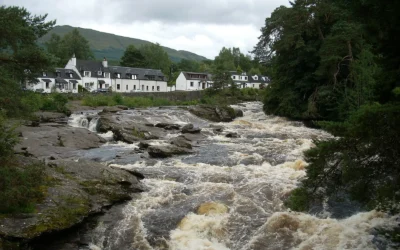
Falls of Dochart
Falls of Dochart: The Waterfall at the Heart of a Village Most waterfalls require a walk to find. The Falls of Dochart require no such effort at all — they run directly through the centre of Killin, beneath the old stone Bridge of Dochart, in full view of the...
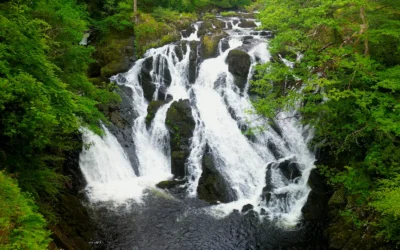
Swallow Falls
Swallow Falls: Wales' Highest Continuous Waterfall The River Llugwy has been performing for visitors at Swallow Falls for well over a century, and it still knows exactly what it is doing. The water tumbles 42 metres through a narrow, tree-lined gorge in a sequence of...
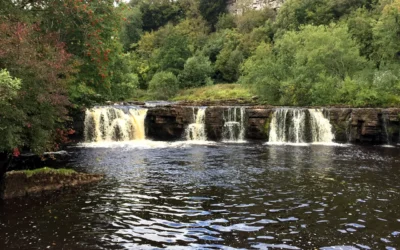
Wain Wath Force
Wain Wath Force: The Broadest Waterfall in Upper Swaledale Wain Wath Force will never win a prize for height. The River Swale drops only around a metre and a half here, sliding gently over a wide limestone ledge beneath the pale cliffs of Cotterby Scar. But what it...
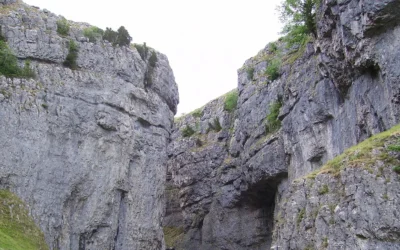
Gordale Scar
Gordale Scar: The Gorge That Stopped Wordsworth in His Tracks There is a moment as you walk the flat, pleasant path from Malham when the gorge closes around you without warning. The sky narrows to a strip above. The walls rear up on either side — overhanging...
Low Force
Low Force: Teesdale's Most Peaceful Waterfall High Force gets the crowds. Low Force gets the quiet. Just a mile and a half downstream from its more famous neighbour, where the River Tees spreads wide across a series of 18-foot cascades over the Whin Sill...