
Edinburgh Castle
Edinburgh Castle: A Thousand Years Above the Capital, on Scotland's Volcanic Rock
Castle Rock rises 130 metres above Edinburgh on a volcanic plug formed 350 million years ago — three sides sheer cliff, the fourth a long ridge descending to what became the Royal Mile. On this rock, a fortress has stood for almost a thousand years, and before the fortress there was human occupation going back to the Iron Age.
Edinburgh Castle has been besieged more times than any other place in Britain: taken by the English in 1174, recaptured by the Scots, besieged again and again through the Wars of Scottish Independence, the Civil War and the Jacobite Risings.
It has been a royal palace, a military headquarters, a prison and a national monument. It is the most visited paid attraction in Scotland, and from its battlements the view across the city — the New Town laid out below, the Forth glittering to the north, Arthur's Seat rising to the east — is one of the finest from any castle in Britain.
Edinburgh Castle sits at the top of the Royal Mile in the heart of Edinburgh's Old Town, which together with the New Town forms a UNESCO World Heritage Site. Behind its walls lie the oldest surviving building in Edinburgh, the oldest Crown Jewels in Britain and the Stone of Destiny, on which Scottish monarchs were crowned. This guide covers everything you need to plan your visit.
Where Is Edinburgh Castle?
Edinburgh Castle is at the top of the Royal Mile, in the heart of Edinburgh's Old Town, at the Esplanade, Edinburgh, EH1 2NG. From Waverley Station — Edinburgh's main railway station, directly below the castle — it is a 10 to 15 minute uphill walk along the Royal Mile or the more direct climb via the steps.
By tram from Edinburgh Airport, services run directly to Princes Street in around 30 minutes; from there the castle is a short walk up the hill. Local buses serve the Royal Mile. There is no public parking at the castle itself — the nearest car park is Castle Terrace NCP; Blue Badge holders can park on the Esplanade, subject to availability.
A Brief History of Edinburgh Castle
The oldest evidence of occupation on Castle Rock dates to the Iron Age, but Edinburgh Castle's recorded history begins in the 12th century. King David I constructed St Margaret's Chapel here in the early 12th century — a simple Romanesque building dedicated to his mother, Queen Margaret of Scotland, who died on this rock in 1093. It is the oldest surviving building in Edinburgh.
The castle's history as a contested fortress runs through the entirety of Scottish medieval history. In 1174, it was captured by the English; it changed hands repeatedly during the Wars of Scottish Independence in the 13th and 14th centuries. It has endured more sieges than any other place in Britain — by some counts over 26 — earning its extraordinary designation as the most besieged place in the British Isles.
A defining moment came in 1566, when Mary Queen of Scots gave birth to the future King James VI in the Royal Palace within the castle walls. James would go on, in 1603, to inherit the English throne and unite the crowns of Scotland and England — the beginning of the process that led to Great Britain. The castle continued as a military garrison through the centuries, housing Napoleonic prisoners of war and undergoing enhancements after the Jacobite Risings.
The remarkable thing about Edinburgh Castle is that it has never stopped being used. Unlike most of the castles in this guide — which are heritage attractions set apart from the present — Edinburgh Castle is still, in a very real sense, in service: a garrison with serving soldiers, a national symbol still used for state occasions, and Scotland's most important historic building in continuous institutional occupation.
Architecture & Design
Castle Rock's natural geometry has shaped everything at Edinburgh. Three sides are sheer volcanic cliff, their defence requiring no human engineering. The fourth side — the long ridge descending east towards Holyrood — is where the defences concentrate: the gatehouse, the Portcullis Gate and the Half Moon Battery, the curve of its gun platform following the line of David's Tower, the original medieval keep destroyed in the Siege of 1573 and replaced with this massive artillery bastion.
Inside the rock's perimeter, the buildings span nine centuries. St Margaret's Chapel (early 12th century) is the oldest, its interior almost entirely Romanesque in character, barely larger than a room. The Great Hall, completed in 1511 for James IV, has a magnificent late-medieval hammerbeam ceiling and was the principal ceremonial chamber of the Scottish court.
The Royal Palace contains the Honours of Scotland — the Crown, Sceptre and Sword of State, the oldest set of Crown Jewels in Britain, which escaped the destruction that eliminated England's medieval regalia under Cromwell. Alongside them, in the same room, is the Stone of Destiny, the ancient coronation stone of Scottish kings, returned to Scotland from Westminster in 1996 after 700 years. The Scottish National War Memorial, built after the First World War, is among the most powerful such memorials in Britain.
Legends & Lore
Edinburgh Castle's ghost stories reflect its violent history with unusual specificity. The headless drummer boy, first reported in 1650, is said to appear when the castle is about to come under attack — a tradition rooted in a period when the castle was under constant military threat.
The phantom piper is perhaps the strangest account: a young piper was said to have descended into a tunnel beneath the castle and never returned, though his playing was reportedly heard for some time beneath the streets; it is one of the oldest Edinburgh ghost stories and shows no sign of fading.
The Grey Lady is associated with Janet Douglas, Lady of Glamis, who was burned on Castle Hill in 1537 on charges of witchcraft against King James V — charges widely considered at the time and since to be politically motivated. Her execution is documented historical fact; the ghost story built around her is folklore, told as part of the castle's long accumulated character.
The castle's screen career is modest compared to its cultural significance, but its profile in film and television — used as a backdrop for everything from historical drama to the famous Edinburgh Hogmanay celebrations broadcast annually — reflects its status as the visual symbol of Scotland.
Visiting the Castle
Edinburgh Castle is open daily throughout the year (closed Christmas Day and Boxing Day), with longer hours in summer than in winter. The scale of the site means that most visitors need at least two hours; three is more comfortable.
The Honours of Scotland and Stone of Destiny in the Crown Room are the undoubted highlight — the oldest Crown Jewels in Britain in the same room as the ancient coronation stone, with the history of both explained in detail. The One O'Clock Gun, fired daily (except Sundays) from Mills Mount Battery since 1861, remains one of the most satisfying of all Edinburgh's daily rituals; positioning yourself near the battery before 1pm is worth the slight rearrangement.
St Margaret's Chapel rewards a quiet visit — it is tiny, ancient and often uncrowded. The National War Museum covers four centuries of Scottish military history and is substantially better than most visitors expect.
Guided tours (approximately 30 minutes) are available for an additional fee and provide context that the audio guide, available in multiple languages, covers more fully. Photography is generally permitted, with restrictions in the Crown Room. On-site cafés serve food and drink throughout the castle — including light meals and snacks; visitors may also bring food, though check current policy on arrival. There is a gift shop. Booking tickets online in advance is strongly recommended for peak summer visits — the castle is Scotland's most visited paid attraction.
Check Tickets & Tour Times for Edinburgh Castle →
For current opening hours and prices, check the official Historic Environment Scotland website before your visit.
Where to Stay Near Edinburgh Castle
Edinburgh Castle does not offer visitor accommodation. Edinburgh itself has one of the widest ranges of accommodation in Britain, from budget hostels on the Royal Mile to five-star hotels in the New Town. Staying in the Old Town puts you within walking distance of the castle and the city's major attractions; the New Town is quieter and five minutes away.
Find Hotels & Stays in Edinburgh →
The Best Time to Visit
Spring (April to June) is outstanding at Edinburgh Castle — the days are lengthening, the views from the ramparts are clear and the visitor numbers are significantly lower than in July and August. Summer (July and August) brings the Edinburgh Festival and the world-famous Royal Edinburgh Military Tattoo on the Castle Esplanade — an extraordinary spectacle of military bands, music and drama against the castle backdrop, but also the busiest and most expensive period for the whole city. Book tickets for both the castle and the Tattoo well in advance.
Autumn (September to October) offers the city at its quietest and most atmospheric, with the Tattoo over and the summer crowds gone. Winter (November to March) brings shorter opening hours but also Edinburgh at its most characterful — the castle in frost or low cloud, the Hogmanay celebrations at the turn of the year.
How to Get There
On foot. From Waverley Station, the castle is a 10 to 15 minute walk uphill along the Royal Mile. It is visible from the station exits.
By tram. From Edinburgh Airport, trams run every 7 minutes to Princes Street in around 30 minutes, from where the castle is a 10-minute walk uphill.
By bus. Lothian Buses serve the Royal Mile and the Mound, both within easy walking distance of the castle.
By car. There is no public parking at the castle. The nearest car park is Castle Terrace NCP; Blue Badge holders can park on the Esplanade, subject to availability, with advance contact required.
Compare Transfers & Local Transport in Edinburgh →
Nearby Attractions
Edinburgh Castle sits at the top of the Royal Mile, which runs for a mile down to the Palace of Holyroodhouse — one of the finest heritage corridors in Britain.
| Attraction | Why Visit | Distance |
|---|---|---|
| Palace of Holyroodhouse | The official Scottish residence of the King — state apartments, abbey ruins and the Queen's Gallery | ~1 mile |
| St Giles' Cathedral | The medieval heart of Edinburgh's Old Town — free entry, outstanding Gothic interior, the Thistle Chapel | ~0.3 miles |
| Real Mary King's Close | Hidden 17th-century streets preserved beneath the Royal Mile — one of Edinburgh's most compelling underground experiences | ~0.3 miles |
| National Museum of Scotland | World-class museum covering Scottish history, science and culture — free entry | ~0.4 miles |
| Camera Obscura | A Victorian optical instrument with extraordinary views of the city — fun for all ages | Adjacent |
The Royal Mile from Edinburgh Castle to Holyroodhouse is one of the great heritage walks in Europe — give it a full half-day if you can.
Browse Edinburgh Tours & Day Trips →
Family & Accessibility
Families. Edinburgh Castle is one of the best family heritage experiences in Scotland. The One O'Clock Gun, the Crown Jewels, the great hammerbeam ceiling of the Great Hall, the National War Museum and the views in every direction from the ramparts all work exceptionally well for families with children of school age. Allow at least two and a half hours.
Accessibility. The castle's hilly volcanic site limits full wheelchair access, but a number of the main attractions are accessible and Blue Badge parking is available on the Esplanade. The official accessibility guide is comprehensive — check it before visiting to plan your route through the accessible areas. Only assistance dogs are permitted within the castle; other dogs are not admitted. Photography is permitted in most areas; the Crown Room is an exception.
Practical Tips
- Book tickets online in advance — it is cheaper than walk-up and guarantees entry at Edinburgh's most visited paid attraction.
- Wear comfortable walking shoes — the castle grounds involve significant uneven ground, cobbles and hills.
- Position yourself near the One O'Clock Gun before 1pm — it is fired daily (except Sundays) and the experience is brief but memorable.
- Pack a compact travel umbrella — the castle is fully exposed to Edinburgh's notoriously variable weather.
- Bring a portable power bank for a full day of photography and the audio guide.
- For the Royal Edinburgh Military Tattoo (August), book separately and well in advance — tickets sell out months ahead.
- Overseas visitor? Pack a UK travel adapter for Type G plugs.
Conclusion
Edinburgh Castle has been besieged more times than any other place in Britain, served as the birthplace of the king who united Scotland and England, holds the oldest Crown Jewels in the British Isles and fires a gun across the city every day at 1pm as it has since 1861.
It is not a preserved monument — it is a fortress still in institutional use, still garrisoned, still the symbol of Scotland in a way that no other building quite manages. On Castle Rock, 350 million years of geology support a thousand years of history, and the views from the ramparts on a clear day reach from the Pentland Hills to the Firth of Forth. This is where Scottish history lives.
Frequently Asked Questions
What are the opening hours of Edinburgh Castle?
The castle is open daily throughout the year, except Christmas Day and Boxing Day. Summer hours (April to September) are generally 9:30am to 6pm; winter hours (October to March) are generally 9:30am to 5pm. Check the official Historic Environment Scotland website for the current schedule.
How much does it cost to visit Edinburgh Castle?
Admission varies by age, with concession rates available, and online booking is cheaper than walk-up. Check the official website for current prices.
What are the Honours of Scotland?
The Crown, Sceptre and Sword of State — the oldest set of Crown Jewels in Britain, used at Scottish coronations since the 15th century. They survive because they were hidden during Cromwell's campaign to destroy the regalia; England's medieval Crown Jewels did not survive.
What is the Stone of Destiny?
The ancient coronation stone on which Scottish monarchs were crowned, taken to England by Edward I in 1296 and returned to Scotland in 1996. It is displayed alongside the Honours of Scotland in the Crown Room.
What is the One O'Clock Gun?
A cannon fired from Mills Mount Battery every day at exactly 1pm (except Sundays) since 1861, originally to allow ships in the Firth of Forth to set their chronometers. It is now one of Edinburgh's most beloved daily rituals.
Is Edinburgh Castle suitable for children?
Yes — the Crown Jewels, the Stone of Destiny, the One O'Clock Gun, the Great Hall and the sweeping views make it one of the best family heritage days in Scotland. Allow at least two and a half hours.
Is Edinburgh Castle wheelchair accessible?
The hilly volcanic site limits full wheelchair access, but several key attractions are accessible. Blue Badge parking is available on the Esplanade with advance notice. Check the official accessibility guide before visiting.
How do I get to Edinburgh Castle?
On foot from Waverley Station (10–15 minutes uphill along the Royal Mile). By tram from the airport to Princes Street (30 minutes), then a short walk. By car to Castle Terrace NCP (no castle parking).
What is the Royal Edinburgh Military Tattoo?
An annual spectacular held on the Castle Esplanade each August, featuring military bands, pipe and drum corps and performers from around the world, against the backdrop of the illuminated castle. Tickets sell out months in advance.
Is photography allowed at Edinburgh Castle?
Photography is permitted in most areas of the castle. There are restrictions in the Crown Room where the Honours of Scotland are displayed.
Audley’s Castle
Audley's Castle: The Free Tower House Above Strangford Lough, Where Game of Thrones Arrived In the first season of Game of Thrones, the fields and approaches to Castle Ward became Winterfell — the ancestral seat of the Starks. The fields around Audley's...
Kilwaughter Castle
Kilwaughter Castle: John Nash's Antrim Ruin, Declared Enemy Property in the Second World War In 1803, John Nash — the architect who designed Regent Street, remodelled Buckingham Palace and built the Royal Pavilion at Brighton — came to County Antrim and...
Shane’s Castle
Shane's Castle: The O'Neill Estate on Lough Neagh, Touched by John Nash and Twice Burned In 1809, John Nash — the architect who designed Regent Street, Carlton House Terrace and remodelled Buckingham Palace for George IV — began redesigning a castle on the...
Belfast Castle
Belfast Castle: The Free Victorian Castle Above the City, with Nine Hidden Cats The legend says the castle will be safe — or its residents will have good fortune — as long as a white cat lives within its walls. The castle's response to this piece of local...
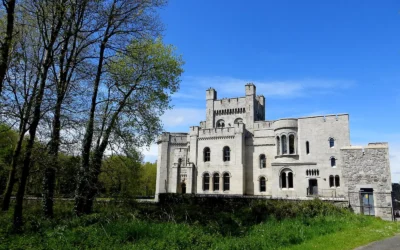
Gosford Castle
Gosford Castle: Ulster's Largest Listed Building — and Game of Thrones' Riverrun When Robin Fedden of the National Trust surveyed Gosford Castle in 1952, he described it as "one of the most original buildings of its time" and noted that it had...