
Blackhead Lighthouse
Blackhead Lighthouse: The Titanic Passed Here, and You Can Stay the Night
In April 1912, RMS Titanic — built at Harland and Wolff’s yards on Queen’s Island in Belfast, launched in 1911 and fitted out over the following months — left Belfast Lough for the last time on her sea trials and then her departure to Southampton. Blackhead Lighthouse, standing on its clifftop above the northern entrance to the lough, was one of the last Irish lights the Titanic saw. The lighthouse had been guiding ships out of Belfast for just ten years when the most famous ship in history passed beneath its beam.
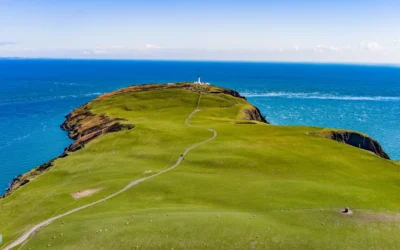
The lighthouse was first lit on 1 April 1902 and still stands above the cliffs of County Antrim at Whitehead, on the Causeway Coastal Route, with Belfast Lough spreading away to the south and the North Channel to the north. The tower is not open to visitors, but three restored lightkeeper’s houses — managed by the Irish Landmark Trust and deliberately kept WiFi-free — are available as holiday accommodation above one of the finest stretches of coastline in Northern Ireland. This guide covers everything you need to know about visiting and staying at Blackhead Lighthouse.
Where Is Blackhead Lighthouse?
Blackhead Lighthouse is situated in Whitehead, County Antrim, Northern Ireland, approximately 20 miles north of Belfast on the Causeway Coastal Route. From Whitehead, the lighthouse is reached via Old Castle Road, with a car park at BT38 9NE.
By public transport: a 40-minute train from Belfast Central to Whitehead station, followed by a 2.4-kilometre coastal walk along the Blackhead Path (which includes over 100 steps) or a short taxi ride. The Causeway Coastal Route connecting Whitehead, Carrickfergus and north towards the Giant’s Causeway is one of the world’s most celebrated coastal drives.
A Brief History of Blackhead Lighthouse
Getting a lighthouse at Blackhead was not straightforward. The Belfast Harbour Board applied for a lighthouse at this site in 1893 — the Commissioners of Irish Lights refused, on the grounds that it primarily benefited Belfast-bound ships rather than general navigation. A second application in 1898 was also refused. It was only after further advocacy from Lloyd’s of London and the Belfast Chamber of Commerce that the Board of Trade and Trinity House approved the construction.
Building began in 1899 and the lighthouse was first lit on 1 April 1902. It was designed by William Douglass and, unusually, was originally painted red — a striking choice that was changed to the familiar white in 1929. The lighthouse was electrified in 1965, increasing its beam range to 27 nautical miles. It remains an active navigational aid, managed by the Commissioners of Irish Lights, one of the three General Lighthouse Authorities covering the British Isles.
The Titanic connection is worth dwelling on. The ship was built in Belfast and spent nearly a year being fitted out at Harland and Wolff before her sea trials in Belfast Lough in April 1912. As she left the lough and headed south towards Southampton — and from there, on 10 April, towards New York — she passed Blackhead. The lighthouse that took nine years of campaigning to build had been standing for only a decade when it guided the most famous ship in the world out of Irish waters for the last time.
Architecture & The Light
Blackhead Lighthouse is a 16-metre (53-foot) octagonal tower, white since 1929, with a lantern room positioned 45 metres above mean high water — giving the beam a commanding view over Belfast Lough and the North Channel. The tower houses a 920mm catadioptric annular lens (a Fresnel lens), paired with modern MBI lamps, producing a beam visible for 27 nautical miles.
The octagonal design, the elevated cliff position and the white-painted exterior make Blackhead an elegant and distinctive lighthouse on this stretch of Antrim coastline.
Visiting the Lighthouse
The lighthouse tower is not open to the public. The Blackhead Coastal Path — a recently restored 2.4-kilometre round trip from Whitehead — is freely accessible and offers outstanding coastal walking, with views of Belfast Lough, the Antrim cliffs and the sea caves below. The path includes over 100 steps and requires moderate fitness.
Guided coastal walks are available, led by local historians, covering the area’s wildlife, geology and local legends — including the stories of the sea caves. Belfast Lough is designated an Area of Special Scientific Interest for its birdlife, and wildlife sightings along the path are common.
Staying at the Lighthouse
Three restored lightkeeper’s houses managed by the Irish Landmark Trust are available as holiday accommodation at Blackhead Lighthouse. The Irish Landmark Trust is a charity devoted to the preservation of historic buildings in Ireland, and their Blackhead properties are furnished with antique furniture, lighthouse memorabilia and warm, carefully considered interiors. Crucially — and unusually — these properties are WiFi-free, making them among the few lighthouse holiday lets in the British Isles specifically designed as digital retreats.
Guests at Blackhead have praised the fresh flowers, the collections of books and the atmosphere of genuine historic warmth — the kind of stay that is becoming increasingly rare in an age of connected accommodation.
|
Accommodation |
Sleeps |
Features |
|
Lightkeeper’s House (large) |
7 |
Antique furniture, lighthouse memorabilia, Belfast Lough views, WiFi-free |
|
Lightkeeper’s House (medium) |
5 |
Antique furniture, lighthouse memorabilia, Belfast Lough views, WiFi-free |
|
Blackhead Cutter (cottage) |
4 |
Standalone cottage, same character and features, WiFi-free |
All three properties can be booked together for larger group gatherings — combined capacity 16 guests. A minimum two-night stay applies. As pricing varies by season, check current rates with the Irish Landmark Trust at the time of booking.
Find Lighthouse & Coastal Stays Near Belfast Lough →
The Best Time to Visit
Spring (April to June) is excellent for the coastal wildlife on Belfast Lough — terns, cormorants and fulmars are active, and dolphins and porpoises are regularly seen offshore. Summer (July to August) brings the best weather and the longest days for the Causeway Coastal Route, and minke whales are occasionally spotted on Belfast Lough in the warmer months.
Autumn (September to October) is quieter on the Causeway Route and offers dramatic coastal light. Winter (November to March) is a particularly fine time for the WiFi-free experience — the antique interiors, the lighthouse views and the coastal wildness create an atmosphere that is genuinely restorative.
How to Get There
By train. A 40-minute journey from Belfast Central to Whitehead station, then a 2.4-kilometre coastal walk (over 100 steps) or a short taxi ride to the lighthouse.
By car. From Belfast, take the coastal A2 north to Whitehead and follow signs for the Blackhead car park on Old Castle Road (BT38 9NE).
By Causeway Coastal Route. If driving the Causeway Coastal Route from Belfast towards the Giant’s Causeway, Whitehead and Blackhead are a natural first stop.
Compare Transfers & Local Transport in County Antrim →
Wildlife & The Coast
Belfast Lough is designated an Area of Special Scientific Interest, and the wildlife around Blackhead is exceptional. Seals are regularly seen on the rocks below the lighthouse. Dolphins and porpoises are seen from the coastal path throughout the year, and minke whales are occasionally spotted on the lough and in the North Channel in summer.
The lough’s birdlife is outstanding: terns, cormorants, fulmars, oystercatchers and a wide range of waders make Belfast Lough one of the most bird-rich coastal designations in Northern Ireland.
A pair of binoculars for wildlife watching is well worth bringing for the seals, dolphins and seabirds from the coastal path.
Nearby Attractions
Blackhead sits on the Causeway Coastal Route, with a remarkable range of attractions within easy reach.
|
Attraction |
Why Visit |
Distance |
|
The Gobbins Coastal Path |
One of Europe’s most dramatic coastal walks — cliffs, bridges, tunnels |
~5 miles |
|
Carrickfergus Castle |
One of the finest Norman castles in Ireland, well-preserved and on the Lough |
~7 miles |
|
Carrick-a-Rede Rope Bridge |
The iconic rope bridge over a 30-metre chasm above the Atlantic — our separate guide covers it |
~55 miles |
|
Giant’s Causeway |
UNESCO World Heritage Site — the extraordinary hexagonal basalt columns |
~60 miles |
|
Titanic Belfast |
The world’s largest Titanic exhibition, in the dock where she was built |
~20 miles |
A natural day out: walk the Blackhead Coastal Path in the morning, drive the Causeway Route to the Gobbins in the afternoon, then return for the evening calm above Belfast Lough.
Browse Causeway Coastal Route & Antrim Tours →
Safety & Accessibility
Safety. The coastal path includes over 100 steps and exposed clifftop sections — suitable for moderately fit walkers with appropriate footwear, but not suitable for those with mobility difficulties. Keep well back from the cliff edges and supervise children at all times. Coastal weather in County Antrim can be unpredictable; check the forecast before walking.
Accessibility. The lightkeeper’s houses are reached via the coastal path, which is not suitable for wheelchairs or pushchairs. Check with the Irish Landmark Trust for specific accessibility information.
Families. The lighthouse grounds and coastal path are excellent for older children. The sea caves, the wildlife and the Causeway Coastal Route’s wider attractions make Blackhead an excellent family base.
Practical Tips
- Embrace the WiFi-free experience — the Irish Landmark Trust properties at Blackhead are deliberately kept without internet connection. Bring books, board games and the ability to actually look at the sea.
- Wear waterproof walking boots for the Blackhead Path and the Gobbins — both are coastal cliff walks.
- Pack a waterproof walking jacket; Antrim coastal weather is notoriously variable.
- Bring binoculars for the seals, dolphins and Belfast Lough birdlife.
- Overseas visitor? The UK uses Type G plugs, so a UK travel adapter is essential for charging your devices.
- Visit Titanic Belfast — the exhibition in the dry dock where the ship was built is one of the finest museum experiences in Ireland, and the Titanic connection with Blackhead Lighthouse makes it a meaningful companion visit.
- Book the Gobbins tour in advance — this popular coastal walk has limited capacity and requires booking.
Conclusion
Blackhead Lighthouse took nine years of campaigning to build. It was lit in 1902 and watched the Titanic leave for the last time a decade later. The keepers’ houses, now managed by the Irish Landmark Trust and kept deliberately WiFi-free, offer an experience increasingly hard to find: a historic building, a remarkable coastal setting, antique furniture and the sound of the sea, with no digital distraction. The Causeway Coastal Route stretches north from Whitehead to the Giant’s Causeway; Belfast and Titanic Belfast lie 20 miles south. Blackhead sits between two of Northern Ireland’s greatest stories — and it has its own.
Frequently Asked Questions
What is the history of Blackhead Lighthouse?
The lighthouse was first lit on 1 April 1902, after the Belfast Harbour Board’s applications in 1893 and 1898 were both refused by the Commissioners of Irish Lights. Designed by William Douglass, the tower was originally painted red and repainted white in 1929.
Where is Blackhead Lighthouse located?
At Whitehead, County Antrim, Northern Ireland, approximately 20 miles north of Belfast on the Causeway Coastal Route.
Did the Titanic pass Blackhead Lighthouse?
Yes — the RMS Titanic, built at Harland and Wolff’s yards in Belfast, departed Belfast Lough in April 1912. Blackhead Lighthouse was one of the last Irish lights she passed as she headed south towards Southampton and her maiden voyage.
Can I stay overnight at Blackhead Lighthouse?
Yes. Three lightkeeper’s houses managed by the Irish Landmark Trust — sleeping 4, 5 and 7 guests respectively — are available as self-catering holiday accommodation. All are WiFi-free.
What is the Irish Landmark Trust?
An Irish charity devoted to the preservation and restoration of historic buildings throughout Ireland. Their Blackhead properties are furnished with antique furniture and lighthouse memorabilia, and are deliberately kept WiFi-free.
Why are the Blackhead properties WiFi-free?
The Irish Landmark Trust’s philosophy is to preserve the character of their historic properties and offer a genuine digital detox experience — guests are encouraged to disconnect and engage with the historic setting and the coastal environment.
What wildlife can I see at Blackhead Lighthouse?
Seals on the rocks, dolphins and porpoises from the coastal path, and the rich birdlife of Belfast Lough ASSI, including terns, cormorants, fulmars and oystercatchers. Minke whales are occasionally seen in summer.
Is Blackhead Lighthouse suitable for families?
Yes — the coastal path, the wildlife and the Causeway Coastal Route’s attractions are all excellent for families. The path includes over 100 steps; cliff edges require supervision of children.
How do I get to Blackhead Lighthouse from Belfast?
By train to Whitehead (40 minutes from Belfast Central), then a 2.4-kilometre coastal walk or short taxi ride. By car, take the A2 north from Belfast to Whitehead.
What is the Gobbins Coastal Path?
A dramatic coastal walk near Blackhead, featuring cliffs, bridges and tunnels — one of the most adventurous coastal walks in Europe. Book in advance as it has limited daily capacity.
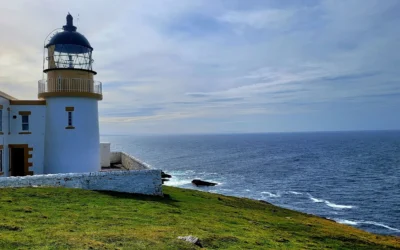
Stoer Lighthouse
Stoer Lighthouse: On Scotland's NC500, Two Miles From the Old Man of Stoer Two miles north of Stoer Lighthouse, the cliff edge drops away and the Old Man of Stoer rises from the sea — a 62-metre sandstone stack, sheer on all sides, standing apart from the headland as...
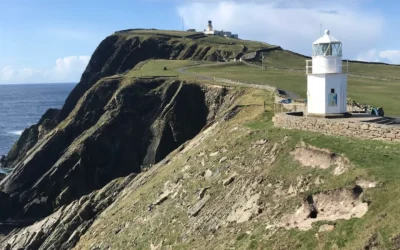
Sumburgh Head Lighthouse
Sumburgh Head Lighthouse: Robert Stevenson's 1821 Beacon on Shetland's Puffin Cliffs At the southernmost tip of Mainland Shetland, where the North Sea and the Atlantic meet in the turbulent tidal race known as the Sumburgh Roost, Robert Stevenson — the founder of the...
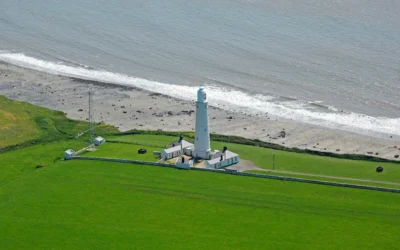
Nash Point Lighthouse
Nash Point Lighthouse: The Last Light in Wales to See Its Keeper Go In 1998, the keeper at Nash Point Lighthouse on the Glamorgan Heritage Coast turned off the oil lamps for the last time, handed the keys to Trinity House and walked away, making Nash Point the last...
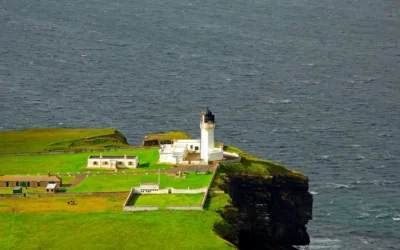
Noss Head Lighthouse
Noss Head Lighthouse: A North Coast 500 Gem With a World-First Lantern On the Noss Head peninsula three miles north-east of Wick, a lighthouse stands above Sinclairs Bay that is less famous than it deserves to be. When Alan Stevenson designed the lantern room here in...
Mull of Galloway Lighthouse
Mull of Galloway Lighthouse: Scotland's Southernmost Beacon, With Four Countries in View At the very tip of the Rhinns of Galloway — the long, narrow peninsula that stretches south from Stranraer like a finger pointing towards Ireland — Scotland ends at a set of sheer...