
Gosford Castle
Gosford Castle: Ulster's Largest Listed Building — and Game of Thrones' Riverrun
When Robin Fedden of the National Trust surveyed Gosford Castle in 1952, he described it as "one of the most original buildings of its time" and noted that it had "no immediate architectural predecessors." Thomas Hopper's 1819 design for Archibald Acheson, the 2nd Earl of Gosford — over 150 rooms of Norman Revival granite, with machicolations, battlements, turrets and a massive round tower housing a circular drawing room — was so singular that there was simply nothing else quite like it in Ireland.
The largest Grade A listed building in Ulster was, from its conception, completely unlike anything around it.
Gosford Castle is now private residences, and its interior is not accessible for public visits. But the surrounding Gosford Forest Park — 240 hectares of woodland, arboretum, rare breeds farm and trails around the castle's exterior — is free to visit.
And the castle itself served as Riverrun, the ancestral seat of House Tully, in HBO's Game of Thrones, giving it a contemporary recognition that adds to its architectural and historical significance. Jonathan Swift visited the earlier manor that stood on this site. The Armagh Observatory is 4 miles away. This guide covers everything you need to know.
Where Is Gosford Castle?
Gosford Castle is in Gosford, Markethill, County Armagh, Northern Ireland, approximately 1 mile from Markethill off the A28 road. From Belfast, allow around 50 minutes by car. From Dublin, around 70 minutes via the M3 and A509. Parking is available at the forest park, with a small fee.
Public transport options to Markethill are limited — driving is the most practical approach. Belfast International Airport and Dublin Airport are the nearest major hubs.
A Brief History of Gosford Castle
The Acheson family were granted land in County Armagh by King James VI & I in 1610 during the Plantation of Ulster. Their original castle was destroyed in the Irish Rebellion of 1641, and a manor house replaced it — the manor in which the satirist Jonathan Swift was a visitor in the early 18th century, leaving his mark in the layout of the gardens, including the feature known as Swift's Chair.
In 1819, Archibald Acheson, the 2nd Earl of Gosford, commissioned London architect Thomas Hopper to design a new castle. Construction proceeded from 1819 through the 1850s, with local architect Thomas Duff and later George Adam Burn contributing to the work. The result was a building of over 150 rooms — a Norman Revival country house of granite, with battlements, turrets, machicolations and a massive round tower that became one of the most original architectural statements in 19th-century Ireland.
The financial scale of the project was substantial, and the castle proved a burden to the family. The Earls of Gosford resided there until 1921, when the 4th Earl sold the castle's contents. The estate was subsequently purchased by the Ministry of Agriculture and became Gosford Forest Park. After decades of deterioration, the castle was sold in 2006 and converted into private residences. The forest park is managed by Armagh City, Banbridge and Craigavon Borough Council.
The castle has an unusual supplementary history: it was used as a prisoner of war camp during its military period, and at one point briefly served as winter quarters for a travelling circus — two of the more unexpected chapters in the story of Ulster's largest listed building.
The remarkable thing about Gosford is the ambition of its original conception. Hopper designed a building with no immediate predecessors in Irish or British architecture — something entirely new in the Norman Revival style that was developing in the 19th century.
Architecture & Design
Thomas Hopper's design for Gosford is the finest Norman Revival castle house in Ireland and among the most original in the British Isles. The castle's exterior presents an imposing granite mass with battlements, turrets and heavy machicolations — the projecting parapet openings from which missiles could be dropped on attackers, here deployed decoratively rather than defensively, though with complete period conviction.
The centrepiece is the massive round tower housing a circular drawing room — a spatial arrangement of considerable boldness in a house of this period. The three-storey keep and the variety of towers, turrets and subsidiary buildings create a silhouette of considerable complexity across its 150-plus rooms. The interior — not publicly accessible — was notable for its dining room in pink Armagh marble with white plaster decoration.
The castle's conversion to private residences has preserved the exterior fabric without restoring public access to the interiors.
Legends & Lore
Gosford Castle's most significant cultural connection is its role in Game of Thrones, in which it appeared as Riverrun — the ancestral fortress of House Tully. The combination of the granite Norman Revival exterior, the County Armagh countryside and the castle's scale made it the production's choice for one of the show's most politically significant locations. For fans of the series, Gosford is a genuine pilgrimage destination.
The earlier estate has the distinction of a literary connection: Jonathan Swift, author of Gulliver's Travels, was a visitor to the earlier manor house in the early 18th century. The garden feature known as Swift's Chair, in the grounds of Gosford Forest Park, commemorates his presence and his contribution to the landscape design of the estate.
Visiting the Estate
Gosford Castle itself is private residences and is not open to the public for tours or visits. However, Gosford Forest Park — the 240 hectares of woodland and parkland surrounding the castle — is open daily and free to enter (a small parking charge may apply).
The forest park offers substantial visitor interest in its own right:
The Gosford Arboretum contains conifer and broadleaf trees over 150 years old, with a walkway through flowering shrubs and a historic sundial. The Rare Breeds Farm is one of the park's most popular features — visitors can see red deer, longhorn cattle, rare sheep breeds, peacocks and gentle draught horses. Walking and cycling trails wind through diverse woodland, millponds and open spaces. A children's play area is near the visitor car park.
The castle's exterior — including its battlements, turrets and machicolations — is visible and photographable from the park. Photography of the exterior is permitted.
Note: The castle interior cannot be entered or photographed, as it is private residences. Respect the privacy of residents at all times.
Some private holiday accommodation within the castle building may occasionally be available — check specialist accommodation listing sites for current availability.
Explore County Armagh & Northern Ireland Tours →
For current park opening times and facilities, check nidirect or the Armagh City, Banbridge and Craigavon Borough Council website before your visit.
Where to Stay Near Gosford Castle
Markethill (1 mile) is the nearest village. Armagh city (around 5 miles) is the most convenient base with hotels, guesthouses and the widest range of amenities — and is worth a stay in its own right for its two ancient cathedrals, the Observatory and the Palace Demesne.
Find Hotels & Stays in Armagh →
The Best Time to Visit
Spring (April to June) is the finest time for Gosford Forest Park — the arboretum is in new growth, the rare breeds farm is lively and the woodland is at its most vivid. Autumn (September to October) brings the arboretum's 150-year-old trees into autumn colour.
Summer (July to August) is busiest; weekdays are generally quieter than weekends.
How to Get There
By car. From Belfast, take the M1 south to the A28 towards Armagh, then follow signs for Markethill and Gosford Forest Park — around 50 minutes. From Dublin, the M3/A509 takes approximately 70 minutes. Parking at the park (small fee may apply).
By public transport. Options to Markethill are limited. The nearest bus connections are from Armagh, with taxis covering the remaining distance.
Compare Transfers & Local Transport in County Armagh →
Nearby Attractions
County Armagh is the ecclesiastical capital of Ireland, with a concentration of religious, heritage and scientific sites unmatched in Northern Ireland.
| Attraction | Why Visit | Distance |
|---|---|---|
| Armagh City (Two Cathedrals) | Both the Roman Catholic and Church of Ireland cathedrals dedicated to Saint Patrick stand in Armagh — the ancient seat of Irish Christianity | ~5 miles |
| Armagh Observatory and Planetarium | One of Ireland's oldest scientific institutions, with public stargazing events and a state-of-the-art planetarium | ~4.5 miles |
| Palace Demesne, Armagh | The former Palace of the Church of Ireland Primate — a historic estate with parkland walks and the Armagh public park | ~4.5 miles |
| Navan Fort (Emain Macha) | The ancient capital of Ulster in Celtic mythology and one of the most significant archaeological sites in Ireland — a Neolithic hillfort of national importance | ~6 miles |
| Saint Patrick's Trail | A 92-mile touring route connecting sites associated with Ireland's patron saint, passing through Armagh | Adjacent |
A natural County Armagh day pairs Gosford Forest Park in the morning with Armagh's two cathedrals and the Observatory in the afternoon — Norman Revival castle, early Christianity and astronomy in a single county.
Browse County Armagh & Northern Ireland Tours →
Family & Accessibility
Families. Gosford Forest Park is excellent for families. The rare breeds farm, children's play area, woodland trails and the Game of Thrones connection work well for all ages. The park's 240 hectares give children substantial space for outdoor exploration.
Accessibility. The park's trails are generally open and accessible. Contact Armagh City, Banbridge and Craigavon Borough Council for specific accessibility information before visiting. Note that the castle itself cannot be entered.
Practical Tips
- Wear comfortable walking shoes — the forest park involves woodland and grass paths across 240 hectares.
- Pack a waterproof walking jacket for County Armagh's changeable weather.
- Bring a portable power bank for photography of the castle exterior, the arboretum and the rare breeds farm.
- The castle cannot be entered — it is private residences. Photography of the exterior is permitted; respect residents' privacy.
- Combine with Armagh city — the two cathedrals, the Observatory and the Palace Demesne are all within 5 miles and make this the best County Armagh full day.
- Visit the Rare Breeds Farm — the peacocks and draught horses are a highlight for visitors of all ages.
- Overseas visitor? Pack a UK travel adapter for Type G plugs.
Conclusion
Gosford Castle is the largest Grade A listed building in Ulster. Thomas Hopper designed it in 1819 as something with "no immediate architectural predecessors." Jonathan Swift walked the grounds of the earlier manor. The 4th Earl sold its contents in 1921. A travelling circus wintered here. Game of Thrones made it Riverrun. The interior is now private residences. And the forest park surrounding it, with its 150-year-old arboretum and rare breeds farm, is free to visit. Gosford is the kind of building that takes several sentences to explain and an afternoon to properly appreciate.
Frequently Asked Questions
Is Gosford Castle open to the public?
No — Gosford Castle is now private residences and is not open for public tours. Gosford Forest Park, surrounding the castle, is open daily and free to enter (small parking fee may apply).
What is Gosford Castle's connection to Game of Thrones?
Gosford Castle served as Riverrun, the ancestral seat of House Tully, in HBO's Game of Thrones. Its Norman Revival granite exterior and County Armagh setting made it the production's choice for one of the show's most important aristocratic locations.
What is special about Gosford Castle's architecture?
Gosford Castle is the largest Grade A listed building in Ulster, designed by Thomas Hopper in 1819. It was described by the National Trust in 1952 as "one of the most original buildings of its time" with "no immediate architectural predecessors." It has over 150 rooms and includes a massive round tower with a circular drawing room.
What is Gosford Forest Park?
A 240-hectare public park surrounding Gosford Castle, managed by Armagh City, Banbridge and Craigavon Borough Council. It includes a historic arboretum with trees over 150 years old, a rare breeds farm, woodland trails, a children's play area and millponds. Entry is free (parking fee may apply).
What is the Rare Breeds Farm at Gosford?
A working farm within the forest park where visitors can see red deer, longhorn cattle, rare sheep breeds, peacocks and draught horses — one of the most popular features of the estate for families.
Who was Jonathan Swift and what is his connection to Gosford?
Jonathan Swift (1667–1745) was the Irish author of Gulliver's Travels. He visited the earlier manor house on this estate in the early 18th century and is said to have contributed to the layout of the gardens. "Swift's Chair," a garden feature, commemorates his presence in the grounds.
Can I photograph Gosford Castle?
Photography of the exterior from the forest park is permitted. The interior cannot be accessed or photographed, as it is private residences. Always respect the privacy of residents.
How do I get to Gosford Forest Park?
By car from Belfast (around 50 minutes via M1/A28) or Dublin (around 70 minutes via M3/A509). Parking is available at the park, with a small fee. Public transport to Markethill is limited — driving is recommended.
Is there accommodation near Gosford Castle?
Armagh city (around 5 miles) has the widest range of hotels and guesthouses in the county. Some private holiday accommodation within the castle building may occasionally be available — check specialist sites for current listings.
Are dogs allowed at Gosford Forest Park?
Dogs on leads are generally welcome in the forest park. Check with the park management for any current restrictions, particularly around the rare breeds farm.
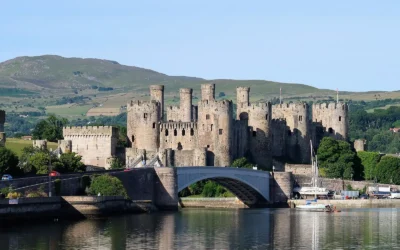
Conwy Castle
Conwy Castle: Eight Towers, Britain's Earliest Machicolations and a King in Hiding In 1399, King Richard II returned from Ireland to find his throne under threat from Henry Bolingbroke. He came to Conwy Castle — the massive fortress that Edward I had built in the...
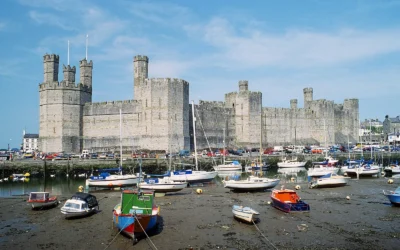
Caernarfon Castle
Caernarfon Castle: Edward I's Imperial Vision, Above the Menai Strait Edward I of England spent approximately £25,000 building Caernarfon Castle — a sum equivalent to around 90% of England's entire annual royal income. The construction took 47 years, from...
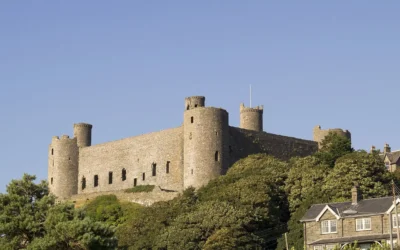
Harlech Castle
Harlech Castle: The Invincible Fortress That Fell to Owain Glyndŵr, Above the Bay In 1404, after four years of the most sustained Welsh uprising against English rule since the Conquest, Owain Glyndŵr took Harlech Castle — the fortress that Edward I had built in seven...
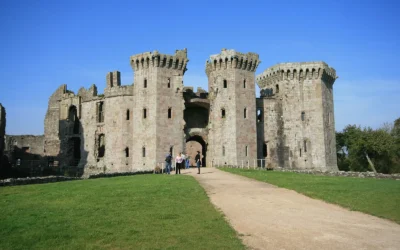
Raglan Castle
Raglan Castle: Where Henry Tudor Was Raised, Among Wales's Grandest Ruins Before Henry Tudor became King Henry VII of England — before he won the Battle of Bosworth in 1485 and founded the Tudor dynasty that would rule Britain for 118 years — he was a boy living...
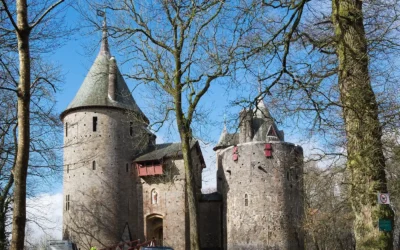
Castell Coch
Castell Coch: William Burges's Fairytale Towers, Rising from the Welsh Forest Above Cardiff The 3rd Marquess of Bute was the wealthiest man in Britain in the 1860s — the fortune built on Cardiff's coal docks, which had made the city the world's greatest...