
St John’s Point Lighthouse
St John’s Point Lighthouse: The Yellow-Banded Giant of County Down
In Van Morrison’s song “Coney Island,” the lighthouse at St John’s Point is mentioned in a list of the things that make the Irish coast of County Down feel like home — somewhere between the Mourne Mountains and the Strangford ferry. It is that kind of place: not famous in the way the Giant’s Causeway is famous, but known deeply by those who know this coast, woven into the landscape of the Lecale Peninsula and the Irish Sea beyond.
At 40 metres, St John’s Point is the tallest shore-based lighthouse in Ireland — the only lighthouse on land that exceeds it is the Fastnet, offshore in the Atlantic. What makes it immediately recognisable is its daymark: black and two vivid yellow bands that make it unmistakeable against the Irish Sea sky, quite unlike any other lighthouse in the British Isles. Two restored keepers’ cottages — managed by the Irish Landmark Trust and, like their Blackhead counterparts, kept deliberately without WiFi or television — are available for stays on this remote and beautiful peninsula. This guide covers everything you need to know about visiting and staying at St John’s Point.
Where Is St John’s Point Lighthouse?
St John’s Point Lighthouse is located in Killough, County Down, Northern Ireland, approximately 30 miles (48 km) south of Belfast and 9 miles (14.5 km) south of Downpatrick. To reach it, take the A24 from Belfast to Clough, then the A2 to Downpatrick, then follow the local roads through Killough to St John’s Point — a journey of around 45 minutes to an hour. The final stretch involves narrow rural roads, with a small parking area at the point itself. Public transport connects Belfast to Downpatrick via Translink; from there the point requires a taxi or local bus.
A Brief History of St John’s Point Lighthouse
St John’s Point Lighthouse was approved in 1839 by the Corporation for Preserving and Improving the Port of Dublin — the predecessor to the Commissioners of Irish Lights — and designed by George Halpin Senior, a prolific lighthouse engineer responsible for many of Ireland’s most important lighthouses. Construction was completed and the light first lit on 1 May 1844. The original tower was 13.7 metres tall with a range of 12 miles; it was extended to its present 40 metres in the late 19th century, transforming it into the dominant presence it is today.
The lighthouse’s history includes a remarkable incident involving one of the most important ships in the history of navigation. In 1846 — just two years after the lighthouse was lit — the SS Great Britain, Brunel’s revolutionary iron steamship (the world’s first ocean-going screw-propelled iron vessel), ran aground in nearby Dundrum Bay. The captain had made a navigational error using outdated charts and confused St John’s Point for another lighthouse. The Great Britain was eventually refloated and went on to serve for decades more; she now rests in Bristol as a museum ship. St John’s Point was, indirectly, one of the most significant incidents in her long career.
The most charming footnote in the lighthouse’s history belongs to 1950. Stephen Behan — the father of Brendan Behan, one of the 20th century’s most celebrated Irish writers and the author of Borstal Boy and The Quare Fellow — was employed to paint the lighthouse tower. According to the account, Brendan’s own contributions to the painting were judged inadequate by the lighthouse keeper. It is a small detail, but it places the lighthouse in the fabric of Irish cultural life in a way that few others can claim.
Architecture & The Light
St John’s Point is a 40-metre (130-foot) cylindrical tapering granite tower — the tallest shore-based lighthouse in Ireland, exceeded in height only by the offshore Fastnet Lighthouse. The daymark of black and two vivid yellow bands (established in the current form in 1954) makes it one of the most immediately recognisable lighthouses in Ireland. The lantern room houses a 920mm annular Fresnel lens producing two quick white flashes every 7.5 seconds, visible for 18 miles.
The light was originally white, changed to red in 1860 for navigational clarity, and has subsequently been adjusted. The lighthouse has been automated since 1981 and is maintained by a part-time attendant. The fog signal was discontinued in 2011.
Visiting the Lighthouse
The lighthouse tower is not regularly open to the public, though limited access during special events or by prior arrangement may be possible. The surrounding grounds are freely accessible, with the coastal setting, the dramatic daymark and the views of the Irish Sea and the Mourne Mountains making St John’s Point a rewarding destination for any coastal walk.
The ruins of a church dedicated to Saint John, dating to at least 1170, stand nearby on this historic peninsula, adding further historical depth to the site.
Staying at the Lighthouse
Two restored lightkeepers’ cottages — Ketch and Sloop — managed by the Irish Landmark Trust are available as self-catering holiday accommodation. Like the Trust’s properties at Blackhead, these are kept deliberately without WiFi or television — a genuine digital retreat on a remote Irish peninsula, with sea views, an outdoor patio and the lighthouse as the constant backdrop.
| Cottage | Sleeps | Features |
| Ketch | 4 | 1 double + 1 twin bedroom, kitchen/dining, sitting room, sea views, patio; no WiFi or TV |
| Sloop | 4 | 1 double + 1 twin bedroom, kitchen/dining, sitting room, sea views, patio; no WiFi or TV |
Both cottages have gas-fired central heating, a fully equipped kitchen and a bathroom with bath and walk-in shower. Pets are not permitted. Children should be supervised due to the coastal setting and the presence of farm animals — two ponies and chickens — in the grounds. A minimum two-night stay applies. Check current rates and availability with the Irish Landmark Trust at the time of booking.
Find Lighthouse & Coastal Stays Near County Down →
The Best Time to Visit
Spring (April to June) brings the seabirds back to the County Down coast and the best conditions for wildlife watching on Strangford Lough, with the Mourne Mountains clear against the spring sky. Summer (July to August) offers the warmest weather and the longest days, with Tyrella Beach nearby at its best. Autumn (September to October) brings dramatic skies over the Irish Sea and a quieter peninsula. Winter (November to March) is remote and elemental on this exposed southern point — the cottages’ gas heating and absence of digital distraction make for a genuinely restorative retreat.
How to Get There
By car. Take the A24 from Belfast to Clough, then the A2 to Downpatrick, then follow local roads through Killough to St John’s Point. Allow 45 minutes to an hour from Belfast.
By public transport. Translink services connect Belfast with Downpatrick; from Downpatrick, a local bus or taxi connects to Killough and the lighthouse.
Compare Transfers & Local Transport in County Down →
Wildlife & The Coast
The Lecale Peninsula and the nearby Strangford Lough are excellent for wildlife. Strangford Lough — an Area of Outstanding Natural Beauty — is one of the finest sea loughs in Ireland for seals (a large colony hauls out on the islands), wading birds and wildfowl, with diving birds abundant in winter. Grey seals are also seen around St John’s Point itself.
From the lighthouse headland, seabirds are visible throughout the year, and dolphins and porpoises pass through the Irish Sea in the warmer months. The Mourne Mountains, rising to the south-west, are often visible above the Irish Sea from the lighthouse grounds — one of the finest views in County Down.
A pair of binoculars for wildlife watching is well worth bringing for the seals, seabirds and the views to the Mournes.
Nearby Attractions
St John’s Point is an excellent base for exploring County Down’s remarkable range of attractions.
| Attraction | Why Visit | Distance |
| Strangford Lough | Area of Outstanding Natural Beauty — seals, seabirds, wildfowl, kayaking | ~10 miles |
| Tyrella Beach | A Blue Flag beach with clear water — swimming, surfing, kite-surfing | ~5 miles |
| Downpatrick | St Patrick’s Grave, Down Cathedral and Down County Museum | ~9 miles |
| Castle Ward (National Trust) | A Georgian mansion in the Strangford Lough landscape — also a Game of Thrones filming location | ~15 miles |
| Titanic Belfast | The world’s largest Titanic exhibition, 30 miles north | ~30 miles |
A natural day out: the lighthouse and coastal walk in the morning, Tyrella Beach for the afternoon, then Downpatrick and St Patrick’s Grave on the return.
Browse County Down & Strangford Lough Tours →
Safety & Accessibility
Safety. The access roads to St John’s Point are narrow rural lanes. The coastal terrain is rocky and uneven — sturdy footwear is essential. Keep well back from the water’s edge and supervise children near the shore.
Accessibility. The site is not suitable for those with mobility difficulties — the access road is narrow and the terrain uneven, and the cottages have steep stairs and low doorways. Confirm specific requirements with the Irish Landmark Trust before booking.
Families. The coastal walking, the wildlife and the nearby beaches at Tyrella and Rossglass are all excellent for families. Note that pets are not permitted in the cottages, and children require supervision around the resident farm animals.
Practical Tips
- Embrace the no-WiFi experience — the Irish Landmark Trust cottages at St John’s Point are deliberately kept without internet or television. Bring books, maps and a willingness to engage with the coast rather than a screen.
- Wear waterproof walking boots — the coastal terrain around St John’s Point is rocky and uneven.
- Pack a waterproof walking jacket; this exposed peninsula takes the full force of Irish Sea weather.
- Bring binoculars for the seals, seabirds and the Mourne Mountain views.
- Overseas visitor? The UK uses Type G plugs, so a UK travel adapter is essential for charging your devices.
- Visit Downpatrick and St Patrick’s Grave — one of the most significant Christian heritage sites in Ireland, just 9 miles away.
- Castle Ward (National Trust) is one of the finest houses on Strangford Lough and has additional appeal as a Game of Thrones filming location.
Conclusion
St John’s Point Lighthouse — the tallest shore-based light in Ireland, in its vivid yellow and black bands, at the tip of the Lecale Peninsula — has been a presence in this stretch of the Irish Sea since 1844. Van Morrison placed it in a song. Brendan Behan’s father painted it.
Brunel’s SS Great Britain came to grief nearby. And through all of it, the lighthouse has kept its light burning over the County Down coast, the Mourne Mountains behind, Dundrum Bay to one side and the Irish Sea ahead. To stay in Ketch or Sloop with no screens, no signal and the lighthouse outside the window is to be as completely in this particular corner of Ireland as it is possible to be.
Frequently Asked Questions
What is the history of St John’s Point Lighthouse?
Designed by George Halpin Senior and first lit on 1 May 1844, the lighthouse was built to prevent shipwrecks on the County Down coast. The original 13.7-metre tower was extended to 40 metres in the late 19th century. Automated in 1981.
Where is St John’s Point Lighthouse located?
At the southern tip of the Lecale Peninsula in Killough, County Down, Northern Ireland, approximately 30 miles south of Belfast and 9 miles south of Downpatrick.
What is the distinctive yellow and black design of St John’s Point?
The black and two yellow bands are the lighthouse’s daymark — a painted identification scheme used to make the tower recognisable by day. St John’s Point’s vivid yellow bands are among the most distinctive of any lighthouse in Ireland or Britain.
Can I stay overnight at St John’s Point Lighthouse?
Yes. Two Irish Landmark Trust cottages — Ketch and Sloop, each sleeping four — are available year-round. Both are WiFi-free and without television.
Why are the cottages WiFi-free?
The Irish Landmark Trust’s philosophy is to preserve the character of their historic properties and offer guests a genuine digital retreat — the same approach used at their Blackhead Lighthouse properties in County Antrim.
What is the SS Great Britain connection?
In 1846, Brunel’s revolutionary iron steamship the SS Great Britain ran aground in nearby Dundrum Bay. The captain mistook St John’s Point for another lighthouse due to outdated charts. The Great Britain was later refloated and is now preserved as a museum ship in Bristol.
What is the Van Morrison connection?
Van Morrison’s song “Coney Island” — a lyrical journey through the County Down landscape — mentions the lighthouse at St John’s Point, placing it in the fabric of Irish musical and cultural heritage.
What wildlife can I see near St John’s Point Lighthouse?
Grey seals around the headland, dolphins and porpoises in the Irish Sea, seabirds throughout the year, and the outstanding wildlife of Strangford Lough (seals, wildfowl, wading birds) nearby.
Is St John’s Point Lighthouse suitable for families?
Yes — the coastal walking, nearby beaches at Tyrella and Rossglass, and Strangford Lough are all excellent for families. Note that pets are not permitted in the cottages.
Is St John’s Point really the tallest lighthouse in Ireland?
It is the tallest shore-based lighthouse in Ireland. The Fastnet Lighthouse (on a rock offshore in the Atlantic) is taller, but as an offshore structure it is in a different category. St John’s Point is the tallest lighthouse built on land in Ireland.
Blackhead Lighthouse
Blackhead Lighthouse: The Titanic Passed Here, and You Can Stay the Night In April 1912, RMS Titanic — built at Harland and Wolff's yards on Queen's Island in Belfast, launched in 1911 and fitted out over the following months — left Belfast Lough for the last time on...
St Ann’s Head Lighthouse
St Ann's Head Lighthouse: The Last Shore-Based Light in Pembrokeshire, on the Tudor Coast In August 1485, a small fleet carrying Henry Tudor — exiled pretender to the English throne — rounded this headland and landed at Mill Bay, a sheltered cove just to the north of...
Point Lynas Lighthouse
Point Lynas Lighthouse: A Castle on the Cliffs of North Wales, Guiding Liverpool's Ships Since 1766 Most lighthouses are towers. Point Lynas is not. The lighthouse that stands on the rocky headland at the north-east corner of Anglesey is a low, castellated structure...
North Ronaldsay Lighthouse
North Ronaldsay Lighthouse: The UK's Tallest, Above the Island of the Seaweed Sheep Around the shoreline of North Ronaldsay — the northernmost and most isolated of the Orkney Islands — runs a drystone wall several miles long called the Sheep Dyke. Its purpose is...
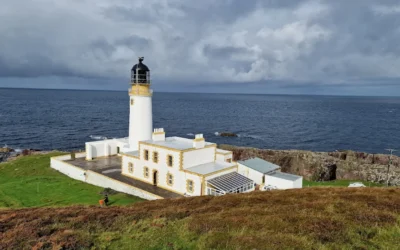
Rua Reidh Lighthouse
Rua Reidh Lighthouse: Wild Wester Ross Beacon Above Loch Ewe's WWII Convoys Three miles beyond the last village on a private track across the moorland of Wester Ross, where the headland of Rubha Rèidh — the Gaelic for flat headland — reaches out into the Minch, a...