
The Old Lighthouse Hunstanton
The Old Lighthouse Hunstanton: The Norfolk Beacon That Changed Lighthouse History
On St Edmund’s Point on the North Norfolk Coast, where the striped cliffs of Hunstanton — banded in layers of red chalk, white chalk and carstone — drop to the beach below and the vast tidal flats of The Wash stretch to the horizon, stands a lighthouse that has a claim to a remarkable place in maritime history. In 1776, the lighthouse that then stood on this spot became the first in the world to use parabolic reflectors, a technological breakthrough that transformed how lighthouses were able to project their beams and was subsequently adopted by lighthouse authorities across the world. The current white cylindrical tower, built by Trinity House in 1840, stands on ground that changed the science of navigation.
Decommissioned in 1921, the Old Lighthouse is now a luxury holiday let — one that accommodates up to eight guests, allows dogs, and offers an 82-stair climb to a 360-degree panorama of The Wash, the North Norfolk coast, and on a clear day the faint outline of Lincolnshire across the water. This guide covers everything you need to know about staying at and visiting the Old Lighthouse Hunstanton.
Where Is the Old Lighthouse Hunstanton?
The Old Lighthouse stands on St Edmund’s Point in Old Hunstanton, Norfolk, perched on the clifftop overlooking The Wash. It is approximately 10 miles from King’s Lynn and 40 miles from Norwich, accessible via the A149 coast road. The town centre of Hunstanton is a short drive or a pleasant 15-minute walk away.
The surrounding environment is distinctive — the striped cliffs of Hunstanton, banded in three colours of stone, are unlike any other chalk cliffs in England, and the vast tidal expanse of The Wash below is one of the most important wildlife estuaries in Britain. Nearby are the ruins of St Edmund’s Chapel, the medieval precursor to the lighthouse on this point.
A Brief History of the Old Lighthouse Hunstanton
The history of lighting St Edmund’s Point stretches back to 1665, when a pair of stone towers were first constructed here to guide ships safely into The Wash. For more than a century, sailors depended on these towers and on the earlier lights of St Edmund’s Chapel to navigate the treacherous sandbanks of the estuary.
The technological leap came in 1776, when the lighthouse on this site became the first in the world to be equipped with parabolic reflectors — curved mirrors that gathered the lamp’s light and projected it into a powerful directional beam, dramatically increasing the range and effectiveness of the light. The innovation was subsequently adopted by lighthouse authorities across Britain and Europe, transforming maritime safety worldwide. The current tower, built by Trinity House in 1840 and first lit on 3 September 1840, replaced the earlier structure and served ships navigating The Wash until its decommissioning in 1921.
After the light was extinguished the lantern was removed in 1922 and the lighthouse passed into other hands. Between 1934 and 1957 it served as a Royal Observer Corps observation post, monitoring the skies during the Second World War and the early Cold War years, and an additional storey was added during this time. Since 1965 it has been privately owned, and it is now a much-loved holiday let on the North Norfolk Coast.
The remarkable thing about the 1776 breakthrough is how completely it changed what a lighthouse could do. Before parabolic reflectors, a lighthouse lamp simply burned — its light radiating in all directions, much of it wasted into the sky and the sea. A parabolic reflector behind the lamp gathered that scattered light and bent it into a focused beam, multiplying its effective range. The lighthouse at Hunstanton was where this idea was first proven in practice. Every powerful lighthouse beam you have ever seen owes something to the experiment on this Norfolk cliff.
Architecture & The Light
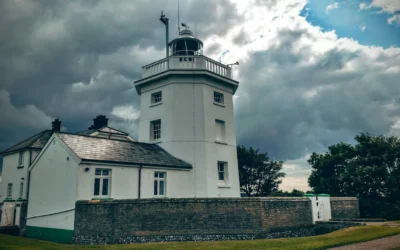
The Old Lighthouse is a handsome white-painted cylindrical brick tower standing 63 feet (19 metres) tall, with its light originally set 109 feet (33 metres) above sea level on the clifftop. Flanking the tower are two-storey gabled keepers’ houses, connected by castellated wings, giving the whole complex a pleasingly domestic and slightly romantic character that makes it one of the most architecturally charming lighthouse ensembles on the English coast. The building is Grade II listed, recognised for both its historical significance and its architectural merit.
As a decommissioned lighthouse — the lantern was removed in 1922 — the tower no longer functions as a navigational aid. But the 82-stair climb to the top remains, and the 360-degree views across The Wash from the summit make the ascent more than worthwhile.
Visiting the Lighthouse
The Old Lighthouse is a private holiday let and has no regular public opening. However, during special events such as Heritage Open Days, the site may open for guided tours — details of any such events are announced locally. Viewing the exterior from the surrounding cliff and coastal path is always free.
For guests staying at the lighthouse, the 82-stair climb to the top is a highlight of the stay, offering panoramic views of The Wash, the North Norfolk coast and the striped cliffs. Binoculars and a telescope are provided in the property for birdwatching, seal-spotting and general exploration of the extraordinary landscape spread out below.
There is no admission fee; access is through a booked stay.
Staying at the Lighthouse
The Old Lighthouse offers one of the largest and most luxurious lighthouse holiday lets in England — four en-suite bedrooms, sleeping up to eight guests, in a beautifully converted Grade II listed building on the clifftops above The Wash. It is privately owned and managed through a specialist holiday cottage agency.
The property is ideal for larger families or groups:
| Accommodation | Sleeps | Features |
| Old Lighthouse | 8 | 4 en-suite bedrooms, open-plan kitchen/lounge, spacious garden, patio, 82-stair tower climb, binoculars and telescope provided; dogs welcome (not in bedrooms) |
The open-plan lounge and fully equipped kitchen make it well suited for self-catering groups, and the spacious garden and patio add to the appeal. Optional extras and special arrangements may be available — enquire with the booking agent. Dogs are welcome, though not in the bedrooms.
As one of the finest lighthouse holiday lets on the Norfolk coast, it books up well ahead for the summer season and school holidays.
Find Lighthouse & Coastal Stays Near Hunstanton →
The Best Time to Visit
Spring (March to May) is a superb time on the North Norfolk Coast — the RSPB reserves are at their most dramatic with wading birds arriving and departing on migration, the seals are visible on the sandbanks of The Wash and the coast has a crisp, clean light before the summer crowds. Summer (June to August) offers the warmest weather, long evenings and the full bustle of the North Norfolk Coast’s holiday season; the lighthouse books up earliest for this period.
Autumn (September to November) is a favourite for birdwatchers — the RSPB reserves at Snettisham and Titchwell come into their own as huge flocks of wading birds gather on The Wash, and the reserve at Snettisham puts on one of Britain’s greatest wildlife spectacles at high tide. Winter (December to February) is quiet and beautiful on this coast, with The Wash at its most atmospheric and the lighthouse a cosy retreat from the North Sea weather.
Sunsets at Hunstanton are particularly special — one of the few east-coast locations in England where you can watch the sun set over the sea, as The Wash opens to the west.
How to Get There
By car. Follow the A149 coast road to Hunstanton and then to Old Hunstanton and St Edmund’s Point. The lighthouse is around 10 miles from King’s Lynn and 40 miles from Norwich.
By public transport. Buses run from King’s Lynn to Hunstanton town centre; from there the lighthouse is around a 15-to-20-minute walk or a short taxi ride to St Edmund’s Point.
On foot. The North Norfolk Coast Path passes through the area, and the clifftop walk from Hunstanton to St Edmund’s Point is one of the finest short coastal walks in Norfolk.
Compare Transfers & Local Transport in Norfolk →
Wildlife & The Coast
The Wash is one of the most important wildlife estuaries in Britain — a vast tidal expanse of sand and mudflat that supports internationally significant populations of wading birds and one of England’s largest colonies of grey seals. From the clifftop at St Edmund’s Point, seals are visible on the sandbanks of The Wash throughout the year, and the passage of wading birds — knot, dunlin, sanderling, oystercatcher — is spectacular at any season. Seabirds wheel along the cliffs, and the North Norfolk Coast is rightly famous for its birdwatching.
The RSPB reserves at Snettisham (a 10-minute drive) and Titchwell Marsh (around 20 minutes) are among the finest in England — Snettisham in autumn, when the rising tide pushes enormous flocks of knot and other waders onto the reserve pools, is a wildlife spectacle on a scale few places in Britain can match.
Binoculars and a telescope are provided at the property, but bringing your own pair of binoculars for wildlife watching means you will have them for the clifftop and the coastal path as well as from the tower top.
Nearby Attractions
The Old Lighthouse sits at the edge of the North Norfolk Coast, one of England’s finest Areas of Outstanding Natural Beauty, with much to explore.
| Attraction | Why Visit | Distance |
| Old Hunstanton Beach | A quiet, westward-facing beach below the striped cliffs — one of Norfolk’s finest | ~3-min walk |
| Hunstanton town centre | Victorian seaside town with beach, amusements, sea life centre and seafood | ~15-min walk |
| RSPB Snettisham | One of England’s great wildlife spectacles — vast wader flocks at high tide | ~10-min drive |
| RSPB Titchwell Marsh | Outstanding coastal reserve for birdwatching and waders | ~20-min drive |
| St Edmund’s Chapel ruins | Medieval precursor to the lighthouse — historic and atmospheric | Short walk |
A natural day out: climb the tower in the morning for the 360-degree Wash panorama, walk the clifftop path and visit St Edmund’s Chapel ruins, then head to RSPB Snettisham for the afternoon.
Browse North Norfolk Coast Tours & Boat Trips →
Safety & Accessibility
Safety. The cliffs at St Edmund’s Point are not as high as the great chalk cliffs of the south coast, but the cliff edges require care — stay on the paths and supervise children. The Wash is a tidal estuary and the beaches and sandbanks are subject to tidal changes; always check tide times before walking on the foreshore.
Accessibility. The lighthouse is accessible by road, with parking nearby. Climbing to the top of the tower requires ascending 82 stairs and reasonable physical fitness; it is not suitable for those with significant mobility difficulties. Dogs are welcome in the property but not in the bedrooms.
Families. The lighthouse is an excellent family destination — spacious enough for a large group, dog-friendly, with the beach, the tower climb, the seals and the RSPB reserves all making for an outstanding family coastal holiday.
Practical Tips
- Book well ahead — this 8-guest lighthouse is popular with large families and groups, and the summer season fills quickly.
- The tower climb (82 stairs) is a highlight of any stay — go at dusk or dawn for the most dramatic views over The Wash.
- Wear waterproof walking boots for the clifftop path and the North Norfolk Coast walks.
- Pack a waterproof walking jacket; the North Norfolk coast is exposed and the North Sea weather comes in fast.
- Overseas visitor? The UK uses Type G plugs, so a UK travel adapter is essential for charging your devices.
- Don’t miss the RSPB reserves at Snettisham and Titchwell — two of the finest birdwatching sites in England, both within easy reach.
- Check the tide times before walking on The Wash foreshore — tidal conditions change rapidly.
- Hunstanton’s westward-facing beach means you can watch the sun set over the sea — rare on England’s east coast.
Conclusion
The Old Lighthouse Hunstanton is where a quiet revolution in navigation began in 1776, and where the North Norfolk Coast and The Wash meet in one of the most distinctive coastal landscapes in England. To stay here — in a lighthouse that changed the science of the sea, with eight guests, a dog, the sunrise over The Wash and the tower to climb for the view — is to occupy a corner of England where history, wildlife and coastal beauty combine in a way that is very hard to find anywhere else on the Norfolk shore.
Frequently Asked Questions
What is the history of the Old Lighthouse Hunstanton?
A lighthouse has stood at St Edmund’s Point since 1665. In 1776, the lighthouse here became the first in the world to use parabolic reflectors, a landmark advance in lighthouse technology. The current tower was built by Trinity House in 1840 and decommissioned in 1921.
Where is the Old Lighthouse Hunstanton located?
On St Edmund’s Point in Old Hunstanton, Norfolk, overlooking The Wash — about 10 miles from King’s Lynn and 40 miles from Norwich.
Can I visit the Old Lighthouse Hunstanton?
As a private holiday let, it has no regular public opening. The exterior can be viewed from the surrounding paths. Heritage Open Days may occasionally offer access; check locally for details.
Can I stay overnight at the Old Lighthouse Hunstanton?
Yes. It accommodates up to 8 guests across 4 en-suite bedrooms. Dogs are welcome. Book through the specialist holiday letting agent; reserving well ahead is recommended.
Can I climb to the top of the Old Lighthouse Hunstanton?
Yes — guests can climb the 82 stairs to the top for 360-degree views of The Wash and the North Norfolk Coast. Binoculars and a telescope are provided.
What wildlife can I see near the Old Lighthouse Hunstanton?
Grey seals on The Wash sandbanks, huge flocks of wading birds (knot, dunlin, sanderling), seabirds along the cliffs and the full range of North Norfolk’s exceptional birdwatching at the nearby RSPB reserves at Snettisham and Titchwell.
What makes the Old Lighthouse Hunstanton unique?
Its role as the site of the world’s first use of parabolic reflectors in 1776, its Grade II listed architecture, its dramatic striped-cliff setting above The Wash, and its capacity for up to 8 guests make it quite unlike any other lighthouse stay on the Norfolk coast.
Is the Old Lighthouse Hunstanton suitable for families?
Yes — spacious enough for large family groups, dog-friendly, with a beach a short walk away, the tower to climb and exceptional wildlife watching nearby.
What are the nearest RSPB reserves to the Old Lighthouse Hunstanton?
RSPB Snettisham (about 10 minutes’ drive) and RSPB Titchwell Marsh (about 20 minutes) are both outstanding and among the finest birdwatching reserves in England.
How do I book the Old Lighthouse Hunstanton?
Through a specialist holiday cottage letting agent — Norfolk Coast Holiday Cottages and similar platforms manage bookings. Book as early as possible for summer and school holiday periods.
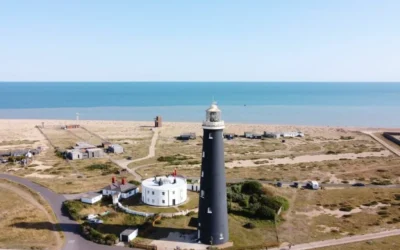
The Old Lighthouse at Dungeness
The Old Lighthouse at Dungeness: A Victorian Tower in Britain's Only Desert Dungeness is like nowhere else in Britain. A vast, flat headland of shingle — grey pebbles stretching to every horizon, sparse vegetation clinging to the stones, fishing boats drawn up on the...
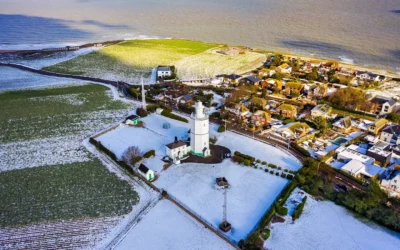
North Foreland Lighthouse
North Foreland Lighthouse: The Kent Beacon That Has Shone Since 1499 The Goodwin Sands lie seven miles offshore from the chalk cliffs of North Foreland, and they have been doing what they do for centuries: appearing and disappearing with the tides, drawing ships onto...
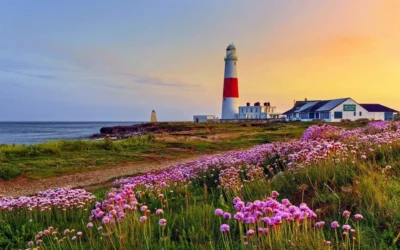
Portland Bill Lighthouse
Portland Bill Lighthouse: Red Stripes Above the Channel's Most Dangerous Race At the very tip of the Isle of Portland — a great block of Jurassic limestone connected to the Dorset mainland only by the eighteen-mile sweep of Chesil Beach — a red and white striped tower...
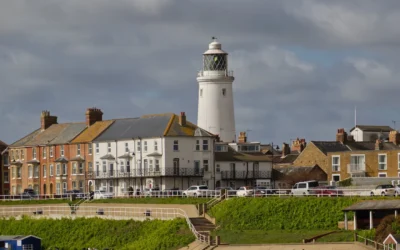
Southwold Lighthouse
Southwold Lighthouse: The Beacon at the Heart of a Suffolk Town Most lighthouses stand alone — on a cliff, a headland, a remote point of land where the sea has the upper hand. Southwold Lighthouse stands in the middle of a town. Walk along any of the streets radiating...
Cromer Lighthouse
Cromer Lighthouse: Standing 84 Metres Above the North Sea on the Cromer Ridge There is something quietly astonishing about the numbers at Cromer Lighthouse. The tower itself stands 18 metres tall — modest by lighthouse standards. Yet the light it projects sits 84...