
Sudeley Castle
Sudeley Castle: Where Henry VIII's Last Queen Rests, in the Heart of the Cotswolds
Of all the ways that the Tudor age has left its mark on the English countryside, perhaps the most intimate is this: in the churchyard of the small, beautiful St Mary's Chapel within the grounds of Sudeley Castle, near the Cotswolds village of Winchcombe, Katherine Parr lies buried.
She was the sixth and final wife of Henry VIII, the one who survived him, and she came to Sudeley in 1547 after the king's death to begin what she hoped would be a quieter life. She died here the following year, in 1548, in childbirth. She was thirty-five. Sudeley Castle is the only privately owned castle in England with a queen buried on its grounds.
Sudeley Castle has stood in the Cotswolds for over a thousand years, its current structure dating from 1443 when Ralph Boteler, Lord High Treasurer of England, built the castle in its present form. It passed through royal hands — Edward IV and Richard III both used it — before the Tudor connection that defines it today. Henry VIII visited here with Anne Boleyn in 1535.
His last queen died here thirteen years later. The castle's ten award-winning gardens, including the Queens Garden named for four Tudor queens, and its position in the Cotswolds above the valley town of Winchcombe make it one of the most complete and beautiful castle visits in the south-west of England. This guide covers everything you need to plan your visit.
Where Is Sudeley Castle?
Sudeley Castle is on the edge of Winchcombe, a small market town in the Cotswold Hills of Gloucestershire, approximately 8 miles north-east of Cheltenham. By car, it is around two hours from London, one hour from Birmingham and around an hour and a half from Oxford. The postcode for navigation is GL54 5JD.
By public transport, trains from London Paddington reach Cheltenham Spa in around two hours; from there, a taxi or bus to Winchcombe takes around 20 minutes. From Winchcombe, the castle is a short walk through the town.
A Brief History of Sudeley Castle
The site at Sudeley has been significant since Saxon times, but the castle in its present form was built in 1443 by Ralph Boteler, who served as Lord High Treasurer of England under Henry VI. Boteler's building was impressive enough to attract royal attention: it was seized by King Edward IV, who used it as a royal residence, and Richard III subsequently added the banqueting hall during his reign.
The castle's Tudor chapter is its most famous. Henry VIII and Anne Boleyn visited together in 1535. After Henry's death in 1547, his sixth wife Katherine Parr came to Sudeley — she had outlasted the king and, unusually for a Tudor queen, was free. She married Thomas Seymour and lived at Sudeley until her death in childbirth in September 1548. She was buried in the chapel of St Mary within the castle grounds, making Sudeley unique among privately owned English castles: it is the resting place of an English queen.
The English Civil War ended this royal association abruptly. Sudeley was a Royalist stronghold; Cromwell's forces besieged it twice and slighted the castle after its capture, leaving it in ruins. For nearly two centuries the castle stood derelict. The restoration of the 19th century, carried out by the Worcester glove-making family the Dents, brought Sudeley back to life, and the castle has been in private family ownership ever since.
The remarkable thing about Sudeley is the directness of its human connections. Katherine Parr is not a legend here — she is buried in the chapel. The chapel itself was restored in the 19th century, and her tomb, effaced by Cromwell's soldiers, was reinstated. Visitors stand a few feet from where an English queen has lain for nearly five hundred years.
Architecture & Design
Sudeley Castle's architecture reflects its long evolution. The 15th-century west wing and the family-occupied east wing frame courtyards that carry the character of each period of occupation. Particularly notable inside is the "Allegory of the Tudor Succession" painting, a rare Tudor work that draws together the monarchs and their religious politics in a single complex image. A sweeping staircase adorned with 16th- and 17th-century Dutch glass panels adds to the castle's visual richness.
The castle's ten gardens across 15 acres are arguably its most extraordinary feature. The Queens Garden is the centrepiece — a formal parterre garden named for the four Tudor queens with a connection to Sudeley: Anne Boleyn, Katherine Parr, Lady Jane Grey and Elizabeth I. The Knot Garden, the Tudor Knot and the Organic Kitchen Garden are among the other distinct garden spaces, each with its own character and season. The collection has won numerous awards and is considered among the finest castle gardens in England.
Legends & Lore
Sudeley Castle has accumulated its ghost stories over five centuries of occupation, abandonment and restoration. The most famous is the spirit of Katherine Parr herself, said to wander the corridors where she lived her final year; the proximity of her tomb in the chapel gives the tradition an unusual physical grounding.
Staff and visitors have also reported the presence of Janet, a Victorian housekeeper whose figure is said to appear on one of the staircases, and there are accounts of ghostly dogs — a black Labrador and King Charles spaniels — seen in the grounds and rooms. These stories are told as part of the castle's atmosphere rather than as documented fact, but in a building of this age and association they sit entirely naturally.
The Tudor connections are the real lore of Sudeley. A castle visited by Henry VIII and Anne Boleyn where his last wife subsequently died and is buried; the Queens Garden named for four queens whose lives intersected in violence and drama; and a chapel that Cromwell's soldiers desecrated and the Victorians restored — this is a history so concentrated that the ghost stories are almost redundant.
Visiting the Castle
Sudeley is open from mid-February to late autumn, Monday to Sunday. The visit encompasses the historic rooms — including exhibitions on the castle's Tudor and Civil War history, the "Allegory of the Tudor Succession" painting and the Dutch glass staircase — and the 10 award-winning gardens, which repay a substantial amount of time in their own right.
The Pheasantry is a distinctive additional attraction: a collection of rare and endangered birds — golden pheasants, peacocks and other species — kept in the castle grounds and forming an unusual complement to the gardens.
The St Mary's Chapel, where Katherine Parr is buried, is one of the most intimate and moving spaces in any English castle. The tomb, restored in the Victorian period, stands in a small, beautiful church within the castle walls; the effigy of the queen above the tomb is a Victorian replacement for the one destroyed by Cromwell's soldiers, but the grave beneath it is original. This is not a museum. A queen lies here.
The castle has a café for refreshments and a gift shop. It is a private family home, and admission is seasonal. Photography policies vary by area — check with staff on arrival for current guidance. Free entry is provided for carers accompanying disabled visitors.
Check Tickets & Tour Times for Sudeley Castle →
Check the official Sudeley Castle website for current opening dates, times and prices before you travel.
Where to Stay Near Sudeley Castle
Sudeley Castle does not offer visitor accommodation. The town of Winchcombe, immediately adjacent, has a small number of hotels and bed and breakfasts, and is a rewarding base for an evening in the Cotswolds — its medieval streets, local independent shops and walking access to the surrounding hills make it one of the most pleasant of all the Cotswold towns. Cheltenham, 8 miles south-west, offers a much wider choice of accommodation and excellent restaurants.
Find Hotels & Stays in Winchcombe →
The Best Time to Visit
Spring (April to June) is outstanding at Sudeley — the Queens Garden and the wider gardens are at their most spectacular, the castle is lively with the season's opening energy and the Cotswolds countryside around Winchcombe is exceptional. Summer (July and August) brings the special events programme, including outdoor concerts, and the full gardens in their summer peak, though the castle is at its busiest.
Autumn (September to October) offers the quietest weekdays and the Cotswolds in golden autumn light — a particular pleasure at Sudeley, whose position above the Winchcombe valley becomes especially beautiful. The castle closes in late autumn before Christmas; check the official website for the current season.
How to Get There
By car. Sudeley is signposted from the B4632 near Winchcombe. From the M5, exit at Junction 9 for Tewkesbury and follow the B4632 through Winchcombe. From Cheltenham allow around 25 minutes.
By train. From London Paddington, trains reach Cheltenham Spa in around two hours; from Cheltenham, a taxi to Winchcombe takes around 20 minutes. From Winchcombe, the castle is a short walk.
On foot. From Winchcombe, a signed path through the town leads to the castle gates in a few minutes — one of the easiest castle approaches in this series.
Compare Transfers & Local Transport in the Cotswolds →
Nearby Attractions
Sudeley is at the heart of the northern Cotswolds, surrounded by some of the most beautiful and historically rich landscape in England.
| Attraction | Why Visit | Distance |
|---|---|---|
| Winchcombe Town | A lovely medieval market town with independent shops, cafés and the historic Sudeley estate on its doorstep | Adjacent |
| Belas Knap Neolithic Long Barrow | A 5,000-year-old burial mound on the hill above Sudeley — a short walk with panoramic Cotswold views | ~1.5 miles |
| Hailes Abbey (National Trust) | A haunting Cistercian ruin in a quiet valley — one of Gloucestershire's finest medieval sites | ~2 miles |
| Cheltenham | A Regency spa town with excellent restaurants, shopping and the Cheltenham Races | ~8 miles |
| Broadway | Perhaps the most photographed of all Cotswold villages — stone houses, galleries and a classic English High Street | ~8 miles |
A natural Cotswolds day pairs Sudeley Castle with a walk up to Belas Knap (30 minutes from the castle on foot) and an afternoon exploring Winchcombe and Hailes Abbey.
Browse Cotswolds Tours & Day Trips →
Family & Accessibility
Families. Sudeley is an excellent family castle, particularly for families with older children interested in the Tudors. The Pheasantry, the gardens and the chapel with Katherine Parr's tomb all provide memorable content; the 10 gardens are spacious enough for younger children to explore freely. Free entry for carers accompanying disabled visitors is available.
Accessibility. The castle provides free entry for carers accompanying disabled visitors; contact the castle in advance for detailed accessibility information, as the historic fabric of the building and gardens varies in its accessibility. Dogs (other than assistance dogs) are not generally admitted into the castle; check the current grounds policy before bringing a dog. Check the official website before visiting.
Practical Tips
- Wear comfortable walking shoes — the 15 acres of gardens involve a substantial amount of walking on grass and gravel paths.
- Book tickets online in advance for a discount on the gate price.
- Pack a compact travel umbrella; the Cotswolds weather is unpredictable, and much of the best of Sudeley is outdoors in the gardens.
- Bring a portable power bank for a full day of photography across the castle and 10 gardens.
- Allow time in St Mary's Chapel — the chapel and Katherine Parr's tomb are the most historically resonant spaces in the castle and should not be rushed.
- Walk up to Belas Knap before or after your castle visit — the 5,000-year-old barrow is a 30-minute walk from the castle and the views over the Cotswolds from the ridge are extraordinary.
- Overseas visitor? Pack a UK travel adapter for Type G plugs.
Conclusion
Sudeley Castle is where an English queen is buried. Katherine Parr, who outlived Henry VIII, came here in 1547 and died the following year; she has been in the chapel ever since, through Cromwell's siege, through two centuries of ruin, through Victorian restoration and into the 21st century.
The Queens Garden above her resting place is named for her and for Anne Boleyn, Lady Jane Grey and Elizabeth I — four Tudor women whose fates intertwined at the highest level of English history. Around the chapel, ten award-winning gardens cover 15 acres of Cotswold hillside. And above it all, Sudeley's walls carry the marks of everything that has happened here since 1443. It is the most personal of all the castle visits in the Cotswolds.
Frequently Asked Questions
When is Sudeley Castle open?
The castle is open from mid-February to late autumn, Monday to Sunday. Check the official website for the current season's exact dates, as they vary year to year.
How much does it cost to visit Sudeley Castle?
Admission fees vary by age, with discounts for online booking. Entry for carers accompanying disabled visitors is free. Check the official website for current prices.
Why is Sudeley Castle unique among English castles?
It is the only privately owned castle in England with a queen buried on its grounds. Katherine Parr, the sixth and final wife of Henry VIII, died at Sudeley in 1548 and is buried in St Mary's Chapel within the castle.
What is the Queens Garden at Sudeley?
A formal parterre garden named for the four Tudor queens with a direct connection to Sudeley: Anne Boleyn, Katherine Parr, Lady Jane Grey and Elizabeth I. It is one of the most historically themed gardens at any English castle.
Can I see Katherine Parr's tomb at Sudeley Castle?
Yes — St Mary's Chapel, containing Katherine Parr's tomb, is included in the castle visit and is open to visitors. The Victorian-era effigied tomb stands above the original grave, which has been in the chapel since 1548.
Is Sudeley Castle suitable for children?
Yes — the 10 gardens, the Pheasantry with its rare birds, the Tudor history and the outdoor spaces make it a rewarding family visit. Older children interested in the Tudors will find the castle particularly engaging.
Is there food at Sudeley Castle?
The castle has an on-site café. Check the official website for current opening hours.
How do I get to Sudeley Castle?
By car, it is near Winchcombe on the B4632 in the Cotswolds (GL54 5JD), approximately 2 hours from London and 25 minutes from Cheltenham. By train to Cheltenham Spa, then a taxi to Winchcombe, and a short walk to the castle.
Can I take photos at Sudeley Castle?
Photography policies vary by area — check with staff on arrival for current guidance inside the historic rooms and chapel.
Who owns Sudeley Castle?
Sudeley is a private family home, owned by the Dent-Brocklehurst family, who have been associated with the castle since the Victorian restoration.
Gwrych Castle
Gwrych Castle: Gothic Revival Ruin, WWII Refuge and Wales's Most Unexpected TV Star In 1940, as Nazi Germany occupied much of Europe, a group of Jewish young people arrived at a ruined Gothic Revival castle on the North Wales coast. Gwrych Castle — already...
Pembroke Castle
Pembroke Castle: Where Henry VII Was Born, Above a Prehistoric Cave Beneath Pembroke Castle, in the limestone bedrock on which the fortress stands, there is a cave. Wogan Cavern is a prehistoric chamber that was occupied by early humans long before any castle existed...
Craigievar Castle
Craigievar Castle: The Pink Tower That Danzig Willy Built, Rising Above Aberdeenshire William Forbes made his fortune trading with the Baltic port of Danzig — now Gdańsk in Poland — in the early years of the 17th century. So successful was his trade that he became...
Laugharne Castle
Laugharne Castle: The "Brown as Owls" Fortress Where Dylan Thomas Found His Voice Dylan Thomas called it "the brown as owls castle" — a phrase that tells you as much about the poet's way of seeing as it does about the castle itself. Thomas...
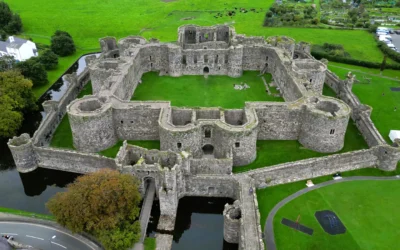
Beaumaris Castle
Beaumaris Castle: The Most Perfect Fortress Never Finished, on the Isle of Anglesey In 1295, Master James of St George began designing the most geometrically perfect concentric castle in the history of medieval military architecture. The inner ward was rectangular,...