
Portland Bill Lighthouse
Portland Bill Lighthouse: Red Stripes Above the Channel’s Most Dangerous Race
At the very tip of the Isle of Portland — a great block of Jurassic limestone connected to the Dorset mainland only by the eighteen-mile sweep of Chesil Beach — a red and white striped tower has stood guard over one of the most treacherous stretches of water in the English Channel since 1906.
Portland Race is the name mariners give to the violent tidal overfalls and standing waves that form south of Portland Bill when the Channel’s currents collide around the headland. It has wrecked ships for centuries, and it was the sinking of fifteen vessels in a single storm in 1901 that finally prompted Trinity House to build a modern lighthouse here, powerful enough to warn ships before the Race claimed them.
The distinctive red and white hooped tower is 41 metres tall, with 155 steps to the lantern room at the top — the most of any lighthouse in this guide — and from that height the views extend along the full arc of the Jurassic Coast UNESCO World Heritage Site in both directions, with the Channel stretching south towards France.
The lighthouse is still active, open to guided tours, and the nearby Old Higher Lighthouse, with its extraordinary roster of famous guests across three centuries, offers self-catering accommodation with some of the most remarkable literary and royal connections of any lighthouse building in England. This guide covers everything you need to know about visiting and staying near Portland Bill.
Where Is Portland Bill Lighthouse?
Portland Bill Lighthouse stands at the southern tip of the Isle of Portland, Dorset, postcode DT5 2JT, approximately 9 miles south of Weymouth. The Isle of Portland is reached from the mainland via the A354 from Weymouth, which connects across the narrow neck of land at the northern end of Chesil Beach.
The setting is dramatically exposed: the Channel to the south, Chesil Beach sweeping away to the north-west, Pulpit Rock and the limestone cliffs on either side. The nearby Trinity House Obelisk marks the site of the original 18th-century lighthouses.
A Brief History of Portland Bill Lighthouse
Portland’s need for a lighthouse goes back to 1716, when the first pair of lighthouses was established on the Bill — the Old Higher Lighthouse and the Old Lower Lighthouse — to warn ships of the Portland Race and the Shambles sandbank beyond. These served the coast for nearly two centuries, but the storms of 1901, in which fifteen ships were wrecked in a single event, demonstrated that more was needed.
The current Portland Bill Lighthouse was built by Trinity House and first lit on 11 January 1906, replacing the two earlier towers. It was conceived as a powerful modern beacon, its First Order catadioptric optic projecting a beam visible for 25 nautical miles. In 2019 the light was upgraded to LED technology, reducing the nominal range to 18 nautical miles while dramatically improving energy efficiency; the original magnificent optic is now displayed at the base of the tower.
The remarkable historical footnote that distinguishes Portland Bill from almost every other lighthouse in England: in April 1912, as the RMS Titanic steamed west along the Channel on her sea trials before setting out for Southampton and then New York, she passed Portland Bill. The lighthouse watched the ship pass — one of the last landmarks on the English coast to see her before she sailed to her fate. She did not return.
Architecture & The Light
Portland Bill is a 41-metre (135-foot) round tower, immediately recognisable for its bold red and white horizontal hoops — a colour scheme that makes it one of the most distinctive lighthouses in England, both as a daymark at sea and as a landmark on the Dorset coast. The tower’s 155 steps make it the tallest climb of any lighthouse currently open for public tours in this guide.
The original First Order catadioptric optic — a magnificent piece of Victorian engineering — is displayed at the tower’s base and is well worth examining before the climb. The current light, upgraded to LED in 2019, flashes its pattern across the Channel and is visible for around 18 nautical miles. The lighthouse has been automated for some years and remains an active navigational aid operated by Trinity House.
Visiting the Lighthouse
Portland Bill is managed as a visitor attraction with a visitor centre (opened 2015) and guided tours up the tower. The visitor centre — freely accessible without booking — houses the “Dark and Light” exhibition, with interactive displays, historical artefacts and an immersive “Into the Dark” zone simulating a stormy sea journey. The gift shop is also free to enter.
Guided tower tours take visitors all the way up the 155 steps to the lantern room, where the views across the Jurassic Coast are extraordinary. A minimum height of 1.1 metres applies for the tower, and visitors must be able to climb the stairs unaided. Sturdy footwear is recommended. Booking is not typically required, but calling ahead (01305 821050) is advisable for late arrivals.
| Ticket | Price (approx.) |
| Visitor Centre only | Adult ~£3, Child ~£1.50, Family ~£8 |
| Visitor Centre + Lighthouse | Adult ~£9, Child ~£7, Family ~£27.50 |
As prices and opening hours are reviewed seasonally, check the official Portland Bill Lighthouse website for current rates and times before visiting.
Check Tickets & Tour Times for Portland Bill Lighthouse →
Staying Near the Lighthouse
Portland Bill Lighthouse itself does not offer accommodation — but the nearby Old Higher Lighthouse, one of the two original 18th-century lighthouses it replaced, is now a holiday let with a history that rivals almost any building on the Dorset coast. King George III visited in 1804. Thomas Hardy knew it well. H.G. Wells stayed here. And for the remarkable decades when it was owned by Dr Marie Stopes, the pioneering advocate for family planning, it became a gathering point for some of the most significant intellectual and cultural figures of the early 20th century.
Two self-catering cottages within the Old Higher Lighthouse, Stopes Cottage and Branscombe Lodge Cottage, are available as holiday accommodation. Both sleep up to four guests and share access to the lighthouse observatory, the garden with its ornamental fishponds and a heated outdoor pool and hot tub (available in the summer months):
| Cottage | Sleeps | Features |
| Stopes Cottage | 4 | 1 double, 1 twin; sea views, shared pool and hot tub (summer), gardens; no pets or children under 5 |
| Branscombe Lodge Cottage | 4 | 1 double, 1 twin; sea views, shared pool and hot tub (summer), gardens; no pets or children under 5 |
Note that the cliff proximity and the ornamental fishponds mean the no-children-under-5 and no-pets restriction applies to both cottages. The heated pool and hot tub are available from May to September.
Find Coastal Stays Near Portland Bill →
The Best Time to Visit
Spring (April to June) is a wonderful time at Portland Bill — the lighthouse tours are in full operation, the birdwatching at the Portland Bird Observatory is at its most exciting as migrants arrive, and the Jurassic Coast walking is exceptional. Summer (July to August) is the busiest season, with the tower tours fully operational, the cottage pool open and the Chesil Beach and coast at their warmest and most visited.
Autumn (September to October) brings quieter trails and the autumn migration season — Portland Bill is one of the finest birdwatching sites in southern England during migration, with rare species regularly recorded. Winter (November to March) is dramatic and exposed on this headland, with the Portland Race at its most violent and the visitor centre and tower tours typically not running.
For the quietest tower visit, weekday mornings in spring or early autumn are ideal.
How to Get There
By car. Follow the A354 from Weymouth onto the Isle of Portland, then south through the town of Portland to Portland Bill. The postcode DT5 2JT takes you to the lighthouse car park. The road from Weymouth is around nine miles.
By public transport. Buses run from Weymouth to Portland, and from Portland town local services reach Portland Bill. Check Traveline South East for current routes and timetables.
On foot. The South West Coast Path runs around the Isle of Portland, offering clifftop walking with views of the lighthouse and the Channel.
Compare Transfers & Local Transport in Dorset →
Wildlife & The Coast
Portland Bill is one of the finest wildlife-watching sites on the English south coast. The Portland Bird Observatory at the Bill is a nationally renowned birdwatching station, particularly outstanding during the spring and autumn migration seasons when rare and unusual species regularly appear. Seabirds are visible throughout the year from the clifftops, including gannets passing offshore, and the Portland Race and the surrounding waters are home to seals, dolphins and porpoises.
A pair of binoculars for wildlife watching is essential here — the clifftop position above Portland Race and the migration watchpoint at the Bill make this one of the most rewarding places on the Dorset coast for scanning the sea and the sky.
Nearby Attractions
The Isle of Portland and the surrounding Jurassic Coast have excellent attractions within easy reach.
| Attraction | Why Visit | Distance |
| Chesil Beach | The extraordinary 18-mile barrier beach — unique geology and dramatic walking | Adjacent |
| Pulpit Rock | A striking natural rock arch at the Bill, popular with climbers | Adjacent |
| Portland Castle | A Henry VIII coastal fort overlooking Portland Harbour (English Heritage) | ~5 miles |
| Weymouth | Georgian seaside town with beach, harbour and historic seafront | ~9 miles |
| Anvil Point Lighthouse | Another National Trust lighthouse on the Jurassic Coast, near Swanage | ~20 miles |
A natural day out: tour the Portland Bill Lighthouse in the morning, walk the coast path to Pulpit Rock, then explore Chesil Beach in the afternoon.
Browse Jurassic Coast & Dorset Tours →
Safety & Accessibility
Safety. The cliffs at Portland Bill are dramatic and the edges require caution — stay on the paths and keep well back. Portland Race, the violent tidal overfalls south of the Bill, makes the sea here genuinely dangerous — never attempt to swim or paddle near the race. Sturdy footwear is needed for the rocky terrain.
Accessibility. The visitor centre and gift shop are accessible without stairs. The tower requires climbing 155 steps and a minimum height of 1.1 metres. Pets are welcome in the visitor centre and grounds but not in the tower or the nearby cottages.
Families. The visitor centre and exhibition are suitable for all ages. The tower has the height restriction (1.1m); the Old Higher Lighthouse cottages do not accept children under 5. The surrounding coast path and beach areas are excellent for families.
Practical Tips
- Check opening times before visiting — the tower tours are seasonal. Call ahead (01305 821050) if planning a late-in-the-day visit.
- The 155 steps are the most of any lighthouse in this guide — take them at your own pace and wear sturdy shoes.
- Portland Bill is one of the UK’s great migration birdwatching sites — bring binoculars and allow time at the Bill, especially in spring and autumn.
- Wear waterproof walking boots for the clifftop paths and the coast walk around the Bill.
- Pack a waterproof walking jacket; Portland Bill is one of the most exposed headlands on the south coast.
- Bring binoculars for wildlife watching — for birds on migration, gannets, seals and dolphins offshore.
- Overseas visitor? The UK uses Type G plugs, so a UK travel adapter is essential for charging your devices.
Conclusion
Portland Bill Lighthouse is a beacon for three things at once: for ships navigating the Portland Race, for the extraordinary history of this headland (the Titanic, Thomas Hardy, Marie Stopes), and for the Jurassic Coast, one of England’s greatest UNESCO landscapes, stretching away in both directions from the clifftops of the Bill. To climb 155 steps to that lantern room and look out over the most dangerous tidal race in the Channel, knowing that the Titanic once passed this very light, is to stand at one of the most evocative viewpoints on the south coast of England.
Frequently Asked Questions
What is the history of Portland Bill Lighthouse?
Built in 1906 following a devastating 1901 storm that wrecked fifteen ships, it replaced two earlier lighthouses from 1716 (the Old Higher and Old Lower Lighthouses) to guide ships past the treacherous Portland Race and Shambles sandbank.
Where is Portland Bill Lighthouse located?
At the southern tip of the Isle of Portland, Dorset, postcode DT5 2JT, about 9 miles south of Weymouth.
Can I climb to the top of Portland Bill Lighthouse?
Yes — guided tours take visitors up 155 steps to the lantern room for panoramic views. A minimum height of 1.1 metres applies and visitors must climb unaided.
What are the opening hours of Portland Bill Lighthouse?
The visitor centre and tower tours are open seasonally, typically spring to autumn. Check the official website or call 01305 821050 for current hours.
How much does it cost to visit Portland Bill Lighthouse?
The visitor centre alone costs approximately £3 for adults. The visitor centre plus lighthouse tour costs approximately £9 for adults. Check the official website for current pricing.
Did the Titanic really pass Portland Bill?
Yes — in April 1912, during the RMS Titanic’s sea trials before her departure from Southampton, she passed Portland Bill on her way along the Channel. It was one of the last English landmarks to see her.
Is there accommodation at Portland Bill Lighthouse?
Portland Bill Lighthouse itself does not offer accommodation. The nearby Old Higher Lighthouse (one of the two earlier lighthouses it replaced) has two self-catering cottages — Stopes Cottage and Branscombe Lodge Cottage — each sleeping up to four guests.
What makes the Old Higher Lighthouse cottages special?
The Old Higher Lighthouse has an extraordinary roll call of famous visitors: King George III (1804), Thomas Hardy, H.G. Wells, and Dr Marie Stopes, who owned it for decades. The cottages have sea views, shared gardens and a heated outdoor pool in summer.
What wildlife can I see near Portland Bill Lighthouse?
Portland Bill is nationally renowned for birdwatching, particularly during spring and autumn migration. Seabirds, gannets, seals, dolphins and porpoises are all regularly seen from the clifftops.
How do I book a tour of Portland Bill Lighthouse?
No advance booking is required for general visits; just arrive and purchase tickets at the visitor centre. For late-in-the-day visits, call 01305 821050 to confirm tour availability.
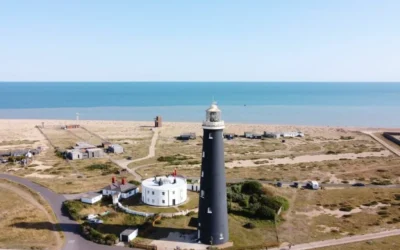
The Old Lighthouse at Dungeness
The Old Lighthouse at Dungeness: A Victorian Tower in Britain's Only Desert Dungeness is like nowhere else in Britain. A vast, flat headland of shingle — grey pebbles stretching to every horizon, sparse vegetation clinging to the stones, fishing boats drawn up on the...
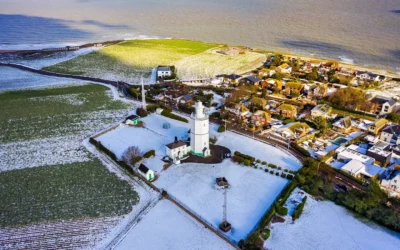
North Foreland Lighthouse
North Foreland Lighthouse: The Kent Beacon That Has Shone Since 1499 The Goodwin Sands lie seven miles offshore from the chalk cliffs of North Foreland, and they have been doing what they do for centuries: appearing and disappearing with the tides, drawing ships onto...
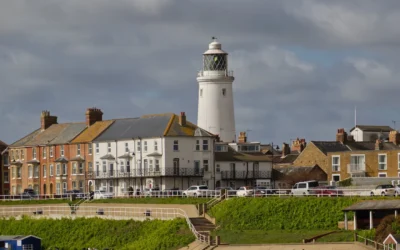
Southwold Lighthouse
Southwold Lighthouse: The Beacon at the Heart of a Suffolk Town Most lighthouses stand alone — on a cliff, a headland, a remote point of land where the sea has the upper hand. Southwold Lighthouse stands in the middle of a town. Walk along any of the streets radiating...
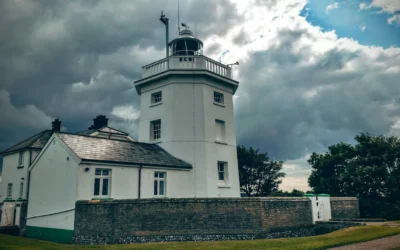
Cromer Lighthouse
Cromer Lighthouse: Standing 84 Metres Above the North Sea on the Cromer Ridge There is something quietly astonishing about the numbers at Cromer Lighthouse. The tower itself stands 18 metres tall — modest by lighthouse standards. Yet the light it projects sits 84...
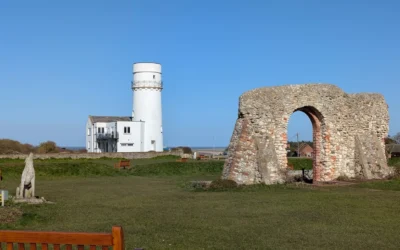
The Old Lighthouse Hunstanton
The Old Lighthouse Hunstanton: The Norfolk Beacon That Changed Lighthouse History On St Edmund's Point on the North Norfolk Coast, where the striped cliffs of Hunstanton — banded in layers of red chalk, white chalk and carstone — drop to the beach below and the vast...