
Lodore Falls
Lodore Falls: The Cascade That Inspired a Poem
Stand beside Lodore Falls after heavy rain and you begin to understand why Robert Southey, the Poet Laureate who lived at Greta Hall just up the road in Keswick, reached for so many words at once. Dashing and flashing and splashing and clashing. The poem he wrote in 1820 — "The Cataract of Lodore" — mimics the falls in onomatopoeic rhyme, line after line tumbling over each other just as the water does, accelerating into a rush at the end. It is one of the most famous poems ever written about a waterfall, and the falls that inspired it are real, close to Keswick, and best seen after precisely the kind of wet Lakeland day that keeps some visitors indoors.
Lodore Falls tumbles more than 100 feet (30 metres) over ancient boulders in a steep-sided, heavily wooded gorge at the southern end of Derwentwater, where Watendlath Beck completes its long journey from a high mountain tarn down into the Borrowdale Valley. It is not the tallest waterfall in the Lakes — Scale Force holds that title — nor the most dramatic in all conditions. In a dry spell it can shrink to little more than a damp trickle over mossy rock. But after rain, it becomes exactly what Southey described: a thundering, misting, boiling cascade that fills the gorge with noise and sets the ferns trembling.
Here is everything you need to plan a visit.
About Lodore Falls
Lodore Falls is fed by Watendlath Beck, which rises at Watendlath Tarn — a high, peaceful mountain lake in a hanging valley above Borrowdale — and descends over a series of boulders and rock outcrops in what the poet Coleridge called "a broad and wide" cascade: not a single clean drop, but a complex tumbling of water over ancient Lakeland rock. The total height is normally given as more than 100 feet (about 30 metres), though the water divides and reunites several times on its descent, making a precise measurement difficult.
The surrounding woodland, designated as a Site of Special Scientific Interest, is one of the finest fragments of ancient oak woodland in Cumbria — the "Borrowdale Rainforest," as it is sometimes called — rich in mosses, ferns and lichens and alive with birdsong. It adds considerably to the atmosphere of the falls, framing the cascade in deep green even in winter.
One interesting note on the name's ancient history: there are theories that Lodore Falls may be the Rhaeadr Derwennydd — "the falls of the Derwent" — mentioned in the Welsh poem Y Gododdin, composed between the 7th and 11th centuries. It is an appealing idea, and not impossible, but it remains a theory rather than a settled fact.
The falls are on private land behind the Lodore Falls Hotel. A signed public footpath from across the road provides free access for all visitors.
Getting there
By car, follow the B5289 south from Keswick along the eastern shore of Derwentwater into Borrowdale. The falls are around three miles from Keswick, halfway between the Ashness Bridge junction and the village of Grange. You cannot miss the Lodore Falls Hotel on the left; the falls are directly behind it, and the public footpath begins on the opposite side of the road.
The nearest public car park is the National Trust's Kettlewell car park (CA12 5UN), about half a mile back towards Keswick on the same road. It is pay-and-display; free for National Trust members. From here a short, signposted woodland path leads to the falls in about fifteen to twenty minutes. The car park fills quickly on summer weekends and bank holidays — arrive early.
By bus, the Stagecoach 78 Borrowdale bus runs from Keswick regularly along the B5289, stopping near the Lodore Falls Hotel. It is a year-round service, unlike some of the seasonal Lake District routes, making it a reliable option for a car-free visit.
By boat, the Keswick Launch runs a regular service across Derwentwater, calling at the Lodore jetty — a short, pleasant walk from the falls. It is one of the most atmospheric ways to arrive, especially on a clear morning with the fells reflected in the water.
If you're coming from further afield and would prefer not to drive the Borrowdale road, a local transfer is easy to arrange.
Compare Transfers & Local Transport in the Lake District →
Where does the name come from?
The word "force" (sometimes "foss") is Norse for a waterfall — the same root found across the north of England in names like Aira Force, High Force and Hardraw Force. "Lodore" is less certain in origin. It is possibly derived from the Welsh Rhaeadr Derwennydd, meaning "the falls of the Derwent," which would reflect the ancient Welsh and Brythonic influence that persisted in Cumbria long after the Roman period. What is clear is that Robert Southey, who lived at Greta Hall in Keswick from 1803 onwards and knew these falls well, appears to have fixed the modern spelling "Lodore" through his famous 1820 poem. Before that, earlier visitors called them "Lodoar Falls," "Lodoar Force" and variations.
The poem itself was written in response to a child's simple question — "How does the water come down at Lodore?" — and Southey answered it in a tumbling rush of onomatopoeic rhyme that has delighted readers for two centuries.
The walk and the trails
The walk to the falls is short and simple. From the Kettlewell car park, a signed path crosses Watendlath Beck by a footbridge, then runs through woodland parallel to the road for about half a mile, before bearing left through the hotel grounds to the falls. Allow fifteen to twenty minutes each way; the path climbs gently, with a viewpoint bench at the foot of the cascade. The final section is on boulders and rough ground, so sturdy footwear is always worthwhile even on this short walk.
Lodore Falls is also the starting point for several longer routes.
The Lodore Falls and Watendlath Tarn route (around 5 miles return, 2–3 hours, moderate) climbs steeply through the gorge above the falls and then follows Watendlath Beck up the valley to Watendlath hamlet, a beautiful National Trust tarn with a stone packhorse bridge and a tearoom. This is a genuinely rewarding half-day outing.
Surprise View and Ashness Bridge are easily combined on the road above — Ashness Bridge is a classic packhorse bridge with a famous view of Derwentwater and Keswick, and Surprise View (around two miles from Lodore) is a sudden and breath-taking panorama over the whole lake, best appreciated by approaching it from below.
The Derwentwater circular (around 9 miles, 4–5 hours) starts in Keswick, follows the full lakeshore south to Lodore, then returns along the western shore via Cat Bells — the most popular fell walk in the Lake District. This is a classic full Lakeland day.
Parking
The National Trust's Kettlewell car park (CA12 5UN) is the public car park for the falls — pay-and-display, free for National Trust members. It holds a good number of cars but fills quickly in summer; arriving early in the morning is strongly recommended. There are no facilities at the car park itself. Check the National Trust website for current charges before you go.
If Kettlewell is full, there is limited additional parking along the roadside verge. Keswick town centre has several car parks about three miles away, from where the 78 bus or the Keswick Launch can bring you directly to the falls.
Facilities
There are no facilities at the falls themselves — no toilets, café or shop on the public path. The Kettlewell car park is also without facilities.
The one nearby option is the Keswick Launch tearoom at the lakeside pier, a short walk from Kettlewell car park, which serves hot drinks and light refreshments. For a full range of cafés, shops and toilets, Keswick is around three miles north and well worth a stop before or after.
Watendlath — reached by a longer walk up through the gorge — has a popular National Trust tearoom in the hamlet, which is a fine reward after the climb.
Things to know before you go
Best time to visit. After heavy and sustained rain is the only reliable time to see Lodore Falls at its most impressive. In a dry spell — particularly in summer — it can diminish to little more than a trickle over mossy boulders, and first-time visitors sometimes find it disappointing. Spring and autumn are generally wetter than summer and offer the fullest flow along with beautiful woodland colour.
Dogs. Dogs are welcome and should be kept under close control on the path, which runs close to the road at points, and near the water.
Accessibility. The path from Kettlewell car park to the viewpoint bench at the foot of the falls is mostly flat but has rough sections, boulders and uneven ground, making it unsuitable for wheelchairs or pushchairs. The lakeshore path beside Derwentwater is more accessible.
Families and safety. It's a lovely short walk for families, and the falls are impressive and safely viewed from the bench. Keep children well back from the water when the beck is in full flow — the rocks are slippery and the current can be powerful.
Swimming. The pool at the base is not a swimming spot — the flow is unpredictable, the rocks are slippery, and access is restricted.
Where to stay
The natural base for Lodore Falls is Keswick, the principal market town of the northern Lakes, around three miles away with the widest range of accommodation, excellent shops and cafés, and the Keswick Launch right on the lakeside for the most scenic route to the falls.
Find Hotels & Stays in Keswick →
What to pack
Even on the short walk, the Lake District's unpredictable weather and the muddy conditions near the falls make a little preparation worthwhile.
- A pair of waterproof walking boots — the path to the falls has rough sections and boulders, and the whole area is very damp.
- A waterproof jacket and warm layers; Borrowdale is one of the wettest valleys in England.
- A pair of binoculars for the rich birdlife of the SSSI oak woodland and across Derwentwater.
- A travel tripod for long-exposure shots of the falls in the dappled woodland light.
An OS Explorer OL4 map and some snacks are worth adding if you plan the Watendlath extension.
Nearby attractions and making a day of it
Lodore Falls sits in one of the most concentrated patches of natural and cultural interest in the Lake District.
| Attraction | Why Visit | Distance |
|---|---|---|
| Derwentwater | One of Lakeland's most beautiful lakes — ringed by fells, crossed by the Keswick Launch and surrounded by National Trust woodland paths | Adjacent |
| Ashness Bridge & Surprise View | A classic stone packhorse bridge with famous lake views, and the sudden panorama of Surprise View | ~2 miles |
| Watendlath Tarn | A peaceful National Trust hamlet with a stone packhorse bridge, a tearoom and the tarn that feeds the falls — reached by a rewarding climb | ~3 miles on foot |
| Bowder Stone | A gigantic 2,000-tonne balanced rock in the Borrowdale Valley, with a ladder to the top — a free and surprising sight | ~2 miles south |
| Cat Bells | The Lake District's most popular fell walk — a satisfying ridge above the western shore of Derwentwater with panoramic views | ~4 miles |
For a classic day, take the Keswick Launch to Lodore, walk to the falls, extend to Watendlath Tarn and back, then return by boat or bus. Combine with Ashness Bridge and Surprise View on the road above for a full day in Borrowdale.
Browse Lake District Tours & Experiences →
Photography tips
Lodore Falls is most rewarding after a wet spell, when the water fills the gorge with noise and spray. The viewpoint bench at the foot of the falls gives the clearest framing of the cascade through the trees, though approaching cautiously further in among the boulders gives a closer, more immersive shot.
Overcast light is generally better than bright sun in the gorge, where the contrast between deep shade and bright water is hard to manage. A tripod is essential for long-exposure shots — the textured, divided cascade responds beautifully to a slow shutter speed, producing the layered silk effect that suits Southey's poem perfectly. Early morning gives the softest light and, in spring, the chance of mist drifting through the woodland.
Conclusion
Lodore Falls asks nothing unreasonable of the visitor — a short car journey from Keswick, a pleasant woodland walk, and the patience to visit after a good spell of rain. In return, it offers a cascade that has moved poets, painters and travellers for over two hundred years, framed by some of the finest oak woodland in England. Southey's poem is still the best description: "And so never ending, but always descending, / Sounds and motions for ever and ever are blending / All at once and all o'er, with a mighty uproar — / And this way the water comes down at Lodore."
FAQs
How tall is Lodore Falls?
More than 100 feet (around 30 metres), cascading in multiple channels over ancient boulders rather than a single clean drop. The total height varies slightly between sources but most settle on around 100 feet as the standard figure.
Is there a fee to visit Lodore Falls?
Access to the falls via the public footpath is free. The National Trust's Kettlewell car park charges for parking (free for National Trust members). Check the National Trust website for current rates.
What is the best time to visit Lodore Falls?
After sustained heavy rain, when the full cascade is visible — in dry weather, particularly summer, it can reduce to a trickle. Spring and autumn tend to bring more reliable flow and fewer crowds.
Are dogs allowed at Lodore Falls?
Yes, dogs are welcome on the public footpath. Keep them under close control near the road and the water.
Is Lodore Falls accessible for wheelchairs?
The public path has rough sections, boulders and uneven ground and is not suitable for wheelchairs or pushchairs. The lakeshore path beside Derwentwater is more accessible. Check the National Trust website for the latest accessibility information.
What are the parking options at Lodore Falls?
The National Trust's Kettlewell car park (CA12 5UN) is the public option, around half a mile from the falls. It fills quickly on summer days — arrive early. Keswick town centre car parks are about three miles away, with bus and boat connections.
Can I swim at Lodore Falls?
No. The pool is not a swimming spot — access is restricted, the rocks are slippery, and the water flow is powerful and unpredictable.
What should I wear when visiting Lodore Falls?
Sturdy waterproof footwear and a waterproof jacket. The path is short but the ground is rough and the valley is very wet.
Was Lodore Falls really in a poem?
Yes. Robert Southey, Poet Laureate and resident of nearby Greta Hall in Keswick, wrote "The Cataract of Lodore" in 1820, one of the most famous onomatopoeic poems in English. The poem is said to have been written in answer to a child's question about how the water comes down at Lodore.
What's nearby?
Derwentwater, Ashness Bridge and Surprise View, Watendlath Tarn with its tearoom and packhorse bridge, the Bowder Stone in Borrowdale, and Cat Bells to the west.
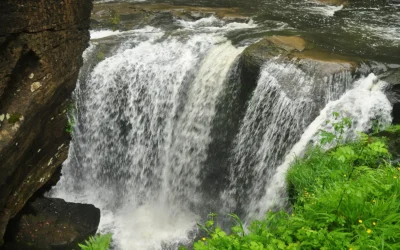
Aberdulais Falls
Aberdulais Falls: Where Wales' Industrial Story Began In the winter of 1584, a German engineer named Ulrich Frosse chose this gorge for a secret reason: the River Dulais plunging over its ridge of hard Pennant sandstone was exactly the power source he needed. Under...
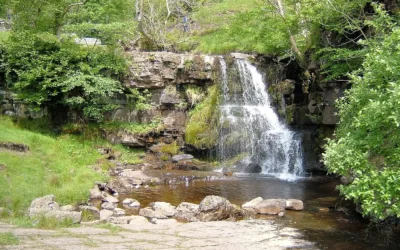
East Gill Force
East Gill Force: Where Two Great Walks Meet There is a particular pleasure in arriving at East Gill Force. You have walked the short path from Keld, crossed the long stone footbridge over the River Swale, and then the path turns and the waterfall is simply there — the...
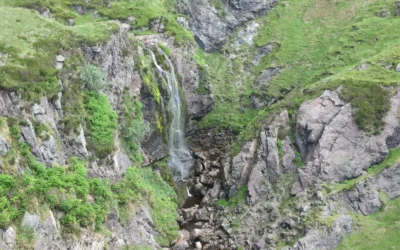
Spout of Garnock
Spout of Garnock: Ayrshire's Highest Waterfall The River Garnock rises on the southern slopes of the Hill of Stake, the highest summit in Clyde Muirshiel Regional Park, and barely has time to become a river before it falls off the edge of the moorland. About a mile...
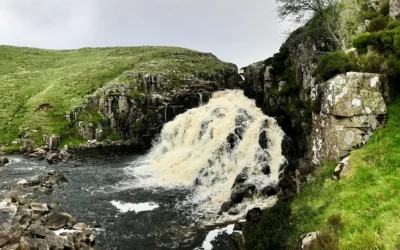
Cauldron Snout
Cauldron Snout: England's Longest Waterfall Most waterfalls announce themselves with a sudden vertical drop. Cauldron Snout does something different: it unrolls. From below, the River Tees is white and relentless for two hundred yards, cascading down the black...
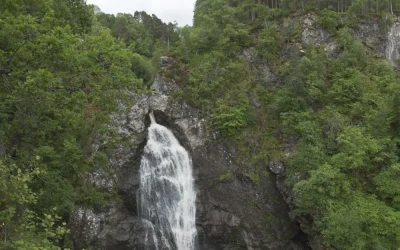
Falls of Foyers
Falls of Foyers: The Smoking Falls of Loch Ness When Robert Burns reached the Falls of Foyers in 1787 and looked down into the gorge, he saw what he described as "the horrid cauldron" — the deep, spray-filled amphitheatre at the base of the lower falls,...