
Killyleagh Castle
Killyleagh Castle: Ireland's Oldest Inhabited Castle, Above Strangford Lough
Sir Hans Sloane was born in Killyleagh in 1660. The physician, naturalist and collector who grew up in this County Down village on the shore of Strangford Lough went on to assemble a personal collection of 71,000 objects — natural specimens, books, manuscripts and artefacts — which he bequeathed to the British nation at his death in 1753.
That bequest became the founding collection of the British Museum, the British Library and the Natural History Museum. The village that produced the man who effectively created three of the most significant public institutions in Britain can be forgiven for being quite proud of the fact.
It can also be proud of its castle. Killyleagh Castle has parts dating to 1180, making it one of the oldest continuously inhabited castles in Ireland, and it has been owned by the Hamilton family since the early 17th century. The current turretted, Loire Valley château-style structure was designed by the celebrated architect Sir Charles Lanyon in the mid-19th century — the same Lanyon responsible for Queen's University Belfast and the Custom House.
The castle remains the private home of Gawn Rowan Hamilton and his family, and is not open for general public tours. It is, however, open for guests to stay in its self-catering tower apartments, each with a rooftop terrace looking out over Strangford Lough. This guide covers everything you need to plan your stay or visit.
Where Is Killyleagh Castle?
Killyleagh Castle is in Killyleagh village, County Down, Northern Ireland, on the A22 road between Belfast and Downpatrick, approximately 22 miles south of Belfast. From Belfast by car, allow around 25 to 30 minutes. Translink buses from Belfast serve Killyleagh; the journey takes around an hour. From Killyleagh village centre, the castle is a short walk.
A Brief History of Killyleagh Castle
The site was first fortified by the Norman knight Sir John de Courcy around 1180 — the same John de Courcy who built Carrickfergus Castle and Dundrum Castle in the same decade of Norman conquest. Killyleagh was part of de Courcy's effort to secure the shores of Strangford Lough, which the Vikings had called "Strangfyorthe" — fiord of the strong currents — and which had served as a route for Viking raids for centuries.
By 1602, the castle was held by Con O'Neill. The Plantation of Ulster transferred it to James Hamilton, later the 1st Viscount Claneboye, beginning the family connection that has lasted over four centuries. In 1649, Cromwell's forces besieged and destroyed the gatehouse. The castle was rebuilt in 1666 by the 2nd Earl of Clanbrassil, who added the north tower and the bawn — the defensive enclosing wall.
The castle's current appearance owes most to the mid-19th-century redesign by Sir Charles Lanyon, who transformed it into a Loire Valley château-style composition — round corner turrets, a steeply sloping roof, and an imposing doorcase that became one of the most distinctive castle silhouettes in Ulster. The baronial gatehouse was the work of architect Benjamin Ferrey. The result is a building that looks as though it was transplanted from the banks of the Loire to the shores of Strangford Lough, and is entirely at ease in its new setting.
Notable residents have included Archibald Hamilton Rowan, a United Irishman who lived here from 1806 to 1834, and Hariot Georgina Hamilton-Rowan, who founded the National Association for Supplying Female Medical Aid to the Women of India in 1885 — a groundbreaking organisation that built women-only hospitals across India and trained the country's first female physicians.
The remarkable thing about Killyleagh is its continuity. Part of the fabric goes back to 1180. The same family has held it since the 17th century. Gawn Rowan Hamilton lives in it now. And the village below it was the birthplace of the man who founded the British Museum.
Architecture & Design
Sir Charles Lanyon's mid-19th-century redesign is the dominant character of the castle today. The round corner turrets, the steeply sloping roof with its candle snuffers at roof level, and the baronial gatehouse (by Benjamin Ferrey) create a silhouette associated more with the Loire Valley than with Ulster. The contrast with the wilder Antrim coast castles of the same MacDonnell period is striking — Killyleagh was always a residence rather than a fortress, even when its walls were defensive.
Inside, the drawing room, dining room and library form an interconnected suite with views of the southern garden. The northern circular tower has vaulted rooms; the Georgian counterpart contains pentagonal rooms — an unusual geometrical variety in one building. The castle gardens include lawns within the bawn and steeply terraced areas descending to ponds.
Legends & Lore
Killyleagh Castle's ghost tradition centres on a female figure in a long gown said to appear in the castle's corridors. Local tradition identifies her as Anne Hamilton, whose deep attachment to the castle is described as keeping her connected to it even after death; some accounts suggest it may be a later Hamilton daughter-in-law. These stories are told as folklore rather than documented fact, and the castle's dungeon and rumoured secret passageways add to the atmosphere they create.
The most vivid historical lore, however, is the Sir Hans Sloane story: the boy who grew up in this village, went to London, became one of the leading physicians and naturalists of his age, accumulated one of the most extraordinary collections in history, and left it to the nation. The Sir Hans Sloane Centre in Killyleagh celebrates his life and legacy. A visit to Killyleagh Castle that does not include a walk to see it is incomplete.
Staying at Killyleagh Castle
Killyleagh Castle is a private family home and is not open for public tours. The castle offers three self-catering apartments for guests, each within the historic fabric of the building and each with a private rooftop terrace with views of Strangford Lough.
| Accommodation | Sleeps | Character |
|---|---|---|
| North Tower Apartment | 4 | Corner tower apartment with rooftop terrace overlooking Strangford Lough |
| South Tower Apartment | 4 | Corner tower apartment with rooftop terrace |
| Gatehouse Apartment | 5 | Central gatehouse apartment with rooftop terrace and courtyard views |
Guests may access the swimming pool and tennis courts by arrangement. Parking is available in the courtyard.
The castle occasionally hosts concerts and cultural events — check the official Killyleagh Castle website for current event information.
Find Rooms & Rates at Killyleagh Castle →
Check the official Killyleagh Castle website for direct booking and current availability.
Where to Stay Nearby (Day Visitors)
For those not staying at the castle itself, Downpatrick (7 miles) has a range of hotels and guesthouses and makes a convenient base for County Down. Strangford village (around 4 miles) has guesthouses and the Ferry Inn on the lough shore.
Find Hotels & Stays in Downpatrick →
The Best Time to Visit
Summer (June to August) is the finest time for Killyleagh — the gardens are at their best, the Strangford Lough views are vivid and the castle tower terraces are usable in the long Ulster evenings. Spring (April to June) offers milder weather and the gardens coming into bloom. Advance booking for the apartments is essential in summer.
How to Get There
By car. From Belfast, take the A7 and A22 south to Killyleagh — around 25 to 30 minutes. Parking is available in the castle courtyard for guests.
By bus. Translink buses from Belfast serve Killyleagh (around 1 hour). The castle is a short walk from the village centre.
Compare Transfers & Local Transport in County Down →
Nearby Attractions
Killyleagh is superbly positioned for exploring Strangford Lough and the heritage of County Down.
| Attraction | Why Visit | Distance |
|---|---|---|
| Sir Hans Sloane Centre | The story of Killyleagh's most famous son — the physician and collector whose bequest to the nation founded the British Museum, the British Library and the Natural History Museum | ~0.1 miles |
| Delamont Country Park | Scenic coastal parkland with walking trails and views across Strangford Lough | ~2 miles |
| Strangford Stone | The tallest megalith in the British Isles — a remarkable standing stone in the County Down countryside | ~1.4 miles |
| Audley's Castle (Historic Environment NI) | A 15th-century tower house with outstanding lough views — free to visit | ~3.5 miles |
| Castle Ward (National Trust) | The eccentric mansion split between Palladian and Gothic styles — and Winterfell from Game of Thrones | ~3.7 miles |
A natural County Down day for non-staying visitors combines the Sir Hans Sloane Centre and Killyleagh village with Castle Ward (Winterfell) and Audley's Castle — four heritage sites within 4 miles, covering 1180 to the 18th century.
Browse Strangford Lough & County Down Tours →
Family & Accessibility
Families. Killyleagh is an excellent self-catering base for families — the tower apartments are unique and memorable, the rooftop terraces are magical for children, and the lough, nearby parks and the surrounding County Down countryside provide substantial space. The swimming pool and tennis courts add further activity.
Accessibility. The castle's historic structure limits wheelchair access in some areas. Contact the castle directly before booking to discuss specific requirements.
Practical Tips
- Book well in advance — the three apartments are limited and in high demand in summer.
- Wear comfortable walking shoes for Killyleagh village, the castle grounds and the nearby Strangford Lough shoreline walks.
- Pack a compact travel umbrella for Strangford Lough weather.
- Bring a portable power bank for photography from the rooftop terraces — the lough and countryside views are outstanding.
- Visit the Sir Hans Sloane Centre — the story of Killyleagh's most remarkable son is genuinely extraordinary and only 100 metres from the castle.
- Overseas visitor? Pack a UK travel adapter for Type G plugs.
Conclusion
Killyleagh Castle has been in the Hamilton family since the early 17th century, has parts dating to 1180, was redesigned by the greatest Victorian architect in Ulster, and looks out over the same Strangford Lough that Viking longships navigated over a thousand years ago. The village below it was the birthplace of the man who founded three of the most significant public institutions in Britain.
A woman who lived here trained India's first female physicians. Van Morrison has played in the courtyard. CBBC filmed a children's series here. And the three tower apartments have rooftop terraces from which you can watch the lough at dusk. Killyleagh is a small village in County Down. It has had an outsized impact on the world, and it knows it.
Frequently Asked Questions
Is Killyleagh Castle open for day visitors?
Killyleagh Castle is a private family home and is not open for public tours. The castle offers three self-catering apartments for overnight guests in its towers and gatehouse.
How do I book accommodation at Killyleagh Castle?
Book directly through the official Killyleagh Castle website or via accommodation booking platforms. Advance booking is strongly recommended, particularly for summer.
Who was Sir Hans Sloane, and what is his connection to Killyleagh?
Sir Hans Sloane (1660–1753) was a physician and collector who was born in Killyleagh. His personal collection of over 71,000 objects, bequeathed to the British nation, became the founding collection of the British Museum, the British Library and the Natural History Museum. The Sir Hans Sloane Centre in the village tells his story.
Is the castle the oldest inhabited castle in Ireland?
Killyleagh Castle has parts dating to around 1180, making it one of the oldest continuously inhabited castles in Ireland. The building has been in continuous family use since the early 17th century.
What is the Strangford Stone?
The tallest megalith in the British Isles, approximately 1.4 miles from Killyleagh Castle. A remarkable prehistoric standing stone in the County Down countryside.
Who designed the current Killyleagh Castle?
The mid-19th-century redesign in Loire Valley château style was the work of Sir Charles Lanyon — the architect who also designed Queen's University Belfast, Belfast Custom House and many other landmark Northern Ireland buildings.
Are dogs allowed at Killyleagh Castle?
Check the castle's current pet policy when booking, as accommodation policies vary.
What self-catering apartments are available at Killyleagh Castle?
Three apartments: the North Tower (sleeps 4), the South Tower (sleeps 4) and the Gatehouse (sleeps 5). Each has a private rooftop terrace with views of Strangford Lough. Swimming pool and tennis court access may be arranged with guests.
How do I get to Killyleagh Castle?
By car from Belfast, around 25–30 minutes via the A7 and A22. By Translink bus from Belfast, around 1 hour; the castle is a short walk from the village centre.
Is photography allowed at Killyleagh Castle?
Photography is generally permitted in the accommodations and public grounds. As the castle is a private family home, visitors should respect any restrictions on areas not available to guests.
Kinbane Castle
Kinbane Castle: The White Head Castle at the End of 140 Steps, Above the Atlantic Kinbane means "white head" in Irish — Caisleán Ceinn Bán — and the name is immediately clear to anyone who looks at the limestone headland on which the castle stands: the cliff...
Hillsborough Castle
Hillsborough Castle: Where Northern Ireland's Peace Was Made, Twenty Minutes from Belfast In 1771, Wills Hill — the first Marquess of Downshire, one of the most powerful men in British colonial politics — received Benjamin Franklin at Hillsborough Castle. The...
Dunluce Castle
Dunluce Castle: The Clifftop Ruin Where Game of Thrones Met Narnia, Above the Antrim Coast In 1588, a Spanish Armada ship called the Girona wrecked on the rocks near Dunluce Castle. The MacDonnell clan — who had controlled the castle since the 1550s — salvaged the...
Craig y Nos Castle
Craig y Nos Castle: The Victorian Opera Star Who Built Her Own Theatre in the Brecon Beacons Adelina Patti was the most celebrated opera singer of the Victorian era — a soprano who commanded the largest fees in the world and whose voice filled La Scala in Milan,...
Gwrych Castle
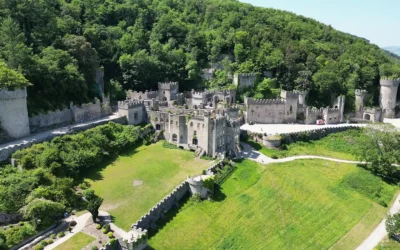
Gwrych Castle: Gothic Revival Ruin, WWII Refuge and Wales's Most Unexpected TV Star In 1940, as Nazi Germany occupied much of Europe, a group of Jewish young people arrived at a ruined Gothic Revival castle on the North Wales coast. Gwrych Castle — already...