
Inveraray Castle
Inveraray Castle: Where Scotland's Most Powerful Clan Meets the Shores of Loch Fyne
The Campbells have been the most politically significant family in the Scottish Highlands for over five centuries — Earls of Argyll since 1457, Dukes since 1701, Chiefs of one of Scotland's largest and most influential clans, advisers to monarchs from Robert the Bruce onwards.
Their seat at Inveraray on the shores of Loch Fyne is not simply a grand house but a symbol of power exercised across every era of Scottish history, from the Wars of Independence to the Jacobite risings to the British Empire. The castle that stands there today is, among other things, one of the earliest Gothic Revival buildings in Scotland — a design that prefigured a movement in British architecture by nearly a century.
Inveraray Castle was begun in 1746 to a design by Roger Morris inspired by a sketch attributed to Sir John Vanbrugh, with the Adam family — William, and later his sons James and Robert — overseeing the construction over the following decades. The 1877 fire that gutted the upper floors gave the building the distinctive conical roofs on its four circular towers that complete its fairy-tale profile today. The 13th Duke of Argyll and his family still live in private apartments within the castle. This guide covers everything you need to plan your visit.
Where Is Inveraray Castle?
Inveraray Castle is on the northern shore of Loch Fyne, immediately adjacent to the Royal Burgh of Inveraray, in Argyll and Bute, approximately 60 miles north-west of Glasgow. The journey from Glasgow by car takes around one and a half hours via the A83 through Loch Lomond and the Rest and Be Thankful pass — a scenic approach in its own right. From the town of Inveraray the castle is easily reached on foot.
Public transport from Glasgow to Inveraray is available via Scottish Citylink bus services. The nearest railway station is Arrochar & Tarbet, around 20 miles away, from where buses or taxis cover the remaining distance.
A Brief History of Inveraray Castle
The Campbell family established a castle at Inveraray as early as 1432, when the Earldom of Argyll was already one of the most powerful in Scotland. The Campbells' political significance grew through the 15th and 16th centuries, their fortunes closely tied to the Protestant cause and the English alliance.
They remained loyal to the government during both the 1715 and 1745 Jacobite risings — their Argyll neighbours the Farquharsons went the other way — and it was in 1746, in the immediate aftermath of Culloden, that the 3rd Duke of Argyll commissioned a new castle to replace the original.
The architects were Roger Morris and William Adam, whose design drew on a sketch from the papers of Sir John Vanbrugh — the playwright and architect of Blenheim Palace. After William Adam's death in 1748, his sons Robert and James completed the work, which spanned some 43 years in total.
Robert Adam, who would become one of the greatest architects in British history, contributed the neoclassical interiors completed for the 5th Duke in the 1780s and 1790s. The castle was substantially complete when fire swept through the upper floors in 1877. The rebuilding added a third floor and the steep conical roofs on the four circular towers that define the castle's silhouette today.
Queen Victoria was a frequent visitor during her Highland travels, and the castle's archives — the Argyll Estates Archives — are among the most historically significant estate records in Scotland, documenting centuries of landscape, land management and political activity. The 13th Duke of Argyll continues to live at Inveraray, maintaining the castle as a family home while opening it to visitors during the season.
The remarkable thing about Inveraray is the continuity of its political centrality. For six centuries, the Campbells have been at the heart of Scotland's governance — loyal to the crown, powerful in their region, never quite marginalized — and the castle on Loch Fyne has been their base throughout.
Architecture & Design
Inveraray Castle is one of the earliest Gothic Revival buildings in Scotland — a distinction significant enough that it influenced later buildings including Strawberry Hill House, the famous Gothic villa created by Horace Walpole from 1749.
The 1746 design by Roger Morris, drawing on the Vanbrugh sketch, created a castle with a symmetrical façade of four circular towers connected by rectangular ranges, all in grey ashlar stone quarried locally. The 1877 fire's legacy — the steep conical roofs added to the four towers during rebuilding — gave the castle the instantly recognisable fairy-tale profile it has today.
Inside, Robert Adam's neoclassical interiors for the 5th Duke represent his work at its most refined. The Armoury Hall is the standout interior in Scotland: nearly 1,300 weapons arranged formally on walls and ceiling — Brown Bess muskets, Lochaber axes, Scottish broadswords, pistols and polearms — forming a composition of extraordinary visual impact, a room that is simultaneously a functional arsenal record and a work of decorative art. The state rooms contain period furniture, tapestries and family portraits across three floors. A clan room displays the Campbell family tree.
Legends & Lore
Inveraray Castle has no strongly established ghost tradition — it is a castle whose fascination lies in documented history rather than folklore, and the Campbells' story is dramatic enough without embellishment. What the castle does carry is the weight of six centuries of real political consequence: decisions made here shaped Scotland's fate through the Reformation, the Covenanting Wars, the Glorious Revolution, the Jacobite risings and the consolidation of the British state.
The castle's cultural connections include royal visits — Queen Victoria came here frequently, finding Argyll as appealing as she found the rest of the Highlands — and film and television appearances that have brought the castle and the Clan Campbell story to wider audiences. The character of the Duke of Argyll is a recurring presence in historical fiction about the 18th-century Highlands, and Inveraray itself appears as a location in several productions.
Visiting the Castle
Important: Inveraray Castle is closed on Tuesdays and Wednesdays throughout the season. Open Thursday to Monday only. The season runs from spring to late October — check the official website for current opening dates and times, as they vary by month.
The visit covers three floors of the castle, taking in the Armoury Hall — which alone is worth the journey, the 1,300-weapon installation unlike anything else in a Scottish castle — the state rooms with their Robert Adam interiors, tapestries and family portraits, and the clan room with the Campbell family tree.
Guided tours provide historical context for the rooms and the family's story. Video tours of the basement and first floor are also available, requiring earphones which can be purchased at the ticket office — useful for those with mobility difficulties who cannot manage the stairs.
A gardens-only ticket is available for those wishing to explore the grounds without entering the castle; the gardens offer outstanding views across Loch Fyne. The castle restaurant serves traditional Scottish cuisine using locally sourced produce. There is a gift shop with Scottish crafts and clan-related items. Photography for personal use is generally permitted in the castle and gardens; confirm with staff on arrival for any room-specific restrictions.
Free entry for blue-badge holders and one assistant.
Check Tickets & Tour Times for Inveraray Castle →
For current opening dates, hours and prices, check the official Inveraray Castle website before you travel.
Where to Stay Near Inveraray Castle
Inveraray Castle does not offer visitor accommodation. The town of Inveraray, a Royal Burgh since 1648, is immediately adjacent and has a range of hotels and guesthouses along Loch Fyne — staying in town allows easy access to both the castle and the town's own historic attractions. Inveraray is also a reasonable base for exploring the wider Argyll landscape.
Find Hotels & Stays in Inveraray →
The Best Time to Visit
Summer (June to August) offers the best weather for the gardens and the Loch Fyne setting, the longest days and the full opening programme. Spring (April to May) and early autumn (September to October) are quieter, and the Argyll landscape is arguably at its most beautiful in the softer light of these seasons.
Always check the opening days before travelling — Inveraray Castle is closed on Tuesdays and Wednesdays throughout its season, and visiting on those days means the castle will be shut. The season ends in late October; check the official website for the current year's closing date.
How to Get There
By car. From Glasgow, take the A82 north along Loch Lomond and then the A83 over the Rest and Be Thankful pass to Inveraray — around one and a half hours. The drive through the Arrochar Alps is one of the finest in the southern Highlands. From Edinburgh allow around two and a half hours.
By bus. Scottish Citylink services from Glasgow to Campbeltown and to Oban pass through Inveraray, with stops in the town centre a short walk from the castle.
By train. The nearest station is Arrochar & Tarbet on the West Highland Line, approximately 20 miles from Inveraray; taxis and occasional buses cover the remaining distance.
Compare Transfers & Local Transport in Argyll →
Nearby Attractions
Inveraray sits in one of the finest landscapes in the southern Highlands, with several excellent nearby sites.
| Attraction | Why Visit | Distance |
|---|---|---|
| Inveraray Jail | A beautifully preserved Victorian prison with immersive exhibits on Scotland's judicial history | ~0.5 miles |
| Inveraray Bell Tower | A striking memorial tower with panoramic views over the town and Loch Fyne — rung regularly by a team of bell-ringers | ~0.5 miles |
| Kilchurn Castle (Historic Environment Scotland) | A dramatic 15th-century Campbell ruin at the head of Loch Awe — one of the finest ruined castles in Argyll | ~12 miles |
| Loch Fyne Boat Trips | Scenic excursions on one of Scotland's longest sea lochs, with views back to Inveraray | Adjacent |
| Argyll Forest Park | The oldest forest park in Britain — outstanding walking, mountain biking and scenery between Loch Lomond and the Kintyre peninsula | ~15 miles |
A natural Argyll day pairs Inveraray Castle with Kilchurn Castle at Loch Awe — two Campbell strongholds separated by 12 miles and centuries of the same family's history.
Browse Argyll & Loch Lomond Tours →
Family & Accessibility
Families. Inveraray Castle works well for older children interested in Scottish history and the Campbells' clan legacy. The Armoury Hall, with its extraordinary display of 1,300 weapons, tends to captivate children immediately. The town of Inveraray and Inveraray Jail add further family-friendly content within walking distance.
Accessibility. The standard castle tour involves stairs throughout with no stair avoidance — visitors with mobility difficulties may find significant areas inaccessible. Video tours of the basement and first floor provide an alternative. Blue-badge holders and one assistant are admitted free. Check the official accessibility information before visiting to plan accordingly. Dogs are not generally admitted inside the castle; check the current grounds policy before bringing a dog.
Practical Tips
- The castle is closed Tuesday and Wednesday — plan your visit for Thursday, Friday, Saturday, Sunday or Monday.
- Book in advance, particularly for peak summer weekends — check the official website for the current ticketing system.
- Wear comfortable walking shoes — the three-floor castle tour involves substantial stair climbing.
- Pack a compact travel umbrella — Argyll weather is notoriously changeable even in summer.
- Bring a portable power bank for a full day of photography across the castle and Loch Fyne.
- Allow time in Inveraray town — the Royal Burgh has considerable charm and Inveraray Jail is a genuinely excellent attraction in its own right.
- Overseas visitor? Pack a UK travel adapter for Type G plugs.
Conclusion
Inveraray Castle has been the seat of the Campbells — Earls and Dukes of Argyll, Chiefs of Clan Campbell — for six centuries, and the Gothic Revival building on the shore of Loch Fyne was already architecturally avant-garde when it was designed in 1746. The Armoury Hall's 1,300 weapons are among the most extraordinary single rooms in a Scottish castle.
The neoclassical interiors by Robert Adam are among his finest surviving work. And the Loch Fyne setting, with the Argyll hills reflected in the water and the town of Inveraray at the castle's gate, is one of the most beautiful in the Scottish Highlands. For a castle where great history was made rather than merely witnessed, Inveraray is exceptional.
Frequently Asked Questions
What days is Inveraray Castle open?
The castle is open Thursday to Monday during its season, which runs from spring to late October. It is closed on Tuesdays and Wednesdays throughout. Always confirm current opening days and dates on the official website before travelling.
How much does it cost to visit Inveraray Castle?
Admission fees vary by age, with concessions for seniors and students, a family ticket, and free entry for blue-badge holders with one assistant. A gardens-only ticket is also available. Check the official website for current prices.
What is the Armoury Hall at Inveraray Castle?
The castle's most celebrated interior — a formal display of nearly 1,300 weapons including Brown Bess muskets, Lochaber axes and 18th-century Scottish broadswords, arranged on the walls and ceiling of the hall. It is one of the most visually striking rooms in any Scottish castle.
Who designed Inveraray Castle?
Roger Morris designed the original 1746 castle, drawing on a sketch attributed to Sir John Vanbrugh. William Adam began construction; after his death in 1748, his sons Robert and James Adam completed the work and designed the neoclassical interiors. Robert Adam is considered one of Britain's greatest architects.
Is the current Duke of Argyll still living at Inveraray Castle?
Yes — the 13th Duke of Argyll and his family reside in private apartments within the castle. Inveraray remains a family home as well as a visitor attraction.
Is Inveraray Castle suitable for visitors with mobility difficulties?
The standard tour involves stairs throughout with no stair avoidance. Video tours of the basement and first floor are available for those who cannot manage the stairs. Blue-badge holders with one assistant are admitted free. Check the official accessibility guide before visiting.
Is there food at Inveraray Castle?
The castle restaurant serves traditional Scottish cuisine made with locally sourced ingredients.
Are dogs allowed at Inveraray Castle?
Dogs are not generally admitted inside the castle. Check the current policy for the grounds before bringing a dog.
How do I get to Inveraray Castle from Glasgow?
By car, take the A82 north along Loch Lomond then the A83 to Inveraray — around one and a half hours. By bus, Scottish Citylink services from Glasgow to Campbeltown and Oban stop in Inveraray.
Can I visit just the gardens at Inveraray Castle?
Yes — a gardens-only ticket is available, giving access to the grounds and the views of Loch Fyne without entering the castle.
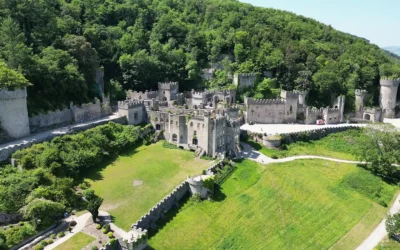
Gwrych Castle
Gwrych Castle: Gothic Revival Ruin, WWII Refuge and Wales's Most Unexpected TV Star In 1940, as Nazi Germany occupied much of Europe, a group of Jewish young people arrived at a ruined Gothic Revival castle on the North Wales coast. Gwrych Castle — already...
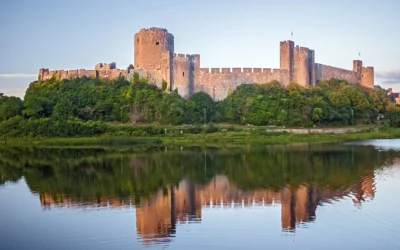
Pembroke Castle
Pembroke Castle: Where Henry VII Was Born, Above a Prehistoric Cave Beneath Pembroke Castle, in the limestone bedrock on which the fortress stands, there is a cave. Wogan Cavern is a prehistoric chamber that was occupied by early humans long before any castle existed...
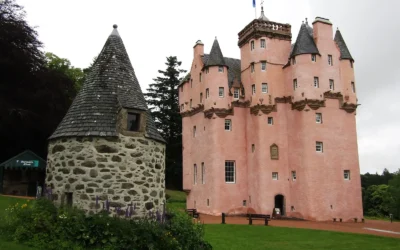
Craigievar Castle
Craigievar Castle: The Pink Tower That Danzig Willy Built, Rising Above Aberdeenshire William Forbes made his fortune trading with the Baltic port of Danzig — now Gdańsk in Poland — in the early years of the 17th century. So successful was his trade that he became...
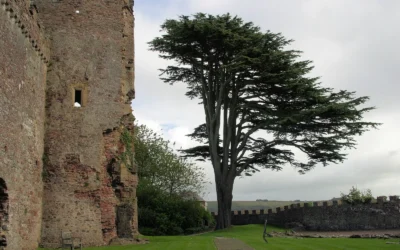
Laugharne Castle
Laugharne Castle: The "Brown as Owls" Fortress Where Dylan Thomas Found His Voice Dylan Thomas called it "the brown as owls castle" — a phrase that tells you as much about the poet's way of seeing as it does about the castle itself. Thomas...
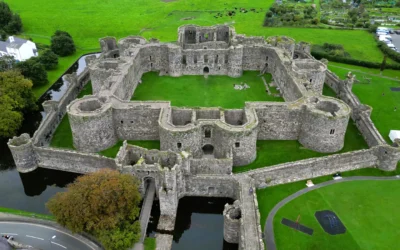
Beaumaris Castle
Beaumaris Castle: The Most Perfect Fortress Never Finished, on the Isle of Anglesey In 1295, Master James of St George began designing the most geometrically perfect concentric castle in the history of medieval military architecture. The inner ward was rectangular,...