
Grey Mare’s Tail
Grey Mare’s Tail: The 60-Metre Cascade That Hides a Secret Loch Above It
Most people who pull into the car park below Grey Mare’s Tail come for the waterfall — a tall, thin ribbon of white water dropping 60 metres down a craggy cliff into the Moffat Water valley. And the waterfall alone is worth the journey. But the falls keep a secret: climb the steep path beside them, and at the top you reach Loch Skeen, a remote upland loch ringed by crags that almost nobody expects. The rangers here call it “the big reveal” — you come over the brow of the hill and there it is, hidden until the last moment.
Grey Mare’s Tail is in the heart of the Southern Uplands, about 10 miles north-east of Moffat in Dumfries and Galloway. The National Trust for Scotland manages the surrounding 922-hectare nature reserve, where peregrine falcons nest on the crags, feral goats roam the slopes, and ospreys sometimes fish in the loch above. The waterfall was an early tourist draw, celebrated by Sir Walter Scott in his poem Marmion. This guide covers everything you need to plan your visit — the falls, the climb, the wildlife, where to park and where to stay.
About Grey Mare’s Tail
Grey Mare’s Tail is a 60-metre (200-foot) hanging valley waterfall, formed where the Tail Burn flows out of Loch Skeen and tumbles over the lip of a hanging valley into the Moffat Water below. It is frequently described as “one of the UK’s highest” — more precisely, it is widely cited as the fifth-highest waterfall in the UK, and the height refers to the main fall, with further cascades above it. It is honest to call it one of the highest in Britain rather than to claim a single superlative; either way, it is among the most impressive cascades in Scotland.
The hanging valley itself is a textbook piece of glacial geology. During the last Ice Age, a large glacier carved the deep main valley of Moffatdale, while a smaller glacier in the tributary valley of the Tail Burn cut less deeply. When the ice melted, the tributary valley was left “hanging” some 250 metres above the main valley floor — and the Tail Burn now plunges over that lip as Grey Mare’s Tail. The underlying rock is Silurian greywacke sandstone and mudstone, and the series of cascades and plunge pools reflects how that bedrock resists erosion at different rates.
Loch Skeen, the loch that feeds the falls, sits in a corrie above and is home to the vendace, one of Britain’s rarest freshwater fish. The reserve as a whole is part of the Southern Uplands Site of Special Scientific Interest, with eight habitats of European importance and a remarkable range of upland plants and birds.
Getting There
By car. The reserve sits on the A708, one of Scotland’s most scenic drives, running between Moffat and Selkirk through rolling hills and the Moffat Water valley. From the M74, exit at Junction 15 for Moffat, then follow the A708 north-east for around 10 miles. The car park is on the valley floor directly below the falls. Selkirk lies around 25 miles to the north-east along the same road.
By bike. The A708 is a popular and beautiful cycling route, though it is a single carriageway road with traffic, so care is needed. Bike racks are provided at the car park.
By public transport. This is the reserve’s weak point — there is no bus that stops at the falls. Buses serve Moffat (around 10 miles away), from where a taxi is the most practical onward option. Check Stagecoach and Borders Buses for current routes to Moffat. Given the limited transport, many visitors make a night of it in Moffat and drive the short, scenic A708 to the falls.
On foot. Walking the full 10 miles from Moffat along the A708 is possible for the very keen, but it is a long roadside walk; most visitors drive or cycle to the car park and walk from there.
Coming from further afield. Moffat sits just off the A74(M) (Junction 15), which makes the falls very reachable from across the UK. By road it is around an hour from Glasgow, roughly an hour and a half from Edinburgh, and about 45 minutes from Carlisle.
The nearest railway station is Lockerbie, around 16 miles south on the main West Coast line, with direct trains from London, Manchester, Glasgow and Edinburgh; from Lockerbie a connecting bus or taxi reaches Moffat.
The most convenient airports are Glasgow (both Glasgow International and Prestwick) and Edinburgh, all with car hire available — and since the reserve has no direct public transport, hiring a car at the airport and driving down is the simplest approach for visitors arriving from outside the region.
Compare Transfers & Local Transport in Dumfries & Galloway →
Where Does the Name Come From?
There are two explanations for the name, and both are worth knowing. The simpler one is visual: the tall, thin, white ribbon of frothing water genuinely resembles the flowing tail of a grey mare, and the name is a straightforward piece of descriptive folk-poetry.
The second is literary. The name is also linked to Tam o’ Shanter’s grey mare, Meg, in Robert Burns’s famous narrative poem — the mare who, in the poem’s climactic chase, loses her tail to the pursuing witches. The image of a horse’s tail, snatched and streaming, attaches neatly to the shape of the falls.
Whichever you prefer, the waterfall’s literary pedigree is real: Sir Walter Scott celebrated it in his poem Marmion, describing how the water “issuing forth one foamy wave… white as the snowy charger’s tail / drives down the pass of Moffatdale.”
The Walk & Trails
There are essentially three walks here, ranging from a five-minute stroll to a serious half-day hike. All start from the car park.
The Waterfall Viewpoint is the easy option: a short, roughly 150-metre walk on a surfaced path on the lower, eastern side, leading to a viewpoint with benches where you can take in the full drop of the falls. This is the route for anyone with limited time or mobility, and it still delivers the headline view.
The Loch Skeen path is the classic walk, and a strenuous one. It begins on the west side of the Tail Burn, crosses a footbridge to an interpretation area in an old sheepfold, then climbs steeply up the side of the gorge, rising above the ravine with increasingly dramatic views of the falls. After the steep lower section the path eases, passing several smaller falls, and continues up the hanging valley to the outflow of Loch Skeen. It is around 2½ miles each way and takes roughly 1½ to 2 hours up. The path runs close to a deep gorge with steep drops, and the surface is rough and slippery when wet — keep to the path and take real care, especially with children.
The White Coomb route continues beyond Loch Skeen to the summit of White Coomb (821 metres), the highest hill in Dumfriesshire, with panoramic views reportedly reaching the Lake District and Northumberland. This is a full mountain walk on rough, exposed terrain for experienced hill-walkers only.
Parking
There is a National Trust for Scotland car park on the valley floor directly below the falls, with a gravel surface and parking on both sides of the river. Parking charges apply and are free for National Trust for Scotland members — check the official NTS website for current rates rather than relying on figures that change. The car park can get busy at weekends and in good weather, so arriving early is sensible. It is not suitable for coaches. Accessible parking and bike racks are available, and there is a small information point. Roadside parking along the A708 is possible in places but requires caution on a fast single-carriageway road.
Facilities
This is a wild upland nature reserve, and facilities are deliberately minimal — it is important to know this before you arrive.
There are no toilets at the reserve. The nearest public toilets are at St Mary’s Loch (around 5 miles north-east) or in Moffat (around 10 miles away). Plan accordingly, especially if you are travelling with children.
There is no café, shop or visitor centre beyond a small National Trust for Scotland information point at the car park (which during the nesting season has featured a webcam of the peregrine falcons). Bring everything you need with you — water, food and warm layers. Moffat, 10 miles away, has a good range of cafés and tea rooms for before or after your visit.
In terms of accessibility, the waterfall viewpoint path is surfaced and suitable for most visitors, including wheelchair and pushchair users for the short distance to the viewpoint. The Loch Skeen and White Coomb paths are steep, rough and unsuitable for wheelchairs, pushchairs or anyone with mobility difficulties.
Things to Know Before You Go
Wildlife. Keep an eye on the crags for nesting peregrine falcons, and the slopes for the reserve’s feral goats. Ring ouzels breed here, kestrels hunt the valley, and on a calm day you might see ospreys fishing at Loch Skeen. The area is also within the range of the South of Scotland Golden Eagle Project. Binoculars are well worth bringing.
Dogs are welcome but must be kept on a lead at all times, due to the livestock grazing the reserve and the ground-nesting birds and wildlife.
Swimming is not recommended at the waterfall, where strong currents, cold water and the gorge make it genuinely dangerous. The deep plunge pools and the fast water are not a safe swimming spot — treat the falls as a place to look at, not to enter.
Safety. The single most important thing to know is that the gorge-side path is steep with sheer drops, and the rock is slippery when wet. Walkers are asked to keep strictly to the path, both for their own safety and to prevent soil erosion. Wear footwear with good grip, and supervise children closely throughout.
Weather. This is upland Scotland — conditions are frequently windy and wet, and change quickly. Dress for the weather whatever the forecast.
Where to Stay
The natural base for visiting Grey Mare’s Tail is Moffat, around 10 miles away — a handsome Victorian former spa town with a famously broad High Street, independent shops, cafés and a wide choice of places to stay. With several hotels in and around the town centre and more than sixty guesthouses and B&Bs, Moffat caters well for walkers exploring the Southern Uplands, and it makes an excellent stopover for anyone travelling the A74(M) between Glasgow and Carlisle.
Staying in Moffat also puts you within easy reach of the Devil’s Beef Tub, St Mary’s Loch and the wider Borders countryside, so it works well as a base for a longer stay rather than just a single afternoon at the falls.
Find Hotels & Stays in Moffat →
What to Pack
Grey Mare’s Tail genuinely rewards coming properly equipped — the terrain is rough and the weather changeable, so a little kit goes a long way.
- Sturdy walking boots with good grip are essential for the steep, often wet gorge path. A pair of waterproof walking boots is the single most useful thing to bring.
- A waterproof jacket — upland Southern Scotland is windy and wet, and the weather turns fast.
- Binoculars for the peregrines, goats and ospreys — this is genuinely good wildlife-watching country.
- A reusable water bottle and snacks, since there are no facilities at the reserve.
- For photographers, a travel tripod is worth the weight for long-exposure shots of the falls.
Nearby Attractions
The reserve sits in some of the finest scenery in southern Scotland, and there is plenty nearby to build a full day or weekend around.
| Attraction | Why Visit | Distance |
|---|---|---|
| Moffat | A charming Victorian spa town with a broad High Street, independent shops, cafés and the famous Moffat Toffee Shop; also Europe’s first official Dark Sky Town | ~10 miles |
| St Mary’s Loch | The largest natural loch in the Borders, a serene spot for a gentle walk in the Yarrow Valley — and home to the nearest public toilets | ~5 miles |
| Devil’s Beef Tub | A spectacular deep “box” valley north of Moffat, once used by reivers to hide stolen cattle and later a refuge for persecuted Covenanters | ~12 miles |
| Dob’s Linn | An internationally important geological site at the edge of the reserve, famous for graptolite fossils that help define a global boundary in the rock record | ~2 miles |
| Selkirk | A historic Borders town known for its textile heritage and its annual Common Riding | ~25 miles |
For a relaxed day, pair the falls with a wander around Moffat and a stop at St Mary’s Loch on the scenic A708. For something more active, combine Grey Mare’s Tail with a guided experience in the wider region.
Browse Dumfries & Galloway Tours & Experiences →
Photography Tips
Grey Mare’s Tail is a rewarding subject, and a little planning makes a real difference.
Visit after rain, when the waterfall carries far more water and becomes genuinely dramatic — this is the single biggest factor in a strong shot. Aim for early morning or late afternoon, when the low golden light catches the falls and the surrounding hills far more flatteringly than harsh midday sun.
Bring a tripod for long exposures that turn the falling water into a smooth white ribbon. And don’t only shoot the falls head-on — include the surrounding peaks and the sweep of the valley for scale and context, and turn around on the climb for the view back down Moffatdale, where the river threads like silver along the valley floor.
Conclusion
Grey Mare’s Tail gives you two things for the price of one steep climb. There’s the waterfall — 60 metres of white water that Walter Scott put into verse and that looks its thunderous best after a day of rain. And there’s the secret above it: Loch Skeen, hidden in its corrie until you crest the final rise and the whole tranquil sheet of water opens out in front of you. Take the five-minute stroll if that’s all you have time for; the view is still worth it. But if your legs are willing and the weather holds, climb past the falls to the loch. That “big reveal” is the moment this place is really about.
Frequently Asked Questions
How tall is Grey Mare’s Tail?
The main fall is 60 metres (200 feet). It is widely described as the fifth-highest waterfall in the UK, with further smaller cascades above the main drop.
Is there a fee to visit Grey Mare’s Tail?
There is no entrance fee to the reserve itself. Parking charges apply at the car park and are free for National Trust for Scotland members — check the official NTS website for current rates.
What is the best time to visit Grey Mare’s Tail?
Spring and autumn bring fewer crowds, vibrant colour and fewer midges. Visiting after rainfall makes the waterfall far more dramatic. Summer has the longest days but the busiest trails.
Are dogs allowed at Grey Mare’s Tail?
Yes, but dogs must be kept on a lead at all times because of grazing livestock and the reserve’s ground-nesting birds and wildlife.
Is Grey Mare’s Tail accessible for wheelchairs?
The short, surfaced path to the waterfall viewpoint is accessible for most visitors, including wheelchair and pushchair users. The longer paths to Loch Skeen and White Coomb are steep, rough and not accessible.
Can I swim at Grey Mare’s Tail?
Swimming is not recommended. The waterfall has strong currents, very cold water and a steep gorge, making it dangerous. It is a place to admire rather than enter.
Are there toilets or a café at Grey Mare’s Tail?
No. There are no toilets, café or shop at the reserve — only a small information point at the car park. The nearest public toilets are at St Mary’s Loch (around 5 miles) or Moffat (around 10 miles), and Moffat has cafés and tea rooms.
How long is the walk to Loch Skeen?
The Loch Skeen path is around 2½ miles each way and typically takes 1½ to 2 hours to climb. It is strenuous, with a steep gorge-side section and rough ground, so allow plenty of time.
What should I wear and bring?
Sturdy walking boots with good grip are essential, along with a waterproof jacket and warm layers for changeable upland weather. Bring water, snacks and ideally binoculars for the wildlife, as there are no facilities on site.
Are there guided tours at Grey Mare’s Tail?
The reserve doesn’t run regular guided tours of its own, though the National Trust for Scotland occasionally offers ranger-led walks, and operators in the wider region run guided experiences. Check the official NTS website for any scheduled events.
How do I get to Grey Mare’s Tail from further afield?
Moffat sits just off the A74(M) at Junction 15 — around an hour from Glasgow, about 90 minutes from Edinburgh and roughly 45 minutes from Carlisle. The nearest railway station is Lockerbie (around 16 miles), on the main West Coast line with direct trains from London, Manchester, Glasgow and Edinburgh. The handiest airports are Glasgow (International and Prestwick) and Edinburgh. As there is no direct public transport to the falls, hiring a car is the easiest way to complete the journey.
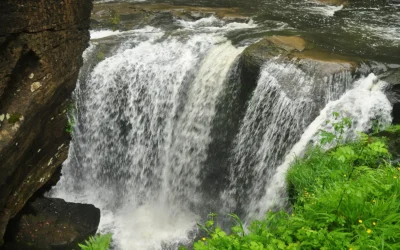
Aberdulais Falls
Aberdulais Falls: Where Wales' Industrial Story Began In the winter of 1584, a German engineer named Ulrich Frosse chose this gorge for a secret reason: the River Dulais plunging over its ridge of hard Pennant sandstone was exactly the power source he needed. Under...
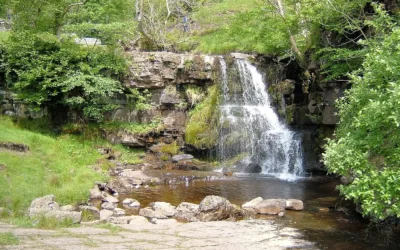
East Gill Force
East Gill Force: Where Two Great Walks Meet There is a particular pleasure in arriving at East Gill Force. You have walked the short path from Keld, crossed the long stone footbridge over the River Swale, and then the path turns and the waterfall is simply there — the...
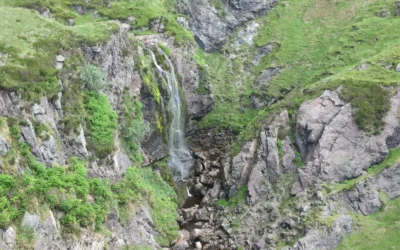
Spout of Garnock
Spout of Garnock: Ayrshire's Highest Waterfall The River Garnock rises on the southern slopes of the Hill of Stake, the highest summit in Clyde Muirshiel Regional Park, and barely has time to become a river before it falls off the edge of the moorland. About a mile...
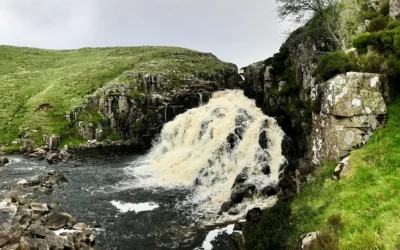
Cauldron Snout
Cauldron Snout: England's Longest Waterfall Most waterfalls announce themselves with a sudden vertical drop. Cauldron Snout does something different: it unrolls. From below, the River Tees is white and relentless for two hundred yards, cascading down the black...
Falls of Foyers
Falls of Foyers: The Smoking Falls of Loch Ness When Robert Burns reached the Falls of Foyers in 1787 and looked down into the gorge, he saw what he described as "the horrid cauldron" — the deep, spray-filled amphitheatre at the base of the lower falls,...