
Falls of Clyde
Falls of Clyde: Scotland's Four Waterfalls on the River Clyde
Stand at the Corra Linn viewpoint after heavy rain and the whole River Clyde seems to gather itself and throw itself over the edge — twenty-six metres of white water crashing into a wooded gorge, the spray hanging in the air and the roar filling the trees. This is the grandest of the Falls of Clyde, a series of four waterfalls near the historic village of New Lanark, and one of the most painted and written-about corners of Scotland.
Turner sketched here; Wordsworth wrote a poem about Corra Linn; Coleridge and Sir Walter Scott came too. Yet there's a catch the old painters never had to worry about — a 1920s hydro scheme now draws off much of the water, so the falls aren't always in full spate. Time your visit for a "Waterfall Day," or for a day or two after rain, and you'll see exactly what inspired them.
Here's everything you need to plan a visit.
About the Falls of Clyde
The Falls of Clyde are a series of four linns — a Scots word for a waterfall or the pool beneath it — on the River Clyde near Lanark, in South Lanarkshire. Three of them lie within the Falls of Clyde wildlife reserve, reached through New Lanark, and the fourth sits some way downstream.
Each has its own character. Corra Linn is the star, the highest and most dramatic, dropping around 26 metres (84 feet) in a multi-tiered cascade. Bonnington Linn, around 9 metres (30 feet), is the uppermost fall, where a weir diverts water to the power station. Dundaff Linn is the smallest at roughly 3 metres (10 feet), close to New Lanark. And Stonebyres Linn, about 24 metres (80 feet), tumbles downstream near Kirkfieldbank, away from the main reserve.
The reserve is cared for by the Scottish Wildlife Trust and forms part of the Clyde Valley Woodlands National Nature Reserve, a Site of Special Scientific Interest. The gorge is cloaked in ancient oak and ash woodland, alive with wildlife — over a hundred bird species have been recorded here, including kingfishers, dippers and a breeding pair of peregrine falcons, while badgers forage in the undergrowth, otters slip along the riverbank and Daubenton's bats feed over the water at dusk. The 15th-century ruin of Corra Castle, now a roost for rare bats, stands close to Corra Linn.
Getting there
By car, the Falls of Clyde are reached through New Lanark, which is well signposted from all major routes. From Glasgow, around 25 miles away, the usual route is to leave the M74 and follow the A72 up the Clyde Valley to Lanark, then pick up the brown tourist signs for New Lanark. From Edinburgh, roughly 35 miles off, take the A70 west via Carstairs. Either way, allow about an hour.
A word on the drive: the A72 along the Clyde Valley is a lovely road through orchard country, but it has tight bends and steep drops in places, so take it steadily — and ignore any sat-nav that tries to send you in via the narrow country track at The Beeches, which isn't suitable for cars.
By train, ScotRail runs regularly from Glasgow Central to Lanark, taking about an hour. From Lanark it's a short bus ride (the 135 serves New Lanark) or a scenic walk of around a mile down to the village — bear in mind the return is uphill.
For visitors coming from further afield who would rather not drive, a local driver can take the strain of the journey from the city.
Compare Transfers & Local Transport around Glasgow →
Where does the name come from?
The word linn is Scots for a waterfall or the deep pool at its foot, from the Old English hlynn. The name of the largest fall, Corra Linn, is less settled: some trace "Corra" to the Gaelic currach, meaning a marshy place, while others link it to a Gaelic word for a weir and to the nearby Corra Castle, once held by the Weir family, leading landowners in the county for centuries.
The legend is more dramatic than the etymology. Local tradition tells of Cora, said to be a daughter of King Malcolm II, who leapt to her death over the falls while fleeing some imagined danger — a tale that has clung to the gorge for generations and given Corra Linn a touch of tragic romance to match its grandeur.
The walk and the trails
The reserve is entered from New Lanark. From the car park you walk down into the village, past the visitor centre, and join the riverside path that climbs gently up the gorge — the final stretch of the long-distance Clyde Walkway.
The first fall you reach is little Dundaff Linn, close to the village. Beyond it the path follows the tumbling Clyde, passing a section of boardwalk almost level with the water (which may be closed when the river is in flood), before climbing past the historic Bonnington power station to the celebrated Corra Linn viewpoint. Most people reach Corra Linn in around twenty to twenty-five minutes, and for many that dramatic view is the highlight of the visit.
The keener walker can carry on upstream to Bonnington Linn at the top of the reserve, returning on a higher path through the woodland to make a loop of roughly four miles, well waymarked with blue markers. It's graded moderate: rewarding, but with some muddy, uneven sections and steep drops into the gorge, so sturdy footwear and care near the edges are essential.
Parking
The main car park is at New Lanark, at the top of the village — parking down within the historic village itself is reserved for residents, with a shuttle bus running between the car park and the village. It's a popular spot and fills quickly on fine weekends and in the school holidays, so arriving early is wise.
If it's full, there are car parks in Lanark town centre about a mile away, from where you can walk down to New Lanark — a pleasant route, but remember it's a steep descent and a climb back up at the end. Check the official New Lanark website for current parking details before you set off.
Facilities
For a Scottish waterfall, the Falls of Clyde are unusually well served. The Scottish Wildlife Trust runs the Falls of Clyde Visitor Centre in New Lanark, with exhibits on the waterfalls, the woodland and the wildlife — including a popular bats display — and a small shop. There are toilets here, and the historic village of New Lanark right beside it has a café, a shop and its own larger visitor centre.
On the accessibility front, the visitor centre is wheelchair accessible, and an accessible parking area near the river gives step-free access to part of the site, including the wildlife garden. The reserve paths up the gorge, however, are a different matter — steps, steep slopes and uneven ground make most of the trail unsuitable for wheelchairs and pushchairs. It's worth checking the latest access details with the ranger service before a visit.
Things to know before you go
Best time to visit. The falls are at their most powerful after heavy rain — but because the hydro scheme draws off much of the water, they aren't always in full flow. The answer is to look out for scheduled Waterfall Days, when water is released so visitors can see the falls in their natural glory; check the Scottish Wildlife Trust for dates. Spring brings woodland wildflowers and breeding peregrines, autumn a wealth of fungi and colour. Note that access to parts of the reserve can be restricted between April and July to protect the nesting peregrines.
Dogs. Well-behaved dogs are welcome but must be kept under close control, as there are steep drops and sensitive wildlife throughout the gorge.
Accessibility. The visitor centre and the riverside wildlife garden are accessible, but the gorge trails have steps, steep slopes and uneven, often muddy surfaces, and are not suitable for wheelchairs or pushchairs.
Families and safety. It's a wonderful walk for children, with wildlife to spot and water to watch, but the hazards are real: steep cliffs, deep, fast-flowing water and riverside boardwalks. Keep children close, stay on the waymarked paths, and never sit on or cross the safety barriers.
Swimming. No — this is not a place to swim. The currents are strong, there are underwater hazards, and the hydro scheme means water levels can change suddenly and without warning, which makes the river genuinely dangerous. Enjoy the falls from the viewpoints.
Where to stay
Most visitors base themselves in or around Lanark, the historic market town about a mile from New Lanark, which has the widest choice of places to stay and a direct rail link to Glasgow — handy for shops, eateries and exploring the wider Clyde Valley.
For something special, you can stay right in the World Heritage village itself: New Lanark's converted mill buildings include a hotel and a hostel, putting you within a few minutes' walk of the falls and able to enjoy the village once the day-trippers have gone.
Find Hotels & Stays in Lanark →
What to pack
The walk is straightforward, but the Scottish weather and the spray near the falls reward a little preparation.
- A pair of waterproof walking boots with good grip — the gorge paths are muddy and slippery, especially after rain.
- A waterproof jacket and warm layers; the weather in the valley can turn quickly.
- A pair of binoculars for the kingfishers, peregrines and the many other birds of the reserve.
- A travel tripod for long-exposure shots of Corra Linn in full flow.
An OS map, a dry bag for your phone and camera, and water and snacks for the walk round out the kit nicely.
Nearby attractions and making a day of it
This corner of the Clyde Valley packs a lot into a small area, from a UNESCO village to a clifftop castle.
| Attraction | Why Visit | Distance |
|---|---|---|
| New Lanark World Heritage Site | A beautifully preserved 18th-century cotton-mill village and UNESCO site — Robert Owen's model community, with museums, working machinery, a rooftop garden and a café | Adjacent |
| Lanark | The historic market town where William Wallace first rose against English rule, with the Tolbooth, a heritage trail and the local museum | ~1 mile |
| Stonebyres Linn | The fourth and lowest of the Falls of Clyde, a wild 24-metre cascade downstream near Kirkfieldbank | ~3 miles |
| Craignethan Castle | A dramatic 16th-century artillery fortress above the Nethan gorge — Sir Walter Scott's "Tillietudlem," which once sheltered Mary, Queen of Scots | ~5 miles |
| Strathclyde Country Park | A vast, free country park around a loch, with walking trails, watersports and family attractions | ~10 miles |
For a full day, pair the falls with New Lanark village right on the doorstep, then drive out to Craignethan Castle or Strathclyde Country Park.
Browse Glasgow & Lanarkshire Tours →
Photography tips
The Falls of Clyde are a rewarding subject. The Corra Linn viewpoint gives you the classic shot — the full multi-tiered drop framed by the wooded gorge — and the riverside path offers pleasing glimpses of the smaller falls and the Clyde along the way.
Visit after rain, or on a Waterfall Day, for the strongest flow, and aim for the soft light of early morning or late afternoon. Bring a tripod for a long exposure that turns the water to silk, watch your footing on the wet rock, and keep an eye out for kingfishers and dippers to add a flash of life to your woodland shots.
Conclusion
The Falls of Clyde are proof that you don't need to travel to the far north for drama — a short walk from a historic mill village delivers you to a 26-metre cascade that has stirred poets and painters for centuries. Just remember the one quirk the old masters never faced: pick a day after rain, or a Waterfall Day, and Corra Linn will give you the full, thundering spectacle it's famous for.
FAQs
How tall are the Falls of Clyde?
The Falls of Clyde are four waterfalls. Corra Linn is the tallest and most impressive at around 26 metres (84 feet); Bonnington Linn is about 9 metres (30 feet), Dundaff Linn around 3 metres (10 feet), and Stonebyres Linn, downstream, roughly 24 metres (80 feet).
Is there a fee to visit the Falls of Clyde?
The falls themselves are free to visit, though the Scottish Wildlife Trust, which cares for the reserve, welcomes a donation. The New Lanark car park charges for parking. Check the official websites for current details.
What is the best time to visit the Falls of Clyde?
After heavy rain for the fullest flow — but as a hydro scheme draws off the water, look out for scheduled Waterfall Days when it's released. Spring brings wildflowers and breeding peregrines, and autumn fine colour and fungi.
What are Waterfall Days at the Falls of Clyde?
Because the Bonnington hydro-electric scheme draws off much of the river, the falls are not always in full spate. On agreed Waterfall Days, water is released so visitors can see them at their natural, dramatic best. Check the Scottish Wildlife Trust for dates.
Are dogs allowed at the Falls of Clyde?
Yes, well-behaved dogs are welcome, but keep them under close control because of the steep drops and the sensitive wildlife in the gorge.
Is the Falls of Clyde accessible for wheelchairs?
The visitor centre and the riverside wildlife garden are accessible, with an accessible parking area giving step-free access to part of the site. The gorge trails, however, have steps and steep, uneven ground and are not suitable for wheelchairs or pushchairs.
What are the parking options at the Falls of Clyde?
The main car park is at New Lanark, with a shuttle bus down to the village (village parking is for residents). It fills quickly at busy times; if it's full, there are car parks in Lanark about a mile away, with a steep walk down to the falls.
Can I swim at the Falls of Clyde?
No. Strong currents, underwater hazards and sudden changes in water level from the hydro scheme make the river genuinely dangerous. Enjoy the falls from the viewpoints.
What should I wear when visiting the Falls of Clyde?
Sturdy, waterproof footwear with good grip and a waterproof jacket with warm layers. The paths can be muddy and slippery, and the weather in the valley changes quickly.
Are there guided tours of the Falls of Clyde?
There are no regular guided tours of the falls, and the paths are easy to follow on your own. The Scottish Wildlife Trust runs seasonal events such as badger and bat watches, and wider tours around Glasgow and Lanarkshire are widely available.
What's nearby?
New Lanark World Heritage Site is right beside the falls, with the historic town of Lanark about a mile away. Further afield lie Stonebyres Linn downstream, Craignethan Castle, and Strathclyde Country Park.
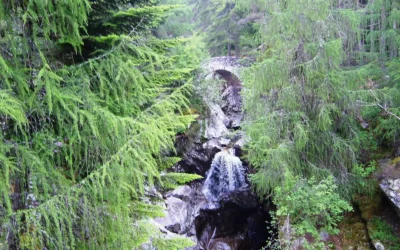
Falls of Bruar
Falls of Bruar: The Waterfall That a Poem Built When Robert Burns visited the Falls of Bruar in September 1787, the gorge was bare moorland. The falls were already beautiful — a series of cascades dropping through a narrow gorge of ancient Highland rock, with two...
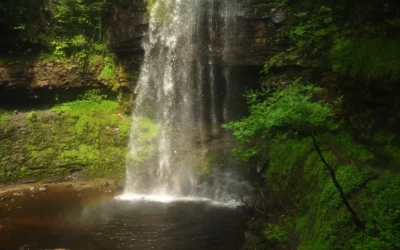
Henrhyd Falls
Henrhyd Falls: South Wales' Tallest Waterfall — and the Batcave The path descends steeply from the car park through sessile oak and ash woodland, and the sound of the water grows before the falls are visible. Then the gorge opens, and Henrhyd Falls drops the full...
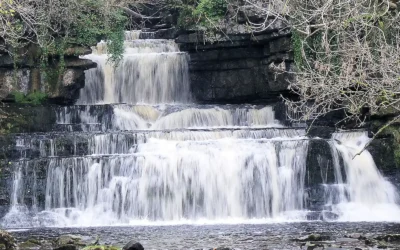
Cotter Force
Cotter Force: Wensleydale's Most Accessible Waterfall Most waterfall walks in the Yorkshire Dales involve a certain amount of commitment — boggy ground, uneven paths, steep descents, a scramble at the end. Cotter Force is different. A level, compacted stone path...
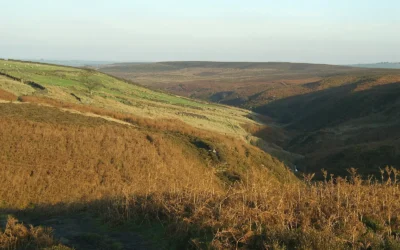
Brontë Waterfall
Brontë Waterfall: A Literary Pilgrimage on the Yorkshire Moors The path from Haworth leads you out of the cobbled streets, past the old church and through kissing gates, and into the wide, windswept moors of West Yorkshire — the same moors that Charlotte, Emily and...
Lodore Falls
Lodore Falls: The Cascade That Inspired a Poem Stand beside Lodore Falls after heavy rain and you begin to understand why Robert Southey, the Poet Laureate who lived at Greta Hall just up the road in Keswick, reached for so many words at once. Dashing and flashing and...