
Dunster Castle
Dunster Castle: Six Hundred Years of the Luttrells, Above the Bristol Channel
The Luttrell family acquired Dunster Castle in 1376 and donated it to the National Trust in 1976. Six hundred years of continuous ownership in a single family.
In that time they turned a Norman fortress into a Jacobean palace, rebuilt it again in the 1680s and again in the Victorian era, and filled its rooms with one of the most unusual collections in any National Trust property: leather tapestries depicting scenes from Antony and Cleopatra, a Tudor allegorical portrait of such rarity that it was once used as a piece of propaganda for the Protestant cause, and a piano once owned by the composer Vivian Ellis.
They kept a herd of deer in the parkland and planted a garden on the terraced hillside where the National Plant Collection of Strawberry Trees now grows. When they finally gave the castle away, six centuries after they bought it, they gave it whole.
Dunster Castle sits on a steep hill known as the Tor above the medieval village of Dunster in Somerset, with views north to the Bristol Channel and east to the open moorland of Exmoor National Park. The hill was fortified in the late Anglo-Saxon period; the Normans built their first castle here after 1066; and the building that visitors explore today carries the marks of every century since. This guide covers everything you need to plan your visit.
Where Is Dunster Castle?
Dunster Castle is in the village of Dunster, Somerset, 3 miles south-east of Minehead on the A39, at the northern edge of Exmoor National Park. The postcode for sat-nav is TA24 6NY. A National Trust car park is on the parkland driveway. Parking fees apply for non-members.
The nearest railway station is Dunster Station on the West Somerset Railway, a 25-minute walk from the castle. The West Somerset Railway is itself a heritage steam railway and a fine day out in its own right. Buses including the Exmoor Coaster also stop at Dunster Steep, half a mile from the castle.
A Brief History of Dunster Castle
The first fortification on the Tor at Dunster predates the Normans — there is evidence of a Saxon hillfort on this site before 1066. After the Conquest, William de Mohun built a timber castle here to secure Somerset for the new order, and by the 12th century this had been replaced with a stone shell keep that withstood a siege during the Anarchy, the civil war between King Stephen and Empress Matilda. The de Mohun family held the castle until 1376, when they sold it to the Luttrell family for five hundred marks.
The Luttrells began the long transformation of a military fortress into a comfortable home almost immediately. The most dramatic phase came in 1617, when Thomas Luttrell commissioned a new Jacobean palace within the medieval walls; further substantial remodelling followed in the 1680s, the 1760s and again in the Victorian era of 1867, when the interiors received the plasterwork and grand staircase that visitors see today.
The castle was held by a Royalist garrison during the English Civil War and besieged by Parliamentarian forces for a prolonged period, leaving marks on its fabric that are still visible. The Luttrells gave the castle to the National Trust in 1976, along with 277 hectares of parkland.
The remarkable thing about Dunster is not the architecture — which is fine but not exceptional — but the sheer weight of accumulated family history. The rooms contain things that the Luttrells accumulated across six centuries: the leather tapestries, the Tudor portrait, the piano. These are not museum objects arranged for display but the possessions of a family gathered over generations, still in the rooms where they were put.
Architecture & Design
Dunster Castle's architecture layers its history visibly. The 13th-century gatehouse, with its massive iron-bound oak doors, and a semi-ruined bastion tower are the most obvious survivals of the medieval fortress. The castle's heart today, however, is the 17th-century manor house, which was remodelled with its present grand staircase and plasterwork ceilings in the Victorian era — a warm, inhabited interior quite different in character from a state palace.
The outstanding features inside are the leather tapestries depicting Antony and Cleopatra, extraordinarily rare in English country houses, and the Tudor allegorical portrait — a copy of Hans Eworth's painting of Sir John Luttrell, which carries considerable art-historical significance as a piece of Edwardian Protestant iconography.
The 15-acre terraced gardens, designed in the 18th century, descend the hillside in formal levels, planted with subtropical species that thrive in Somerset's mild climate and including the National Plant Collection of Strawberry Trees — one of the most distinctive horticultural collections in the south-west of England. A restored 18th-century watermill nearby demonstrates traditional milling and has its own café.
Legends & Lore
Dunster Castle has a well-established reputation as one of Somerset's most haunted sites, and its stories are a genuine part of the experience. The most famous is the Lady in White — a melancholy figure said to wander the upper rooms, her presence reported by staff and visitors over many generations. Other apparitions include a phantom dog, a soldier from the English Civil War period and a mysterious figure known as the man in green.
Visitors have reported the sound of footsteps and what some describe as the chinking of coins — a sound linked by tradition to the silver minted at Dunster during a medieval siege. These tales are told as folklore rather than documented fact, but they are part of the castle's long and accumulated character.
The Famous Five connection is more straightforward. The 1996 television adaptation of Enid Blyton's stories used Dunster Castle as a filming location, and the castle has also appeared in various documentaries and BBC programmes. For those interested in the castle's story outside its walls, George Clarke's National Trust Unlocked has given Dunster coverage that has introduced it to a new generation of visitors.
Visiting the Castle
Dunster Castle opens daily from spring through to autumn. The visit takes in the historic rooms — the dining room, drawing room and bedrooms, each furnished with Luttrell family possessions that range from the unique leather tapestries to the Tudor portrait — alongside the grand staircase and the Victorian plasterwork that defines the interior's present character.
Outside, the terraced gardens descending from the castle walls reward substantial time — the subtropical planting, the National Plant Collection of Strawberry Trees and the views north to the Bristol Channel and east to the Exmoor moorland are exceptional on a clear day. The parkland below supports a deer herd, and the new Parkland Trail guides visitors through the estate's architectural and botanical highlights. The restored watermill nearby adds a further layer to the visit, with demonstrations of traditional milling and a café.
The castle stages living history events including English Civil War reenactments with musket firing, and a range of seasonal events throughout the year. Check the National Trust website for the current events calendar. Visitors can bring food to eat in the grounds; the Watermill Tearoom provides refreshments. There is a gift shop. Personal photography is generally permitted; check with staff for any restrictions in the historic rooms.
Check Tickets & Tour Times for Dunster Castle →
National Trust members visit free. Check the official National Trust website for current opening hours and admission prices.
Where to Stay Near Dunster Castle
Dunster Castle does not offer visitor accommodation. The village of Dunster itself — one of the finest medieval villages in Somerset, with its remarkable octagonal Yarn Market and ancient dovecote — has a small number of characterful inns and bed and breakfasts. Minehead, 3 miles north, offers a wider range, and the Exmoor National Park is dotted with excellent self-catering and hotel options for those wanting to explore the moorland properly.
Find Hotels & Stays Near Dunster →
The Best Time to Visit
Spring (April to June) is one of the finest times at Dunster — the terraced gardens are coming into bloom, the views to the Bristol Channel and Exmoor are clear, and the castle is less crowded than in summer. The National Plant Collection of Strawberry Trees is particularly striking in spring flowering. Summer (July and August) brings the full events programme, the best weather for the parkland and the living history days, but also the busiest visitor numbers; weekdays are always quieter.
Autumn (September and October) turns the Exmoor moorland to gold and red, and the deer in the parkland are particularly active. Winter sees reduced opening, but the castle in winter light — the Tor above the frosted village, the Bristol Channel grey to the north — has its own austere appeal.
How to Get There
By car. From the A39, follow the signs for Dunster and then for the castle (postcode TA24 6NY). The parkland driveway leads to the National Trust car park. Parking fees apply for non-members.
By heritage railway. The West Somerset Railway runs steam services to Dunster Station, a 25-minute walk from the castle — a memorable approach to a historic visit.
By bus. The Exmoor Coaster bus service and local services stop at Dunster Steep, half a mile from the castle.
Compare Transfers & Local Transport in Somerset →
Nearby Attractions
Dunster sits at the edge of Exmoor, one of England's finest National Parks, with excellent attractions in the surrounding Somerset countryside.
| Attraction | Why Visit | Distance |
|---|---|---|
| Exmoor National Park | Wild moorland, red deer, dramatic coastal cliffs and the Valley of Rocks — one of England's most atmospheric National Parks | Adjacent |
| Dunster Village | A remarkable medieval village with an octagonal Yarn Market, a dovecote and ancient streets — worth exploring before or after the castle | 0.5 miles |
| West Somerset Railway | A classic heritage steam railway through the Somerset coast and Quantock Hills — the approach to Dunster Station is one of the finest in England | ~3 miles |
| Minehead & North Hill | A Victorian seaside resort at the start of the South West Coast Path, with walks onto North Hill above the town | ~3 miles |
| Watchet | A historic harbour town with a maritime museum, connections to Coleridge's Rime of the Ancient Mariner and a working harbour | ~7 miles |
A natural Somerset day out pairs Dunster Castle with a walk on the Exmoor moorland above the village and a drive west through the National Park in the late afternoon.
Browse Somerset & Exmoor Tours →
Family & Accessibility
Families. Dunster Castle is an excellent family visit. The living history days with Civil War reenactments and musket firing are particularly effective for children; the deer in the parkland, the Parkland Trail and the working watermill add further dimensions that engage younger visitors. The castle's ghost stories tend to capture children's imaginations, and the views from the Tor over Exmoor and the Bristol Channel are genuinely dramatic.
Accessibility. The castle's steep hillside setting limits access for visitors with mobility difficulties — many areas involve steps and steep gradients. Mobility scooters are available, and accessible toilets are located near the shop. Check the official National Trust accessibility guide before visiting. Dogs are welcome in the grounds and parkland on leads. Photography for personal use is generally permitted.
Practical Tips
- National Trust members visit free — Dunster is a standard NT property, and membership covers hundreds of other sites across the UK.
- Wear comfortable walking shoes with good grip — the paths to the castle are steep, and the terraced gardens involve uneven ground.
- Pack a waterproof walking jacket — the Tor is exposed to Bristol Channel weather and Exmoor mists.
- Visit the Dunster Yarn Market in the village before or after the castle — the medieval octagonal market building is one of the most remarkable in England.
- Bring a portable power bank for a full day of photography across the castle, gardens and Exmoor views.
- Check the events calendar — the Civil War reenactment days are outstanding and worth timing a visit around.
- Overseas visitor? Pack a UK travel adapter for Type G plugs.
Conclusion
Dunster Castle was owned by the Luttrell family for six hundred years, and the rooms they left behind carry that weight of occupation in a way that few houses do. The leather tapestries showing Antony and Cleopatra, the Tudor portrait, the deer in the parkland, the terraced gardens with their subtropical planting above the village rooftops — these are not arranged for effect but accumulated across centuries of actual use.
The views from the Tor over Exmoor and the Bristol Channel are among the finest from any castle in the south-west of England, and the medieval village below the hill is one of the most complete in Somerset. Dunster rewards more time than most visitors give it.
Frequently Asked Questions
What are the opening hours of Dunster Castle?
The castle opens daily from spring through to autumn, generally from 10am. Check the official National Trust website for current seasonal hours and any winter openings.
How much does it cost to visit Dunster Castle?
Standard National Trust admission fees apply; National Trust members enter free. Check the National Trust website for current prices.
What are the famous leather tapestries at Dunster Castle?
A rare set of leather tapestries depicting scenes from the story of Antony and Cleopatra, accumulated by the Luttrell family over their six-century ownership of the castle. Leather tapestries are extremely unusual in English country houses.
Is Dunster Castle suitable for children?
Yes — the Civil War reenactment events, the deer parkland, the working watermill and the castle's ghost stories all work well for families. The steep paths require care with younger children.
Is Dunster Castle wheelchair accessible?
Mobility scooters are available and accessible toilets are near the shop. However, the castle's hillside setting means many areas involve steep gradients and steps. Check the National Trust access guide before visiting.
Is there food at Dunster Castle?
The Watermill Tearoom provides refreshments. Visitors may also bring food to eat in the castle grounds.
Are dogs allowed at Dunster Castle?
Dogs are welcome in the grounds and parkland on leads.
How do I get to Dunster Castle?
By car via the A39 to Dunster (TA24 6NY), 3 miles from Minehead. By heritage steam railway to Dunster Station (West Somerset Railway, 25 minutes from the castle). By the Exmoor Coaster bus to Dunster Steep (half a mile).
Can I take photos at Dunster Castle?
Personal photography is generally permitted in the grounds and gardens. Check with staff for any restrictions in the historic rooms.
What is the National Plant Collection of Strawberry Trees at Dunster?
The terraced gardens at Dunster hold the National Plant Collection of Arbutus (Strawberry Trees), a designation recognising the garden's role in preserving a representative collection of this distinctive small tree, which produces red strawberry-like fruits in autumn.
Carrickfergus Castle
Carrickfergus Castle: Ireland's Greatest Norman Fortress, Above Belfast Lough In 1315, Robert the Bruce's brother Edward invaded Ireland with an army and besieged Carrickfergus Castle. The siege went on so long, and provisions ran so completely dry, that the...
Kinbane Castle
Kinbane Castle: The White Head Castle at the End of 140 Steps, Above the Atlantic Kinbane means "white head" in Irish — Caisleán Ceinn Bán — and the name is immediately clear to anyone who looks at the limestone headland on which the castle stands: the cliff...
Hillsborough Castle
Hillsborough Castle: Where Northern Ireland's Peace Was Made, Twenty Minutes from Belfast In 1771, Wills Hill — the first Marquess of Downshire, one of the most powerful men in British colonial politics — received Benjamin Franklin at Hillsborough Castle. The...
Dunluce Castle
Dunluce Castle: The Clifftop Ruin Where Game of Thrones Met Narnia, Above the Antrim Coast In 1588, a Spanish Armada ship called the Girona wrecked on the rocks near Dunluce Castle. The MacDonnell clan — who had controlled the castle since the 1550s — salvaged the...
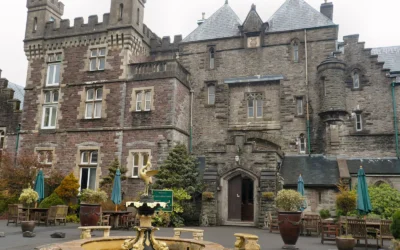
Craig y Nos Castle
Craig y Nos Castle: The Victorian Opera Star Who Built Her Own Theatre in the Brecon Beacons Adelina Patti was the most celebrated opera singer of the Victorian era — a soprano who commanded the largest fees in the world and whose voice filled La Scala in Milan,...