
Carrickfergus Castle
Carrickfergus Castle: Ireland's Greatest Norman Fortress, Above Belfast Lough
In 1315, Robert the Bruce's brother Edward invaded Ireland with an army and besieged Carrickfergus Castle. The siege went on so long, and provisions ran so completely dry, that the garrison — before eventually surrendering — was reduced to eating the leather from their boots and equipment. The detail appears in contemporary chronicles and has attached itself to the castle ever since: a vivid measure of how seriously the defenders took their duty and how grimly effective a prolonged siege could be.
Carrickfergus Castle was built in 1177 by John de Courcy, an Anglo-Norman knight who had just conquered eastern Ulster and needed a headquarters. He chose a rocky outcrop on the northern shore of Belfast Lough where the sea provided natural defences on three sides. The castle he built — and which subsequent lords expanded over the following 65 years — is one of the best-preserved medieval fortresses in Ireland, its great square keep and curtain walls standing largely as they were in the 13th century.
In 1690, King William III of Orange came ashore at Carrickfergus on his way to the Battle of the Boyne. In 1760, a French privateer briefly seized it. In 1778, John Paul Jones fought a naval engagement in the waters just offshore. It served as a prison during the Napoleonic Wars, a garrison in World War One and an air-raid shelter in World War Two. Important: the castle is closed on Mondays (except bank holidays) throughout the year. This guide covers everything you need to plan your visit.
Where Is Carrickfergus Castle?
Carrickfergus Castle is at Marine Highway, Carrickfergus, County Antrim, on the northern shore of Belfast Lough, approximately 10 miles north of Belfast city centre. By car from Belfast, take the M5 motorway; the journey takes around 20 minutes. Free parking is available on site.
By train, services from Belfast Central or Belfast Great Victoria Street reach Carrickfergus station in around 20 minutes, from where the castle is a five-minute walk straight ahead from the exit. Buses also serve Carrickfergus from Belfast.
A Brief History of Carrickfergus Castle
John de Courcy built the Inner Ward and Great Tower from 1177, creating a powerful base for the Norman conquest of eastern Ulster. The castle was extended in phases: the Middle Ward was added in 1216, the Outer Ward between 1226 and 1242, giving the castle its present three-part structure. The strategic position — water on three sides, with the lough as both moat and highway — made it the most significant fortress in Ulster for several centuries.
King John besieged and took the castle in 1210 from Hugh de Lacy, asserting English royal control. A century later, Edward Bruce's 1315 siege is the most famous episode — the garrison's leather-eating endurance before surrender became one of the defining stories in Ulster medieval history. The castle changed hands repeatedly across the centuries of Irish-English conflict.
The 17th and 18th centuries brought some of the most colourful chapters. In 1690, King William III — William of Orange — landed at Carrickfergus in June, just before crossing to the Boyne. One of the defining moments in Irish Protestant history had its staging post at this castle.
In 1760, during the Seven Years' War, the French privateer François Thurot led a raid on the town, briefly seized the castle and occupied it for a few days before withdrawing; he was caught and killed by the Royal Navy shortly after. In 1778, during the American War of Independence, John Paul Jones — the American naval hero — brought his ship into the North Channel and engaged the Royal Navy frigate HMS Drake in battle just offshore. The castle garrison watched from the walls.
The remarkable thing about Carrickfergus is the sheer accumulation of history on one site across eight centuries: Norman conquest, English royal assertion, Scottish invasion, Jacobite crisis, French privateering, American revolutionary naval engagement, Napoleonic imprisonment, two World Wars. Few buildings anywhere in Ireland have been more continuously and more consequentially used.
Architecture & Design
Carrickfergus Castle is a textbook example of Norman military architecture developing from simple keep to complex defensive system across three building phases. The Great Tower — a four-storey square keep — is the oldest and most imposing element, built by de Courcy in the Inner Ward and offering panoramic views of Belfast Lough from its battlements. The keep's walls are enormously thick, designed to resist both assault and artillery.
The gatehouse and barbican of the Outer Ward retain their murder holes and arrow slits. Six of the original 22 cannons from the 17th to 19th centuries survive and are displayed along the east battery, a tangible reminder of the castle's continued military role well beyond the medieval period. The curtain walls originally stood with water on three sides — land reclamation has reduced this, but the lough still forms the northern boundary, giving the castle its characteristic silhouette from the waterfront.
The Great Hall has been renovated with a new roof, restoring the main ceremonial space to something approaching its original function as a gathering place.
Legends & Lore
Carrickfergus Castle is not primarily known for ghost stories or folklore — its well-documented military and royal history is dramatic enough to sustain any number of visits without invention. The stories of Courcy's conquest, John's siege, Edward Bruce's leather-eating garrison, William's landing, Thurot's raid and John Paul Jones's naval engagement are not legend but documented history.
The castle's most enduring cultural connection is the traditional Irish folk song "Carrickfergus" — a song of longing and exile, with the castle and lough as its central image. Widely interpreted as a composition of the 18th or 19th century, it became one of the best-known Irish songs in the world through performances by Van Morrison, The Chieftains and countless others. The castle itself is named in the song's opening lines.
Carrickfergus also appeared as a filming location for Game of Thrones, adding a further layer of modern cultural recognition.
Visiting the Castle
Carrickfergus Castle is managed by the Department for Communities and is open Tuesday to Sunday throughout the year, with seasonal variation in hours. The castle is closed on Mondays except bank holidays — check the official website before travelling to confirm the current schedule. Admission fees apply; concessions are available.
The visit is self-guided with maps provided; guided tours may occasionally be arranged through the Carrickfergus Historical Society. The Great Tower climb is the centrepiece — four storeys to the top, with Belfast Lough views. Life-sized figures and exhibits throughout the castle bring its history to life.
The six surviving cannons on the east battery are a permanent and striking display. The Great Hall is accessible with its new roof. An education room with video content in multiple languages and a sensory room for children with additional needs make this one of the more inclusive castle visits in Northern Ireland.
There is no café at the castle. Carrickfergus town, immediately adjacent, has cafés and restaurants. A designated picnic area is available within the grounds.
Photography is permitted for personal use. Assistance dogs are welcome.
Check Tickets & Tour Times for Carrickfergus Castle →
For current opening hours and prices, check the official Department for Communities website before your visit — and confirm the castle is open on your chosen day, as it is closed on Mondays.
Where to Stay Near Carrickfergus Castle
Carrickfergus town has hotels and guesthouses within easy reach of the castle. Belfast, 10 miles south (around 20 minutes by car or train), offers the full range of city accommodation — the natural base for a day trip to Carrickfergus combined with Belfast's own substantial attractions.
Find Hotels & Stays in Belfast →
The Best Time to Visit
Spring (March to May) and early autumn (September to October) are the best times for Carrickfergus — mild weather, clear views across Belfast Lough and lower visitor numbers than the July and August peak. The castle is open year-round with seasonal hour variations.
Summer (July to August) brings the longest visiting hours and the best weather for the lough-side setting. Note that the castle closes on Mondays regardless of season — plan accordingly.
How to Get There
By car. From Belfast, take the M5 motorway towards Carrickfergus. Free parking is available on site.
By train. Trains from Belfast Central or Great Victoria Street reach Carrickfergus in around 20 minutes. The castle is a five-minute walk from the station.
By bus. Several bus services connect Belfast and Carrickfergus.
Compare Transfers & Local Transport near Belfast →
Nearby Attractions
Carrickfergus sits on the northern shore of Belfast Lough, within easy reach of Belfast and the County Antrim coast.
| Attraction | Why Visit | Distance |
|---|---|---|
| Andrew Jackson Cottage & US Rangers Centre | The ancestral home of the 7th US President — Andrew Jackson's family emigrated from here — alongside a museum commemorating the US Army Rangers who trained in the area during WWII | ~2 miles |
| Carrickfergus Museum | The history of Carrickfergus town and its people — an ideal companion to the castle for context | Adjacent |
| Belfast | Titanic Belfast, the Ulster Museum, the Cathedral Quarter and Cave Hill — 10 miles south, 20 minutes by train | ~10 miles |
| Larne & the Antrim Coast | The gateway to the Glens of Antrim and the start of the Causeway Coastal Route north towards the Giant's Causeway | ~10 miles |
| Belfast Lough RSPB Reserve | Internationally important wildfowl and wader habitat visible from the castle walls | Adjacent |
A natural day out pairs Carrickfergus Castle with the Andrew Jackson Cottage (for the US connection) before returning to Belfast — two distinct aspects of Northern Ireland's transatlantic history in an afternoon.
Browse Belfast & Northern Ireland Tours →
Family & Accessibility
Families. Carrickfergus is one of the best family castle visits in Northern Ireland. The life-sized figures, the cannon displays, the Great Tower climb and the education room all engage children well. The sensory room for children with additional needs is a genuine and thoughtful addition.
Accessibility. The castle grounds are accessible; some areas, including the Great Tower, involve stairs. An assistance dogs are welcome. Visitors with mobility requirements should check the castle's current accessibility information before visiting.
Practical Tips
- Check the Monday closure before booking your visit — the castle is closed on Mondays except bank holidays.
- Wear comfortable walking shoes — the castle involves stairs and uneven historic surfaces.
- Pack a compact travel umbrella — Belfast Lough weather is changeable.
- Bring a portable power bank for photography — the lough views from the Great Tower and the cannon battery are excellent.
- No café on site — plan refreshments in Carrickfergus town, immediately adjacent.
- Photography is permitted for personal use throughout.
- Overseas visitor? Pack a UK travel adapter for Type G plugs.
Conclusion
Carrickfergus Castle has been besieged by the English, by the Scots, by the French and by a garrison so hungry it ate its own leather. King William III landed at its feet in 1690. John Paul Jones fought a naval battle within sight of its walls in 1778.
François Thurot seized it for four days in 1760. A famous folk song carries its name around the world. And it is 10 miles and 20 minutes by train from Belfast, intact, open and still standing above Belfast Lough exactly where John de Courcy built it in 1177. Go on a Tuesday.
Frequently Asked Questions
What are the opening hours of Carrickfergus Castle?
The castle is open Tuesday to Sunday throughout the year, with seasonal variation in hours (generally around 9:00–9:30am opening and 4:00–5:00pm closing). The castle is closed on Mondays except bank holidays. Always check the official Department for Communities website before travelling.
How much does it cost to visit Carrickfergus Castle?
Admission fees vary by age; concessions are available for students, over-65s, disabled visitors and the unemployed. Check the official website for current prices.
Why is the castle closed on Mondays?
Carrickfergus Castle is closed on Mondays (except bank holidays) — this is the standard operating pattern. Plan your visit for any other day of the week.
What is the connection between Carrickfergus Castle and the song "Carrickfergus"?
The traditional Irish folk song "Carrickfergus" takes its name from the town and its famous castle — the opening lines describe the lough and the castle's setting. The song became internationally known through recordings by Van Morrison, The Chieftains and many others, making the castle's name one of the most widely recognised in Irish music.
What happened during the 1315 siege?
Edward Bruce, brother of Robert the Bruce of Scotland, besieged Carrickfergus Castle as part of his Irish campaign. The siege was prolonged; the garrison ran so completely out of food that they were reduced to eating leather before eventually surrendering.
Did King William III really land at Carrickfergus?
Yes — King William III (William of Orange) landed at Carrickfergus in June 1690 on his way to the Battle of the Boyne. The landing is one of the most historically significant events in Irish history, and Carrickfergus Castle was the landmark at which it took place.
Is there food at Carrickfergus Castle?
No café is available at the castle itself. A picnic area is provided in the grounds. Carrickfergus town, immediately adjacent to the castle, has a range of cafés and restaurants.
Is Carrickfergus Castle wheelchair accessible?
The castle grounds are accessible. Some areas, including the Great Tower, involve stairs. Contact the castle directly for current accessibility details. A sensory room is available for visitors with additional needs.
How do I get to Carrickfergus Castle from Belfast?
By train from Belfast Central or Great Victoria Street (around 20 minutes to Carrickfergus station, then a 5-minute walk). By car, take the M5 motorway (around 20 minutes from the city centre). Free parking is available at the castle.
Can I take photos at Carrickfergus Castle?
Photography for personal use is permitted throughout the castle. Professional photography or filming may require prior permission.
Kinbane Castle
Kinbane Castle: The White Head Castle at the End of 140 Steps, Above the Atlantic Kinbane means "white head" in Irish — Caisleán Ceinn Bán — and the name is immediately clear to anyone who looks at the limestone headland on which the castle stands: the cliff...
Hillsborough Castle
Hillsborough Castle: Where Northern Ireland's Peace Was Made, Twenty Minutes from Belfast In 1771, Wills Hill — the first Marquess of Downshire, one of the most powerful men in British colonial politics — received Benjamin Franklin at Hillsborough Castle. The...
Dunluce Castle
Dunluce Castle: The Clifftop Ruin Where Game of Thrones Met Narnia, Above the Antrim Coast In 1588, a Spanish Armada ship called the Girona wrecked on the rocks near Dunluce Castle. The MacDonnell clan — who had controlled the castle since the 1550s — salvaged the...
Craig y Nos Castle
Craig y Nos Castle: The Victorian Opera Star Who Built Her Own Theatre in the Brecon Beacons Adelina Patti was the most celebrated opera singer of the Victorian era — a soprano who commanded the largest fees in the world and whose voice filled La Scala in Milan,...
Gwrych Castle
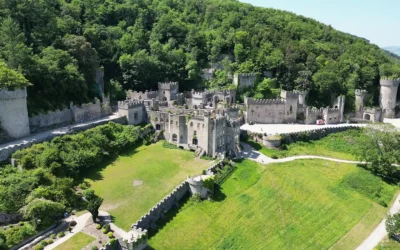
Gwrych Castle: Gothic Revival Ruin, WWII Refuge and Wales's Most Unexpected TV Star In 1940, as Nazi Germany occupied much of Europe, a group of Jewish young people arrived at a ruined Gothic Revival castle on the North Wales coast. Gwrych Castle — already...