
Caernarfon Castle
Caernarfon Castle: Edward I's Imperial Vision, Above the Menai Strait
Edward I of England spent approximately £25,000 building Caernarfon Castle — a sum equivalent to around 90% of England's entire annual royal income. The construction took 47 years, from 1283 to 1330, making it by far the most expensive and longest-built of his Welsh fortresses.
He designed it not merely to defend against Welsh rebellion but to project an imperial authority reaching back to Rome itself: the multi-banded masonry of alternating light and dark stone, the polygonal towers crowned with eagle statues, the entire composition was deliberately modelled on the Theodosian Walls of Constantinople — connecting his conquest of Wales to the lineage of Roman and Byzantine emperors.
Caernarfon Castle is the crown of Edward I's Iron Ring — the chain of fortresses he built across North Wales to hold the conquered principality — and it was meant to be seen as such. It is part of the UNESCO World Heritage Site "Castles and Town Walls of King Edward in Gwynedd" (with Harlech, Conwy and Beaumaris), designated in 1986 as among the finest medieval military architecture in Europe.
It is also the place where, in 1301, Edward invested his son (born at the castle in 1284) as the first English Prince of Wales — a tradition that has continued to the present day. This guide covers everything you need to plan your visit.
Where Is Caernarfon Castle?
Caernarfon Castle is in the town of Caernarfon, Gwynedd, North Wales, on the south-west shore of the Menai Strait, at the mouth of the River Seiont. The A487 and A4085 roads serve the town. The nearest railway station is Bangor, 10 miles (16 kilometres) away, with bus connections to Caernarfon. Bus routes 5, 5A and 5B stop 200 metres from the castle. Pay-and-display car parks are available nearby.
A Brief History of Caernarfon Castle
Edward I began building Caernarfon in 1283, in the immediate aftermath of his conquest of Wales following the death of Llywelyn ap Gruffudd — the last native Prince of Wales. The castle was designed by Master James of St George, the greatest castle architect of medieval Europe, who had already built castles for the Count of Savoy and would design the entire programme of Edward's Welsh fortresses.
At Caernarfon, however, the brief was different from Harlech or Conwy: this was to be not only a fortress but the administrative capital of conquered north Wales and a seat of imperial authority.
The deliberate echo of Constantinople in the design was not accidental. Edward I was aware of the Welsh legend of Macsen Wledig — Magnus Maximus, a Roman emperor of the 4th century, who in the Welsh text of the Mabinogion dreamed of a great castle at the mouth of a river in Wales.
Edward exploited this legend deliberately, presenting his new castle at the mouth of the Seiont as the fulfilment of ancient Welsh prophecy — connecting his conquest to Welsh tradition rather than simply imposing English power. The bones of Magnus Maximus were ceremonially reburied at the castle in 1283.
In 1284, Edward's son — future Edward II — was born at the castle; in 1301, Edward I presented him to the Welsh people as the first English Prince of Wales, beginning a tradition. Welsh rebels under Madog ap Llywelyn briefly captured the incomplete castle in 1294, prompting renewed fortification. The full construction took 47 years, ending in 1330.
The investiture tradition was revived in 1911 (the future Edward VIII) and most recently in 1969, when Queen Elizabeth II invested Prince Charles as Prince of Wales at Caernarfon — a ceremony watched by hundreds of millions around the world.
The remarkable thing about Caernarfon is its ambition. This was not merely a castle but a statement: Edward I building something that declared his conquest to be not the imposition of English rule on Wales but the fulfilment of ancient prophecy and the continuation of Roman imperial tradition. The statement was controversial and is contested; the castle survives to tell the story.
Architecture & Design
Caernarfon's design is unique among Edward I's Welsh castles. While Harlech and Beaumaris are exercises in military geometry — concentric, rational, precise — Caernarfon is an exercise in imperial display. The polygonal towers, rather than the round towers of the other castles, are a direct reference to the Theodosian Walls of Constantinople. The banded masonry — horizontal stripes of different-coloured stone in the walls — echoes the same walls. Eagle statues decorate the tower tops. The entire composition is designed to be read as a statement of power rather than simply a defensive system.
The King's Gate is the most complex castle gate in Britain — a sequence of five doors and six portcullises, with murder holes above and arrow loops on every side. It was the principal entrance to the castle and was designed to make any assault a near-impossible proposition. A lift now provides access to the upper levels for visitors with mobility difficulties. The Eagle Tower is the most prominent single structure, rising above the town waterfront. The curtain walls are largely complete, allowing the full circuit to be walked.
The Royal Welch Fusiliers Museum, housed within the castle, covers the history of Wales's oldest infantry regiment — included in the admission price and a significant additional attraction.
Legends & Lore
Caernarfon's deepest lore is the legend of Macsen Wledig — Magnus Maximus — from the Mabinogion, the medieval collection of Welsh mythology. In the tale, the Roman emperor dreams of sailing to an island and finding a great castle at the mouth of a river; the dream's location is identified as the site of Caernarfon.
Edward I's use of this legend to legitimise his conquest was calculated and sophisticated: he was not conquering Wales but fulfilling Welsh prophecy. The bones attributed to Magnus Maximus were ceremonially reburied in the new castle's church. Whether this persuaded any Welsh person of Edward's legitimacy is another matter, but the story remains one of the most interesting intersections of myth and political manipulation in British history.
The castle's most documented modern connection is the investiture of the Prince of Wales in 1969, broadcast around the world and giving Caernarfon a global audience it had not had since Edward's original ceremonies. The ceremony, designed by the Earl of Snowdon, used the castle's dramatic setting to create images that remain among the most widely reproduced in the castle's history.
Visiting the Castle
Caernarfon Castle is managed by Cadw and is open year-round, with longer hours in summer and shorter in winter. Cadw members enter free.
The visit covers the towering walls and towers of the main circuit, walkable throughout in a way that few of Edward's castles allow. The King's Gate with its extraordinary sequence of defences repays careful attention. The Eagle Tower is the most prominent structure and offers views across the Menai Strait to Anglesey. The Royal Welch Fusiliers Museum, included in admission, is a significant and often underappreciated addition to the visit. An on-site exhibition and audio guide provide historical context.
Refreshments are available from a café and seasonal kiosk; check the Cadw website for current catering arrangements. A gift shop is on site. Photography is permitted for personal use; tripods and professional equipment may require prior approval.
Assistance dogs only inside the castle; other dogs are not admitted.
Check Tickets & Tour Times for Caernarfon Castle →
For current opening hours and prices, check the official Cadw website before your visit.
Where to Stay Near Caernarfon Castle
Caernarfon town has a range of hotels, guesthouses and self-catering accommodation within walking distance of the castle. Bangor, 10 miles away across the Menai Strait, offers a wider choice and direct rail connections to Chester and London. Anglesey, immediately across the water, has outstanding coastal accommodation for those wanting to combine the castle with the island's landscapes.
Find Hotels & Stays in Caernarfon →
The Best Time to Visit
Spring (April to June) and early autumn (September to October) offer the best combination of pleasant weather, clear views across the Menai Strait and lower visitor numbers than the July–August peak. Summer (July to August) brings the longest opening hours and the best chance of sunshine for walking the full circuit of walls, but also the highest visitor numbers.
The castle is worth visiting at any time of year — the winter silhouette of the polygonal towers above the Menai is outstanding.
How to Get There
By car. Caernarfon is on the A487 between Bangor and Porthmadog. Pay-and-display car parks are in the town centre. From Bangor allow around 20 minutes; from Porthmadog around 25 minutes.
By bus. Routes 5, 5A and 5B connect Bangor to Caernarfon and stop about 200 metres from the castle.
By train. The nearest station is Bangor (10 miles), with services from Chester (around one hour), Cardiff and London.
Compare Transfers & Local Transport in North Wales →
Nearby Attractions
Caernarfon is at the gateway to Eryri and the Isle of Anglesey, with exceptional heritage and landscape in every direction.
| Attraction | Why Visit | Distance |
|---|---|---|
| Segontium Roman Fort (Cadw) | A 1st-century Roman legionary fort at the edge of Caernarfon — the fort that inspired the Macsen Wledig legend | ~0.5 miles |
| Isle of Anglesey (Ynys Môn) | An island of ancient monuments (Bryn Celli Ddu, Beaumaris Castle), AONB coastline and the iconic Menai Suspension Bridge | ~3 miles |
| Beaumaris Castle (Cadw, UNESCO) | The most perfect concentric castle ever designed — the fourth castle in Edward I's UNESCO Iron Ring, never completed | ~14 miles |
| Eryri National Park (Snowdonia) | Wales's highest mountain (Snowdon/Yr Wyddfa), the Llanberis Pass and some of the finest mountain walking in Britain | ~10 miles |
| Caernarfon Town & Harbour | The medieval town walls, the harbour and the independent shops and cafés of a compact Welsh town | Adjacent |
A natural North Wales day combines Caernarfon Castle with a visit to Segontium Roman Fort (to complete the Roman connection) and a drive across the Menai to Beaumaris Castle — three points of the UNESCO Iron Ring in one day.
Browse North Wales & Eryri Tours →
Family & Accessibility
Families. Caernarfon is one of the best family castle experiences in Wales. The walkable walls, the Eagle Tower, the King's Gate and the Royal Welch Fusiliers Museum all work well for families; the scale of the castle gives children room to explore. The investiture story and the prince-related history engage older children and teenagers.
Accessibility. A lift provides access to the King's Gate upper levels. Accessible toilets with baby-changing facilities are available. A portable induction loop is provided. The castle grounds involve uneven terrain in some areas. Check the Cadw accessibility guide for detailed information. Only assistance dogs are permitted inside.
Practical Tips
- Wear comfortable walking shoes — the full circuit of the walls involves substantial walking on stone and uneven surfaces.
- Pack a compact travel umbrella; North Wales weather is changeable.
- Bring a portable power bank for photography across the walls, the Eagle Tower and the Menai views.
- Walk the full circuit of the walls — the views across the Menai to Anglesey and back down to the town and harbour are extraordinary.
- Visit Segontium Roman Fort before or after — the 1st-century fort is a ten-minute walk and provides the Roman context for the Macsen Wledig legend.
- Photography is permitted for personal use throughout.
- Overseas visitor? Pack a UK travel adapter for Type G plugs.
Conclusion
Caernarfon Castle cost the equivalent of 90% of England's annual income. It was designed to echo the walls of Constantinople. It was built at the mouth of the river where Welsh prophecy said a great castle would stand.
And in 1969, it broadcast the investiture of the Prince of Wales to hundreds of millions of people around the world. Edward I intended it as a statement of imperial ambition, and in that at least he succeeded: Caernarfon has been making statements for 700 years, and it is still the most dramatic castle on the Menai Strait.
Frequently Asked Questions
What are the opening hours of Caernarfon Castle?
The castle is open year-round, with longer hours in summer and shorter in winter. Check the official Cadw website for current times before travelling.
How much does it cost to visit Caernarfon Castle?
Admission fees vary by age; Cadw members enter free. Online booking may offer a small discount. Admission includes access to the Royal Welch Fusiliers Museum. Check the Cadw website for current prices.
Is Caernarfon Castle a UNESCO World Heritage Site?
Yes — it is part of "Castles and Town Walls of King Edward in Gwynedd," designated in 1986, alongside Harlech, Conwy and Beaumaris castles.
What is the Prince of Wales investiture?
In 1301, Edward I invested his son (born at Caernarfon in 1284) as Prince of Wales at the castle, beginning the tradition of investing the heir to the English and British throne with the title. The most recent investiture was in 1969, when Queen Elizabeth II invested Prince Charles at Caernarfon — a ceremony watched by hundreds of millions globally.
Why does Caernarfon Castle look different from other Welsh castles?
The multi-banded masonry (alternating light and dark stone) and polygonal towers were deliberately designed to echo the Theodosian Walls of Constantinople, connecting Edward I's conquest of Wales to Roman and Byzantine imperial tradition.
What is the Macsen Wledig legend?
The Welsh text of the Mabinogion tells of a Roman emperor, Macsen Wledig (identified with the historical Magnus Maximus), who dreamed of a great castle at the mouth of a river in Wales — identified with Caernarfon. Edward I used this legend to legitimise his conquest, reburying bones attributed to Magnus Maximus at the new castle in 1283.
Is there food at Caernarfon Castle?
Refreshments are available from a café and seasonal kiosk at the castle. Check the Cadw website for current catering arrangements.
Are dogs allowed at Caernarfon Castle?
Only assistance dogs are permitted inside the castle.
Is Caernarfon Castle wheelchair accessible?
A lift provides access to the King's Gate upper levels. Accessible toilets are available. The castle involves uneven terrain in some areas. Check the Cadw accessibility guide for detailed information.
How do I get to Caernarfon Castle?
By car via the A487 (around 20 minutes from Bangor). By bus from Bangor (routes 5/5A/5B, stopping 200 metres from the castle). By train to Bangor (10 miles), then bus or taxi.
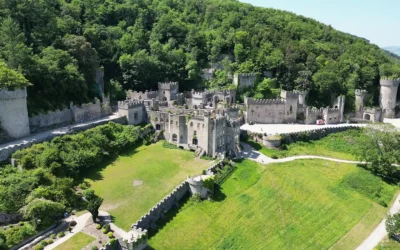
Gwrych Castle
Gwrych Castle: Gothic Revival Ruin, WWII Refuge and Wales's Most Unexpected TV Star In 1940, as Nazi Germany occupied much of Europe, a group of Jewish young people arrived at a ruined Gothic Revival castle on the North Wales coast. Gwrych Castle — already...
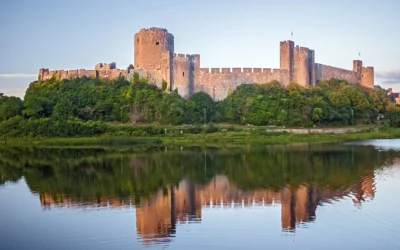
Pembroke Castle
Pembroke Castle: Where Henry VII Was Born, Above a Prehistoric Cave Beneath Pembroke Castle, in the limestone bedrock on which the fortress stands, there is a cave. Wogan Cavern is a prehistoric chamber that was occupied by early humans long before any castle existed...
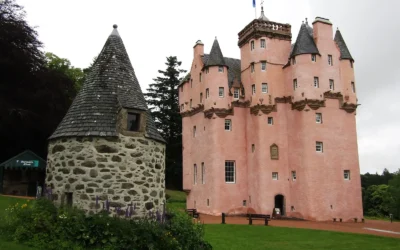
Craigievar Castle
Craigievar Castle: The Pink Tower That Danzig Willy Built, Rising Above Aberdeenshire William Forbes made his fortune trading with the Baltic port of Danzig — now Gdańsk in Poland — in the early years of the 17th century. So successful was his trade that he became...
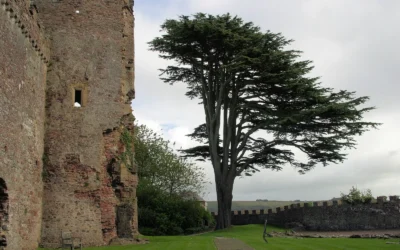
Laugharne Castle
Laugharne Castle: The "Brown as Owls" Fortress Where Dylan Thomas Found His Voice Dylan Thomas called it "the brown as owls castle" — a phrase that tells you as much about the poet's way of seeing as it does about the castle itself. Thomas...
Beaumaris Castle
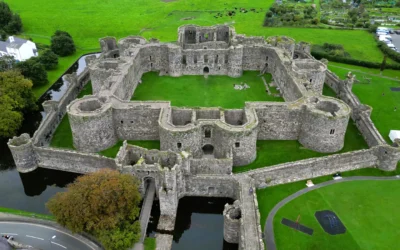
Beaumaris Castle: The Most Perfect Fortress Never Finished, on the Isle of Anglesey In 1295, Master James of St George began designing the most geometrically perfect concentric castle in the history of medieval military architecture. The inner ward was rectangular,...