
Belvoir Castle
Belvoir Castle: The Home of Afternoon Tea, the Belvoir Witches and the Dukes of Rutland
The name is French — Belvoir, meaning "beautiful view" — but in England it has been pronounced "Beaver" for so long that no one argues the point. The beautiful view, however, is entirely accurate: from the hill above the Vale of Belvoir, the ground falls away across the fields of Nottinghamshire, Leicestershire and Lincolnshire in one of the longest and most uninterrupted views from any castle in the East Midlands.
The castle rising above it is a Regency Gothic Revival composition — turrets, battlemented walls, soaring terraces — that has been the home of the Dukes of Rutland and their Manners family predecessors for nearly a thousand years.
Belvoir Castle is where afternoon tea is said to have been invented. In the 1840s, Anna, Duchess of Bedford, hungry in the long gap between lunch and the late Victorian dinner, began the practice of taking tea with small sandwiches and cakes in the afternoon — first privately, then as a social event, then as a national institution. It happened here.
The castle is also the place where, in 1619, the trial of the Belvoir Witches took place: three women servants accused of using witchcraft to cause the deaths of the Earl of Rutland's two young sons, one of the most notorious witchcraft cases in Jacobean England. Few English castles combine a food history innovation and a dark trial legacy in quite this way. This guide covers everything you need to plan your visit.
Where Is Belvoir Castle?
Belvoir Castle is in Leicestershire, 6 miles west of Grantham and 10 miles north-east of Melton Mowbray. The postcode for sat-nav is NG32 1PE. It is approximately two and a half hours from London by car and around one and a half hours from Birmingham. Note that from the car park there is a 15-minute uphill walk to the castle; disabled visitors can contact the castle in advance to arrange parking closer to the entrance.
The nearest railway station is Grantham, 6 miles away, with direct services from London King's Cross in around an hour. Local bus connections to the castle are limited; most visitors travel by car.
A Brief History of Belvoir Castle
A Norman fortification was first raised on this hill by Robert de Todeni, William the Conqueror's standard bearer at Hastings, in 1067. That first castle fell into ruin during the Wars of the Roses. A Tudor rebuilding followed between 1528 and 1555 under Thomas Manners, 1st Earl of Rutland, establishing the Manners family — who would become Dukes of Rutland — as the castle's long-term owners.
In 1649, the castle was slighted during the English Civil War for its Royalist allegiance; a new house followed between 1654 and 1668; and then, in 1816, a catastrophic fire destroyed that building too. The castle that stands today was completed in 1832, designed by James Wyatt in the Regency Gothic Revival style that defines its current character.
The Belvoir Witches case of 1619 is the most notorious episode in the castle's history. Joan Flower and her daughters Margaret and Phillipa had worked at the castle as servants; following a dispute with the Countess of Rutland, they were dismissed. When two of the Earl's young sons died in quick succession, the Flowers were accused of using witchcraft to cause their deaths.
Joan died before trial; Margaret and Phillipa were tried at Lincoln Assizes and hanged. A monument in the nearby church of St Mary at Bottesford still records that the Earl's sons died "by wicked practice and sorcerie." The case is documented history, not folklore.
The afternoon tea story is more delightful. Anna, 7th Duchess of Bedford, found the long afternoon gap between lunch and the late Victorian dinner difficult to bear, and began in the 1840s the practice of taking tea with sandwiches and small cakes in the afternoon. From a personal habit at Belvoir it spread to fashionable society and then, eventually, to every tearoom in the country. The tradition was, in this sense, invented here.
Architecture & Design
Belvoir Castle's current appearance dates from James Wyatt's rebuilding after the 1816 fire, completed in 1832 — a Regency Gothic Revival composition of battlemented walls, stately terraces and soaring turrets that recalls Windsor Castle in its general silhouette and has regularly doubled for it in film productions. The castle is a Grade I listed building, recognising the quality and completeness of Wyatt's design.
Inside, the Regent's Gallery is the standout interior: a long, light room hung with Gobelin tapestries purchased by the 5th Duke in Paris in 1814, depicting the story of Don Quixote in elaborate pictorial scenes. The castle's art collection includes a Holbein portrait of Henry VIII and several works by Gainsborough, alongside the accumulated family portraits and heirlooms of nearly a thousand years of Manners family occupation.
The gardens, based on Capability Brown's 1780 plans and recently restored, include formal terraces, a Japanese Woodland and the Duchess Garden, with the panoramic views across the Vale of Belvoir providing the backdrop that gave the castle its name.
Legends & Lore
The Belvoir Witches are the castle's darkest historical chapter, and the full weight of that chapter belongs in the factual record. In 1619, Joan Flower and her daughters Margaret and Phillipa — servants who had been dismissed from the castle after a dispute — were accused of causing the deaths of two of the Earl of Rutland's young sons through witchcraft.
Joan died before her trial; her daughters were tried and hanged. The Bottesford church monument recording the boys' deaths by "sorcerie" remains standing today. This is documented Jacobean legal history, not ghost story — but it casts a long shadow.
The castle's more recent lore is lighter. Residents have shared accounts of unexplained occurrences in the older parts of the building, and Belvoir is periodically described as one of Leicestershire's more atmospheric houses. Its screen career is better documented: the castle has appeared in The Da Vinci Code, The Crown, The Young Victoria and The Haunting, among other productions, regularly standing in for Windsor Castle and other grand English houses. That reputation reflects the quality and completeness of Wyatt's design — few Regency Gothic compositions anywhere in England photograph so well.
Visiting the Castle
Belvoir Castle opens seasonally, generally from spring to autumn, for guided tours and for garden and grounds visits. The visit divides between the castle interior and the extensive grounds and gardens.
Inside, guided tours lead visitors through the principal rooms — the Regent's Gallery with its Gobelin tapestries, the King's Rooms, the Elizabeth Saloon and the formal dining rooms, each containing the Manners family's accumulated collection of paintings, furniture and objects. The Holbein portrait of Henry VIII and the Gainsborough works are among the most significant pieces. Photography is permitted in the grounds and gardens but not inside the castle.
Outside, the restored Capability Brown gardens — terraced, formal and planted for seasonal colour — offer the full view across the Vale of Belvoir for which the castle was named. An Adventure Playground with a giant timber castle makes this one of the more family-friendly castle grounds in the Midlands.
The Engine Yard Retail Village, built from the castle's former sawmill, houses local food producers, fashion and homeware. The Aviary Tearoom is where to take afternoon tea — the tradition that Anna, Duchess of Bedford, began here in the 1840s and that the country subsequently adopted.
Check Tickets & Tour Times for Belvoir Castle →
Check the official Belvoir Castle website for current opening dates, tour times and prices.
Where to Stay Near Belvoir Castle
Belvoir Castle does not offer visitor accommodation. Grantham, 6 miles away, is the most convenient base — with good rail connections to London King's Cross and a range of hotels and guesthouses. Melton Mowbray, 10 miles south-west, is a charming market town with independent accommodation and excellent local food — it is the home of both Stilton cheese and Melton Mowbray pork pies. The Vale of Belvoir villages offer self-catering options for those preferring a rural setting.
Find Hotels & Stays Near Grantham →
The Best Time to Visit
Spring (April to June) is outstanding at Belvoir — the restored gardens are at their freshest, the terraced views across the Vale are clear and visitor numbers are lower than in high summer. Summer (July and August) brings the full events programme, including seasonal open-air events in the castle grounds, and the best weather for the Adventure Playground and the gardens; book ahead for castle tours.
Autumn (September to October) is gentler, with lower crowds and the autumn light across the Vale of Belvoir exceptional on a clear day. The castle closes in late autumn and reopens for any Christmas-themed events — check the official website for the current pattern.
How to Get There
By car. From the A1 near Grantham or from Melton Mowbray via the A607, follow signs to Belvoir (postcode NG32 1PE). The car park is at the foot of the hill; allow 15 minutes for the uphill walk to the castle. Disabled parking closer to the entrance can be arranged in advance.
By train. Grantham station has direct services from London King's Cross (around one hour) and connections from the Midlands and the North. Local bus services to the castle from Grantham are limited; a taxi from the station takes around 15 minutes.
Compare Transfers & Local Transport in Leicestershire →
Nearby Attractions
Belvoir sits in a quietly rewarding part of the East Midlands, with several excellent attractions within easy reach.
| Attraction | Why Visit | Distance |
|---|---|---|
| Woolsthorpe Manor (National Trust) | The birthplace of Sir Isaac Newton and the farmhouse where he developed the theory of gravity — one of the most significant scientific sites in England | ~10 miles |
| Rutland Water | England's largest reservoir — a nature reserve with outstanding bird watching, watersports and the attractive villages of Rutland | ~15 miles |
| Bolsover Castle (English Heritage) | A 17th-century Baroque castle with extraordinary decorated interiors — one of the most unusual castles in the East Midlands | ~30 miles |
| Grantham Museum | The history of a remarkable town — birthplace of Isaac Newton and Margaret Thatcher — in a well-presented local museum | ~6 miles |
| Grimsthorpe Castle | A historic Lincolnshire estate with William Vanbrugh's north façade and extensive landscaped grounds | ~20 miles |
A natural East Midlands day pairs Belvoir Castle with Woolsthorpe Manor and its gravity apple tree — two of the most unexpected historical connections within a 10-mile drive.
Browse East Midlands Tours & Day Trips →
Family & Accessibility
Families. Belvoir has invested in family attractions more than most of the houses in this series: the Adventure Playground with its giant timber castle and HMS Resolution is a significant draw for younger visitors, and the grounds are spacious enough for children to run freely between attractions. The guided interior tours work better for older children with an interest in history or art.
Accessibility. The castle offers ground-floor wheelchair access to the castle interior; upper floors are not accessible. Blue Badge holders can arrange parking closer to the castle entrance by contacting the ticket office on arrival. Disabled WCs are available. Check the official accessibility information before visiting. Dogs are not generally admitted inside the castle; check current grounds policy before bringing a dog.
Practical Tips
- Book guided tours in advance, especially for summer weekends — the castle's interior is only accessible on a tour.
- Wear comfortable walking shoes — the walk from the car park to the castle is a 15-minute uphill climb.
- Photography is not permitted inside the castle but is freely allowed in the grounds and gardens.
- Pack a compact travel umbrella; the hilltop exposure means the weather can change quickly.
- Bring a portable power bank for a full day of photography in the grounds and gardens.
- Have afternoon tea in the Aviary Tearoom — the connection to Anna, Duchess of Bedford and the invention of afternoon tea makes this one of the most historically resonant teatimes in England.
- Overseas visitor? Pack a UK travel adapter for Type G plugs.
Conclusion
Belvoir Castle — pronounced "Beaver," views of three counties — is one of the most quietly distinguished castle visits in the East Midlands. James Wyatt's Regency Gothic Revival composition is among the finest of its kind; the Gobelin tapestries in the Regent's Gallery are extraordinary; the Belvoir Witches trial casts a long historical shadow; and the afternoon tea tradition that Anna, Duchess of Bedford, started here in the 1840s gave the whole country a daily ritual. The Vale of Belvoir falls away below the hill in every direction, exactly as the castle's name promised.
Frequently Asked Questions
When is Belvoir Castle open?
The castle opens seasonally from spring to autumn for guided tours, with gardens and grounds open year-round on most days. Check the official website for the current season's opening dates and any winter openings.
How much does it cost to visit Belvoir Castle?
Tickets vary depending on whether you are visiting the castle and grounds or the grounds only; family tickets and concessions are available. Check the official website for current prices.
How is Belvoir Castle pronounced?
"Beaver" — the French name has been anglicised over centuries into an entirely different pronunciation. The name means "beautiful view" in French.
What is the Belvoir Witches story?
In 1619, Joan Flower and her daughters Margaret and Phillipa, dismissed servants at the castle, were accused of causing the deaths of the Earl of Rutland's two young sons through witchcraft. Joan died before trial; her daughters were tried and hanged. The case is documented Jacobean legal history, and a church memorial in nearby Bottesford still records the deaths.
Where was afternoon tea invented?
Afternoon tea is traditionally attributed to Anna, 7th Duchess of Bedford, who in the 1840s began the practice of taking tea with sandwiches and cakes in the afternoon at Belvoir Castle. The custom spread to fashionable society and ultimately became a national tradition.
Is Belvoir Castle wheelchair accessible?
The castle offers ground-floor wheelchair access to the interior; upper floors are not accessible. Blue Badge holders can arrange parking closer to the entrance on arrival. Check the official accessibility information before visiting.
Is there food at Belvoir Castle?
Yes — the Aviary Tearoom serves afternoon tea and light refreshments; the Bistro at the Engine Yard Retail Village offers further dining. Bringing your own food inside is not generally permitted; check the grounds policy for picnics.
Can I take photos at Belvoir Castle?
Photography is permitted in the grounds and gardens. It is not allowed inside the castle rooms.
How do I get to Belvoir Castle?
By car via the A1 or A607 (postcode NG32 1PE), around 2.5 hours from London. By train to Grantham (1 hour from London King's Cross), then taxi (15 minutes).
Are dogs allowed at Belvoir Castle?
Dogs are not generally permitted inside the castle. Check the current policy for the grounds and gardens before bringing a dog.
Gwrych Castle
Gwrych Castle: Gothic Revival Ruin, WWII Refuge and Wales's Most Unexpected TV Star In 1940, as Nazi Germany occupied much of Europe, a group of Jewish young people arrived at a ruined Gothic Revival castle on the North Wales coast. Gwrych Castle — already...
Pembroke Castle
Pembroke Castle: Where Henry VII Was Born, Above a Prehistoric Cave Beneath Pembroke Castle, in the limestone bedrock on which the fortress stands, there is a cave. Wogan Cavern is a prehistoric chamber that was occupied by early humans long before any castle existed...
Craigievar Castle
Craigievar Castle: The Pink Tower That Danzig Willy Built, Rising Above Aberdeenshire William Forbes made his fortune trading with the Baltic port of Danzig — now Gdańsk in Poland — in the early years of the 17th century. So successful was his trade that he became...
Laugharne Castle
Laugharne Castle: The "Brown as Owls" Fortress Where Dylan Thomas Found His Voice Dylan Thomas called it "the brown as owls castle" — a phrase that tells you as much about the poet's way of seeing as it does about the castle itself. Thomas...
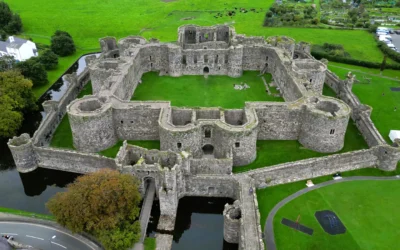
Beaumaris Castle
Beaumaris Castle: The Most Perfect Fortress Never Finished, on the Isle of Anglesey In 1295, Master James of St George began designing the most geometrically perfect concentric castle in the history of medieval military architecture. The inner ward was rectangular,...