
Aira Force
Aira Force: The Lake District's Best-Loved Waterfall
For three hundred years, people have walked into a wooded gorge above Ullswater to watch Aira Beck gather itself, slip beneath an old stone bridge, and hurl itself some twenty metres into the dark pool below. This is Aira Force — arguably the most famous waterfall in the Lake District, and certainly one of the most loved.
Its magic isn't really about height; there are far taller falls in Britain. It's the setting: a Victorian pleasure garden of towering firs and rare red squirrels, two handsome bridges framing the drop, the cool drift of spray on the lower viewing platform, and a tragic old legend hanging over the whole scene. Add an easy approach from Penrith — or, better still, a steamer across the lake — and you have a near-perfect Lakeland day out.
Here's everything you need to plan it.
About Aira Force
Aira Force drops around 20 metres (roughly 65 to 70 feet) through a steep, rocky ravine. You'll see the figure given variously as 20, 22 or 65 feet depending on where the measurement is taken, but the headline number most people settle on is about 20 metres — a compact fall with a powerful punch rather than a record-breaker.
The water comes from Aira Beck, which rises high on the slopes of Stybarrow Dodd at around 720 metres and travels some eight kilometres before reaching Ullswater. The falls happen about a kilometre short of the lake, where the beck squeezes through the gorge.
The site is owned and cared for by the National Trust, and it's as much a garden as a waterfall. The Howard family landscaped it as a pleasure ground in the 18th century, and in 1846 an arboretum was planted at the foot of the falls with more than 200 specimen conifers from around the world — including the towering Himalayan firs you'll walk beneath today. The woods are now one of the best places in the Lakes to spot a native red squirrel. Keep an eye out, too, for the "wish tree" — a trunk studded with coins pressed in for luck.
Getting there
By car, the falls sit just off the A592, the road that hugs the western shore of Ullswater; the postcode CA11 0JS will bring you to the main car park. From Penrith it's around ten miles, and from Keswick roughly thirteen. If you're coming up from the south, the A592 over the Kirkstone Pass is one of the most dramatic drives in the Lakes — steep, twisting and spectacular, so take it steadily.
The loveliest way to arrive, though, is by boat. Ullswater 'Steamers' run from Glenridding and Pooley Bridge to a pier at Aira Green, just across the A592 from the falls, so you can sail in across the lake and stroll back along the shore. If you're coming from further afield and would rather not drive the passes, a local driver can take the strain.
Compare Transfers & Local Transport in the Lake District →
By bus, the Stagecoach 508 runs between Penrith and Patterdale and stops right outside the Aira Force car park and tea-room — check the operator's current timetable before you set off.
On foot or by bike, you can follow the lakeshore path up from Glenridding, about three miles to the south, a walk of roughly an hour with Ullswater at your side the whole way.
Where does the name come from?
The name is Old Norse, like so many in the Lakes. Aira comes from eyrr, a gravel bank, and á, a river — together, "the river at the gravel bank," a nod to the gravelly spit where the beck spills into Ullswater. Force is from fors, simply meaning waterfall, a word borrowed into northern English dialects long ago.
The legend is darker and more romantic. Local tradition tells of Emma, a lady of nearby Lyulph's Tower, who fell in love with a knight named Sir Eglamore. While he was away, she pined for him and began to walk in her sleep, drifting night after night to the edge of the falls. When he finally returned and found her sleepwalking by the water, he reached out to her — she woke with a start, lost her footing, and fell into the torrent. Heartbroken, he is said to have lived out his days as a hermit beside the falls.
It's a tale William Wordsworth knew well; he retold it in his poem "The Somnambulist." The poet was a frequent visitor to this corner of Ullswater — it was on the shore nearby, at Glencoyne Bay, that he and his sister Dorothy saw the dancing daffodils that inspired his most famous lines.
The walk and the trails
For most people, the heart of the visit is the short circular Waterfall Trail — about a kilometre and a half, taking three-quarters of an hour to an hour at a gentle pace, with a climb of around seventy metres. The National Trust runs it as a one-way loop, so you follow the path up one side of the gorge and back down the other.
Make sure you see both bridges, because they offer completely different views. One arches right over the very lip of the falls, giving you a giddy look straight down the drop; the other sits at the foot, where a metal viewing platform beside it serves up the most dramatic angle of all — and, in the right light, a rainbow in the spray. The two bridges were built in memory of members of the Spring Rice family in the early 20th century.
If you want more, the path continues up the beck to a quieter upper fall, while the longer haul up Gowbarrow Fell — around seven kilometres and a few hundred metres of climbing — rewards you with sweeping panoramas over the length of Ullswater. At the gentler end, a level Arboretum Trail of about half a mile loops through the trees and the glade.
Parking
The National Trust runs four car parks here: the main Aira Force car park, which is closest to the falls, tea-room and toilets, plus Glencoyne Bay, High Cascades and Park Brow a little further along. All of them charge for parking, with free parking for National Trust members — just scan your membership card at the machine.
The main car park is popular and tends to fill by late morning in the school holidays and on fine weekends, with spaces freeing up again from mid-afternoon. Arriving early or later in the day is the surest way to get in. You can pay by cash or parking app; check the official website for current charges.
Facilities
Aira Force is well set up for a day out. At the main car park you'll find a tea-room serving hot and cold drinks, cakes, sandwiches and light bites, along with an information kiosk and shop stocking snacks and gifts.
There are toilets at the car park, including an accessible toilet, and a picnic area with benches for anyone bringing their own food. Dogs are well catered for too, with water bowls around the car park and tea-room. For a Lakeland waterfall, that's a generous spread of comforts.
Things to know before you go
Best time to visit. Aira Force is at its most powerful after heavy rain, when the gorge roars. Spring brings fresh greenery and the famous Ullswater daffodils; autumn turns the woods gold. Whatever the season, early morning or late afternoon means thinner crowds and a better chance of both a parking space and a red squirrel.
Dogs. Well-behaved dogs on leads are welcome throughout, with water bowls provided — keep them close on the steep, stepped paths and near the livestock on the open fells.
Accessibility. Be realistic about the falls themselves: the gorge paths are stepped and uneven and can't be managed with a wheelchair or pushchair. However, the level path through the glade and arboretum is suitable for pushchairs, as is the route across to Aira Green on the lakeshore, and there's an accessible toilet at the car park. The site also takes part in the Sunflower Lanyard scheme.
Families and safety. Children love it here — squirrels to spot, bridges to cross, rocks to scramble. But the paths are steep in places and the gorge has real drops, so keep little ones close, use the handrails, and remember the stone steps turn slippery after rain.
Swimming. This isn't a swimming spot — the falls drop into a rocky gorge pool that's no place to bathe. If you want the water, Ullswater itself offers paddling and paddle sports from Aira Green and Glencoyne Bay, but always check the forecast first; the lake is cold and Lakeland weather turns quickly.
Where to stay
Where you base yourself comes down to whether you want the lake on your doorstep or a wider choice of options.
For the most accommodation to choose from, Penrith is the nearest town, around ten miles away, with good road and rail links and an easy run out to the falls.
To wake up beside Ullswater, the villages of Glenridding and Pooley Bridge are hard to beat — both sit on the lake, both have steamer piers, and both put you within a short hop of Aira Force. Glenridding in particular makes a lovely base if you fancy arriving by boat.
Find Hotels & Stays in Penrith →
What to pack
The most important thing you can bring is footwear with grip — the stepped gorge paths are damp and uneven, and slick after rain.
- A pair of waterproof walking boots for the steps and the woodland trails.
- A waterproof jacket and warm layers — the spray and the Lakeland weather can chill you fast.
- A pair of binoculars to pick out the red squirrels high in the firs.
- A travel tripod for long-exposure shots of the falls from the lower platform.
Walking poles help on the steep sections, and a dry bag, a power bank and plenty of water and snacks are always worth tucking in.
Nearby attractions and making a day of it
You're spoilt here — Ullswater and its surrounding fells offer some of the finest scenery and walking in the whole Lake District.
| Attraction | Why Visit | Distance |
|---|---|---|
| Ullswater | The district's loveliest lake, ringed by the 20-mile Ullswater Way and crossed by the historic steamers — paddling and watersports at Aira Green | Adjacent |
| Gowbarrow Fell | A direct climb from the falls to one of the finest panoramas over the length of Ullswater | From the falls |
| Lyulph's Tower | The 18th-century Howard family folly tied to the tragic Emma legend, standing close to the falls (private, viewed from the path) | ~0.5 miles |
| Glencoyne Bay | The lakeshore where Wordsworth's daffodils still flower in spring — the inspiration for his most famous poem | ~1.5 miles |
| Castlerigg Stone Circle | One of Britain's most beautifully sited prehistoric stone circles, near Keswick, with a mountain backdrop | ~13 miles |
For a classic day, sail in on an Ullswater 'Steamer', walk the Waterfall Trail, then climb Gowbarrow Fell for the view. The villages of Glenridding and Pooley Bridge add cafés and shops, and Helvellyn's high ridges lie within reach for serious walkers.
Browse Lake District Tours & Cruises →
Photography tips
Aira Force is made for photographs. The metal viewing platform beside the lower bridge gives you the classic, dramatic head-on shot of the full drop; the upper bridge lets you look straight down the falls for something more vertiginous.
Visit after rain for maximum flow, and aim for soft early-morning light, when the mist sometimes throws a rainbow across the gorge and the crowds haven't yet arrived. Bring a tripod for a long exposure that turns the water to silk, and use the surrounding ferns, rocks and arched bridges to frame the scene.
Conclusion
Aira Force proves that a waterfall doesn't need to be the tallest to be the most magical. Sail in across Ullswater, climb through a Victorian arboretum loud with squirrels, stand on the lower bridge in the cool of the spray, and spare a thought for poor Emma at the top — and you'll see exactly why this small but mighty fall has been drawing visitors for three hundred years, and shows no sign of stopping.
FAQs
How tall is Aira Force?
Around 20 metres (roughly 65 to 70 feet). Some sources cite 22 metres or 72 feet depending on the measurement, but Aira Force is famous more for its setting than its height.
Is there a fee to visit Aira Force?
The waterfall itself is free to visit. The National Trust car parks charge for parking, with free parking for members — check the official website for current charges and times.
What is the best time to visit Aira Force?
After heavy rain for the fullest flow, in spring for the daffodils and greenery, or in autumn for colour. Arrive early or late in the day for quieter paths and easier parking.
Are dogs allowed at Aira Force?
Yes, well-behaved dogs on leads are welcome, and there are water bowls at the car park and tea-room. Keep them close on the steep paths and near livestock.
Is Aira Force wheelchair or pushchair accessible?
The falls themselves aren't, as the gorge paths are stepped and uneven. However, the glade and arboretum path and the route to Aira Green on the lakeshore are pushchair-friendly, and there's an accessible toilet at the car park.
What are the parking options at Aira Force?
The main Aira Force car park is closest to the falls and facilities, with Glencoyne Bay, High Cascades and Park Brow nearby. All charge for parking and are free for National Trust members, and the main car park usually fills by late morning.
Can I swim at Aira Force?
No — the falls drop into a rocky gorge pool that isn't suitable for swimming. For a paddle, Ullswater offers paddle sports from Aira Green and Glencoyne Bay, weather permitting.
What should I wear when visiting Aira Force?
Sturdy footwear with good grip, a waterproof jacket and warm layers. The stepped paths stay damp and slippery, and the weather can change quickly.
Are there guided tours of Aira Force?
There are no formal tours of the falls, and the paths are easy to follow on your own. Arriving by Ullswater 'Steamers' makes for a memorable guided-feel approach, and wider Lake District tours are widely available.
How do I get to Aira Force by boat?
Ullswater 'Steamers' run from Glenridding and Pooley Bridge to a pier at Aira Green, just across the road from the falls — one of the most scenic ways to arrive.
What's nearby?
Ullswater and the Ullswater Way, Gowbarrow Fell, Lyulph's Tower, the daffodil shore at Glencoyne Bay, Castlerigg Stone Circle and Helvellyn near Keswick, and the villages of Glenridding and Pooley Bridge.
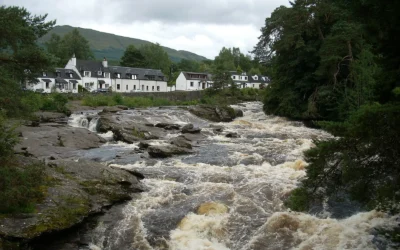
Falls of Dochart
Falls of Dochart: The Waterfall at the Heart of a Village Most waterfalls require a walk to find. The Falls of Dochart require no such effort at all — they run directly through the centre of Killin, beneath the old stone Bridge of Dochart, in full view of the...
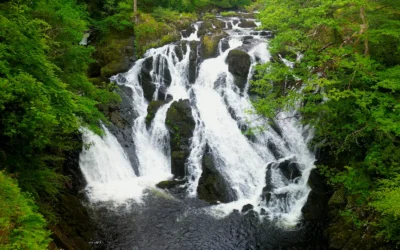
Swallow Falls
Swallow Falls: Wales' Highest Continuous Waterfall The River Llugwy has been performing for visitors at Swallow Falls for well over a century, and it still knows exactly what it is doing. The water tumbles 42 metres through a narrow, tree-lined gorge in a sequence of...
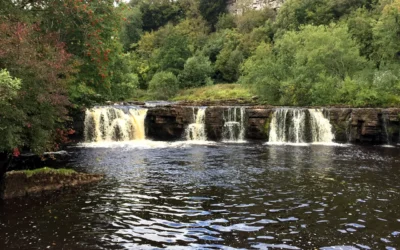
Wain Wath Force
Wain Wath Force: The Broadest Waterfall in Upper Swaledale Wain Wath Force will never win a prize for height. The River Swale drops only around a metre and a half here, sliding gently over a wide limestone ledge beneath the pale cliffs of Cotterby Scar. But what it...
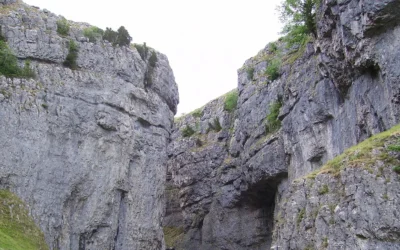
Gordale Scar
Gordale Scar: The Gorge That Stopped Wordsworth in His Tracks There is a moment as you walk the flat, pleasant path from Malham when the gorge closes around you without warning. The sky narrows to a strip above. The walls rear up on either side — overhanging...
Low Force
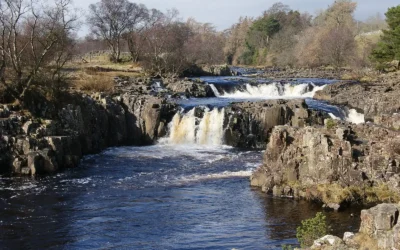
Low Force: Teesdale's Most Peaceful Waterfall High Force gets the crowds. Low Force gets the quiet. Just a mile and a half downstream from its more famous neighbour, where the River Tees spreads wide across a series of 18-foot cascades over the Whin Sill...