
Lizard Lighthouse
Lizard Lighthouse: Twin Towers Guarding Britain’s Southern Tip
At the very bottom of mainland Britain, where the Lizard Peninsula reaches its final point of granite and the English Channel opens out towards the Atlantic, a lighthouse has stood guard for nearly 270 years. Lizard Lighthouse is unlike almost any other in Britain: instead of a single tower, it has two, linked by a long, low keeper’s cottage — a distinctive twin-tower silhouette born of the dangerous waters it watches over. On a clear night its beam reaches up to a hundred miles out to sea, sweeping the approaches that have wrecked countless ships over the centuries.
This is the southernmost lighthouse on mainland Britain, set within the Cornwall Area of Outstanding Natural Beauty, with the South West Coast Path running along the cliffs and the famous Kynance Cove just along the shore. It remains a working light, automated since 1998, but visitors can explore its history at the Lizard Lighthouse Heritage Centre, climb one of its towers, and even stay the night in a former keeper’s cottage. This guide covers everything you need to know about visiting and staying at the Lizard.
Where Is Lizard Lighthouse?
Lizard Lighthouse stands at Lizard Point on the Lizard Peninsula in Cornwall, the southernmost point of mainland Britain. It is approximately 12 miles south of the nearest town, Helston, and is reached via the B3293 road, which leads directly down to Lizard Point.
The setting is pure Cornish drama: rugged serpentine cliffs, the vast sweep of the English Channel, and the unspoilt landscape of the Cornwall AONB. The South West Coast Path runs right along the clifftops here, and the celebrated Kynance Cove is a short distance up the coast. Public transport to this remote tip is limited, so do check local options or plan to drive.
A Brief History of Lizard Lighthouse
The first attempt to light the Lizard came in 1619, when Sir John Killigrew built a tower to warn ships off this notorious headland. It was a short-lived venture — by 1630 it had been demolished, undone by the financial difficulty of funding it through voluntary contributions from passing ships. For more than a century afterwards, the Lizard remained dark and deadly.
The lighthouse that survives today was built in 1751 by Thomas Fonnereau, and from the start it took its unusual twin-tower form. In its earliest years the two towers were topped with coal-fired braziers, with a keeper stationed between them to keep the coal fires blazing and signal if either light faltered. Trinity House, the charity responsible for England’s lighthouses, took over the Lizard in 1771 and began a long programme of improvement: oil lamps in 1811, additional keepers’ cottages in 1845, an engine room in 1874, a powerful rotating optic in 1903, and electrification in 1926.
The remarkable thing about the Lizard is how long it has kept watch — and how it changed shape to do so. It is the second oldest working lighthouse in the United Kingdom, and over its lifetime the design was refined: in 1903 the eastern tower received a four-panel rotating optic, while the western tower’s lantern was removed altogether, leaving the single powerful light that still guides ships across the Channel and out into the Atlantic today.
Architecture & The Light
The Lizard’s defining feature is its pair of stone towers, connected by the long, low keeper’s cottage built in 1751 — a layout that gives the lighthouse its unmistakable, almost symmetrical profile against the Cornish sky. Originally both towers carried coal-fired braziers; these gave way to oil lamps and reflectors in 1812, and in 1903 the eastern tower was fitted with a four-panel rotating optic while the western tower’s lantern was removed. The cottage between them once housed the keeper, whose job was to watch both lights through the night and raise the alarm if either needed attention.
The current light, powered by an electric filament lamp since 1926, has a range of around 26 nautical miles, and on clear nights its loom can be seen far out to sea. An automatic fog signal warns ships when the notorious Cornish mists roll in and visibility drops. The engine room, added in 1874 to power the fog signals and machinery, has since been beautifully restored and now houses the heritage centre — so the very building that once kept the light running now tells its story.
Visiting the Lighthouse
The heart of the visitor experience is the Lizard Lighthouse Heritage Centre, housed in the restored Victorian engine room and opened in 2009 by HRH The Princess Royal. It is an engaging, hands-on museum: interactive displays, audio-visual exhibits, preserved engines and the full story of the Lizard, Trinity House and the history of navigation. It suits families particularly well, with plenty to touch and try.
Seasonal guided tours allow visitors to climb the eastern tower to the lantern room, where the reward is a sweeping panorama of the cliffs, the Channel and the southernmost coast of Britain. The climb is about 100 steep, narrow steps and requires a reasonable level of fitness; it is not suitable for those with mobility difficulties or very young children.
The heritage centre is typically open from spring to autumn, and a small admission fee applies, with concessions for children and families. Tower-climb tours run seasonally and advance booking is recommended in peak periods. As opening times and prices change, check the official Trinity House website for current details before you travel.
Check Tickets & Tour Times for Lizard Lighthouse →
Staying at the Lighthouse
You can sleep at the very tip of Britain. The former lighthouse keepers’ cottages at the Lizard are now available as self-catering holiday accommodation, offering a genuinely special stay — historic buildings with stunning views of the towers and the sea, combining period character with modern comforts. To wake at the southernmost point of mainland Britain, with the Channel stretching to the horizon and the lighthouse beam having swept the dark all night, is an experience few accommodations can match.
The cottages suit a range of group sizes, from couples to families, and are managed by a Cornish holiday-cottage specialist:
|
Cottage |
Sleeps |
Features |
|
Keeper’s Cottages |
2–6 (varies) |
Sea and lighthouse views, period character, modern self-catering amenities |
Because these are unique cottages in an extraordinary location, availability varies by season and they book up well ahead — reserving early is strongly advised, particularly for the summer months and school holidays.
Find Lighthouse & Coastal Stays Near Lizard →
The Best Time to Visit
Spring (March to May) sees the heritage centre reopen for the season, the clifftop wildflowers of the Lizard — some of the rarest in Britain — coming into bloom, and the coast path at its freshest, all before the summer crowds arrive. Summer (June to August) offers the warmest weather, the longest days, full access to tours and the heritage centre, and the best chance of calm seas for spotting dolphins offshore; it is also the busiest and the time the cottages book up earliest.
Autumn (September to October) brings quieter days, dramatic Atlantic skies and a softer light much loved by photographers, with the heritage centre usually open into the autumn. Winter (November to February) is wild — the Lizard takes the full force of Atlantic storms — and while the heritage centre is generally closed, the coastline at this time of year is spectacular for those who come prepared.
For the calmest visit, weekday mornings in spring or autumn are ideal. This is an exposed Atlantic headland where the weather changes fast, so always check the forecast and dress for wind and sudden rain.
How to Get There
By car. The most practical option by far. Follow the B3293 from Helston south to Lizard village, then continue to Lizard Point, where there is parking near the lighthouse. Enter Lizard Point into your sat-nav.
By public transport. Public transport to this remote southern tip is limited. Buses run from Helston towards Lizard village, but services are infrequent — check local timetables carefully and allow plenty of time. From Lizard village it is around a quarter-mile to the lighthouse.
On foot. The South West Coast Path runs directly past the lighthouse along the clifftops, making the Lizard a rewarding goal for walkers. The coastal walking here is some of the finest in Cornwall, but the cliffs are steep and the terrain exposed, so wear proper footwear and keep well back from the edges.
Compare Transfers & Local Transport in Cornwall →
Wildlife & The Coast
The seas and cliffs around Lizard Point teem with wildlife. The waters of the Channel below are frequented by seals, dolphins and porpoises, most often seen on calm days from the clifftops, while the rugged coastline supports nesting seabirds through spring and summer. The Lizard’s rare serpentine geology gives rise to wildflowers found almost nowhere else in Britain, and the heathland behind the cliffs is rich with butterflies and choughs — the red-billed crows that are the emblem of Cornwall.
A pair of binoculars for wildlife watching makes all the difference here — the elevated clifftop position is superb for scanning the sea for marine life and the cliffs for nesting birds. The South West Coast Path stretches away in both directions, with Kynance Cove and its famous serpentine rock stacks just along the coast, inviting walkers to make a full day of the dramatic Lizard shoreline.
Nearby Attractions
The Lizard Peninsula is one of the most beautiful and distinctive corners of Cornwall, with much to explore close to the lighthouse.
|
Attraction |
Why Visit |
Distance |
|
Kynance Cove |
One of Cornwall’s most beautiful beaches — serpentine rock stacks and turquoise water |
~2 miles |
|
Lizard Point (NT) |
The official southernmost point of mainland Britain, with clifftop walks |
Adjacent |
|
Lizard village |
Cornish village with shops, cafés and traditional pasties and seafood |
~0.25 miles |
|
South West Coast Path |
World-class clifftop walking in both directions from the lighthouse |
On-site |
|
Helston |
The nearest market town, gateway to the peninsula |
~12 miles |
A natural day out: explore the heritage centre and climb the tower in the morning, walk a stretch of the coast path, then head along to Kynance Cove in the afternoon.
Browse Lizard & Cornwall Coast Tours →
Safety & Accessibility
Safety. The cliffs at Lizard Point are dramatic and dangerous — stay well back from the edges, keep to the marked paths, and supervise children closely at all times. This is an exposed Atlantic headland where the weather, and the sea, can change quickly; check the forecast and dress for wind and rain. The coastline is rugged, so wear suitable footwear for any clifftop walking.
Accessibility. Access to the site is affected by the rugged terrain, and climbing the eastern tower involves around 100 steep, narrow steps, requiring a good level of fitness — it is not suitable for those with mobility difficulties or very young children. The heritage centre is more accessible than the tower. Visitors with specific access needs should contact Trinity House before visiting.
Families. The hands-on heritage centre is excellent for families and children, but the tower climb is demanding and the clifftops require constant supervision of younger children.
Practical Tips
- Book your cottage stay well in advance — these are unique, much-sought-after holiday lets in a remarkable location, especially in summer.
- Check the heritage centre’s opening season and tower-tour times on the official Trinity House website before travelling, as both are seasonal.
- Wear waterproof walking boots — the coast path and clifftops are uneven and often wet or slippery.
- Pack a waterproof walking jacket; this Atlantic headland is fully exposed and the weather turns quickly.
- Bring binoculars for the seals, dolphins and seabirds — the clifftops are an outstanding spot for wildlife-watching.
- Overseas visitor? The UK uses Type G plugs, so a UK travel adapter is essential for charging your devices.
- Keep well back from the cliff edges and stay on the paths — the Lizard’s cliffs are steep and unstable in places.
- Allow time for the coast path and Kynance Cove; the Lizard rewards a full day rather than a quick visit.
Conclusion
Lizard Lighthouse is a place of firsts and lasts: the second oldest working light in Britain, standing at the country’s southernmost point, with its rare twin towers watching the meeting of Channel and Atlantic. Whether you come to explore the heritage centre, climb the tower for that sweeping southern view, or stay the night in a keeper’s cottage with the sea on every side, the Lizard offers a deep sense of Cornwall’s wild, maritime soul. It is a fitting beacon for the very end of the land.
Frequently Asked Questions
What is the history of Lizard Lighthouse?
A light was first established here in 1619 by Sir John Killigrew but demolished by 1630. The current twin-tower lighthouse was built in 1751 by Thomas Fonnereau and has been managed by Trinity House since 1771 — making it the second oldest working lighthouse in the UK.
Where is Lizard Lighthouse located?
At Lizard Point on the Lizard Peninsula in Cornwall, the southernmost point of mainland Britain, about 12 miles south of Helston.
Can I visit Lizard Lighthouse?
Yes. The Lizard Lighthouse Heritage Centre offers interactive exhibits, and seasonal guided tours allow visitors to climb the eastern tower.
What are the opening hours of Lizard Lighthouse?
The heritage centre is typically open from spring to autumn (roughly March to October). Check the official Trinity House website for current opening hours.
How much does it cost to visit Lizard Lighthouse?
A small admission fee applies for the heritage centre and tower climbs, with concessions for children and families. Check the official website for current prices.
Can I climb to the top of Lizard Lighthouse?
Yes, seasonal guided tours allow climbing the eastern tower via around 100 steep, narrow steps. A reasonable level of fitness is required, and it is not suitable for very young children.
Can I stay overnight at Lizard Lighthouse?
Yes. The former keepers’ cottages are available as self-catering holiday accommodation with sea and lighthouse views. Booking well ahead is strongly recommended.
Is Lizard Lighthouse suitable for families?
Yes — the hands-on heritage centre is excellent for children. Supervise children closely near the cliffs, and note that the tower climb is demanding.
What wildlife can I see near Lizard Lighthouse?
Seals, dolphins and porpoises are seen offshore on calm days, with nesting seabirds on the cliffs and rare wildflowers and choughs on the heathland. Bring binoculars.
What makes Lizard Lighthouse unique?
Its rare twin-tower design, its status as the second oldest working lighthouse in the UK, and its position at the southernmost point of mainland Britain all set it apart.
St John’s Point Lighthouse
St John's Point Lighthouse: The Yellow-Banded Giant of County Down In Van Morrison's song "Coney Island," the lighthouse at St John's Point is mentioned in a list of the things that make the Irish coast of County Down feel like home — somewhere between the Mourne...
Blackhead Lighthouse
Blackhead Lighthouse: The Titanic Passed Here, and You Can Stay the Night In April 1912, RMS Titanic — built at Harland and Wolff's yards on Queen's Island in Belfast, launched in 1911 and fitted out over the following months — left Belfast Lough for the last time on...
St Ann’s Head Lighthouse
St Ann's Head Lighthouse: The Last Shore-Based Light in Pembrokeshire, on the Tudor Coast In August 1485, a small fleet carrying Henry Tudor — exiled pretender to the English throne — rounded this headland and landed at Mill Bay, a sheltered cove just to the north of...
Point Lynas Lighthouse
Point Lynas Lighthouse: A Castle on the Cliffs of North Wales, Guiding Liverpool's Ships Since 1766 Most lighthouses are towers. Point Lynas is not. The lighthouse that stands on the rocky headland at the north-east corner of Anglesey is a low, castellated structure...
North Ronaldsay Lighthouse
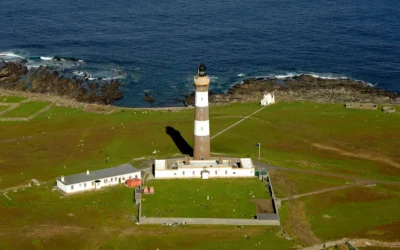
North Ronaldsay Lighthouse: The UK's Tallest, Above the Island of the Seaweed Sheep Around the shoreline of North Ronaldsay — the northernmost and most isolated of the Orkney Islands — runs a drystone wall several miles long called the Sheep Dyke. Its purpose is...